In Indian culture, the curiosity to calculate Time (Kaal) and understand the mysteries of the universe has always been profound. When other civilizations of the world were still in the early stages of development, the sages of India were conducting subtle studies of the galaxy, constellations, and planetary movements. This study gave birth to 'Jyotish Shastra' (Astrology).
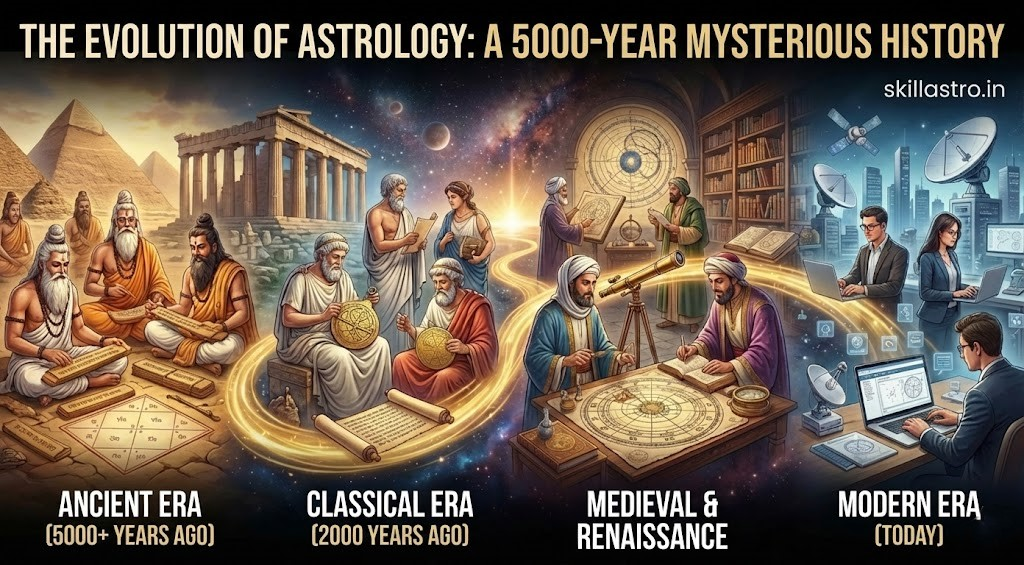
Astrology is not merely the art of knowing the future; it is humanity's dialogue with the universe. Based on the principle of "Yatha Pinde Tatha Brahmande" (As is the body, so is the universe), the journey of astrology has been incredibly fascinating and mysterious. In today's detailed article, we will unfold the layers of the evolution of astrology and its 5000-year history.
Part 1: Vedic Era – The Origin of Astrology (5000 BC - 1500 BC)
The first ray of astrology's development is seen in the Vedas. It is considered 'Apaurusheya' (not created by humans, but divinely revealed).
1. The Eye of the Vedas
To understand the Vedas, six limbs (Vedangas) were created, in which Astrology was called "Vedasya Chakshuh," meaning 'The Eye of the Vedas'. Just as a path cannot be seen without eyes, knowledge of the correct time (Kaal) was impossible without astrology.
2. Yagya and Time Calculation
In the early Vedic period, the main purpose of astrology was not to predict individual futures. Its purpose was to determine the auspicious time for Yagyas (sacrificial rituals) and ceremonies.
Mentions of Nakshatras are found in the Rigveda and Yajurveda. Instead of dividing the sky into 360 degrees, the sages divided it into 27 Nakshatras based on the movement of the Moon. This was the most fundamental and ancient discovery of Indian astrology.
Nakshatra Vidya: At that time, the concept of 'Rashi' (Zodiac signs like Aries, Taurus) did not exist. Everything was based on Nakshatras (Ashwini, Bharani, etc.).
Meteorology: The arrival of seasons and rainfall was predicted based on the Sun's position, which was essential for an agrarian society.
Skill Astro - Fixed Centering Banner Talk to India's Best Astrologer at ₹1/min Only
Expert guidance for Career, Love & Marriage. Get accurate predictions instantly from verified Vedic Astrologers.
Chat Now »
Skill Astro - Fixed Centering Banner Talk to India's Best Astrologer at ₹1/min Only
Expert guidance for Career, Love & Marriage. Get accurate predictions instantly from verified Vedic Astrologers.
Chat Now »
Part 2: Vedanga Jyotish Era – The First Systematic Form (1400 BC)
As civilization developed, the need to document calculations was felt. During this era, astrology took the form of a formal scripture.
Contribution of Lagadha Muni
'Vedanga Jyotish', composed by Lagadha Muni, is the oldest available text on this subject. This text focused primarily on Astronomy (Mathematics). It explained:
The laws of the movement of the Sun and Moon.
How to calculate Solstices (Uttarayana and Dakshinayana).
Why changes occur in the duration of day and night.
Until this period, astrology was entirely limited to 'Mathematics' and the creation of the 'Panchang' (Calendar). The element of prediction (Falita) was minimal.
Part 3: Epics and Puranic Era – Omens and Future (1000 BC - 600 BC)
By the time of the Ramayana and Mahabharata, the form of astrology began to change. It was no longer limited to the time of Yagyas but became a tool for determining the fate of kings and kingdoms.
1. Influence of Planets on Human Life
There are descriptions of planetary positions in many places in the Mahabharata. Bhishma Pitamah waited for the Sun to move into Uttarayana for his death, proving how significant Time was in that era.
2. Rise of Omenology (Shagun Shastra)
In this era, planetary conjunctions, eclipses, and comets began to be considered inauspicious for kings. There is a description of a 'thirteen-day fortnight' (two eclipses in one fortnight) during the Mahabharata war, which was considered catastrophic. This laid the foundation for 'Mundane Astrology' (Medini Jyotish)—predicting the future of nations and society.
Part 4: Siddhanta Era – The Golden Age of Astrology (5th - 12th Century AD)
This was the most critical phase in the history of Indian astrology. It is called the 'Golden Age' because a magnificent fusion of mathematics, astronomy, and predictive astrology occurred during this time. There were 18 great propounders in this era, including Surya, Pitamaha, Vyasa, Vashistha, Atri, Parashara, Kashyapa, Narada, Garga, Marichi, Manu, Angira, Lomasa, Paulisa, Chyavana, Yavana, Bhrigu, and Shaunaka.
1. Aryabhata and Spherical Astronomy
The great mathematician Aryabhata (476 AD) composed the text 'Aryabhatiya'. He proved that the Earth rotates on its axis and that eclipses are caused by the shadows of the Earth and Moon, not by demons named Rahu and Ketu. His calculations made chart construction precise.
2. Classification by Varahamihira
The scholar of Ujjain, Varahamihira, perfected astrology by dividing it into three Skandhas (Pillars):
Tantra (Mathematics): Planetary movements and astronomical calculations.
Hora (Predictive): Individual birth charts and future.
Samhita: Omens, Vastu, Rainfall, and Physiognomy. His work 'Brihat Samhita' is still considered the encyclopedia of astrology.
3. Arrival of the Zodiac
In this era, the 12 Zodiac signs (Aries to Pisces) were clearly incorporated into Indian astrology. Although some influence is attributed to Greek (Yavana) astrology, Indian sages fully Indianized it by linking it with the 'Karma Theory' and 'Reincarnation'.
4. Maharishi Parashara and Hora Shastra
'Brihat Parashara Hora Shastra', composed by Maharishi Parashara, is considered the foundation of astrology in the Kali Yuga. He introduced the system of 'Vimshottari Dasha' (planetary periods), which is not found in any other astrological system in the world. This system indicates which planet will yield its results during which year of life.
Part 5: Medieval Era – Tajik and Transitional Period (12th - 17th Century AD)
During the medieval period, India faced external invasions, leading to a cultural exchange. Astrology remained untouched by this.
Tajik Shastra: Through contact with Arab and Persian astrologers, 'Tajik Shastra' developed. The method of creating an 'Annual Horoscope' (Varshphal) was prominent in this, which is still prevalent today.
Prashna Marga: A new branch of astrology called 'Prashna Marga' developed in South India, especially Kerala. In this, answers were given based solely on the time a question was asked, without a birth chart. Astrologers were also respected in Mughal courts, and they translated many Sanskrit texts into Persian.
Part 6: Modern Era – Fusion of Science and Technology
The arrival of the British and the spread of modern education gave a new challenge and direction to astrology.
1. Impact of Printing
Previously, knowledge was limited to palm leaves and the Guru-Shishya tradition. With the advent of the printing press, Panchangs and astrological texts reached the common public. Panchangs published from Varanasi and Ujjain became part of every household.
2. Krishnamurti Paddhati (K.P. Astrology)
In the 20th century, South Indian scholar K.S. Krishnamurti observed that traditional methods sometimes lacked precision. He divided Nakshatras into even subtler parts (Sub-lords). This is called 'K.P. System', which is famous for its accurate predictions.
3. Computer Revolution
The arrival of computers after the 1980s transformed astrology.
Calculations that took hours and were prone to error became available in moments.
This spread astrology globally. Today, people from the USA to Japan accept the accuracy of Vedic astrology.
Simplified Chart of Evolutionary Order
| Era | Key Feature | Major Text/Sage |
| Vedic Era | Nakshatra based, Determining Yagya time | Rigveda, Yajurveda |
| Vedanga Era | Beginning of astronomical calculations | Lagadha Muni (Vedanga Jyotish) |
| Siddhanta Era | Zodiac signs, Hora Shastra, Mathematical precision | Aryabhata, Varahamihira, Parashara |
| Medieval Era | Annual Horoscope (Varshphal), Tajik System | Tajik Nilakanthi |
| Modern Era | K.P. System, Computer Astrology | K.S. Krishnamurti, B.V. Raman |
Frequently Asked Questions (FAQs)
Q1: What is the difference between Indian Astrology and Western Astrology?
Answer: Indian (Vedic) astrology is based on the position of Nakshatras and the Moon, known as the 'Sidereal System'. It is astronomically more accurate. Western astrology is based on the Sun and Seasons (Tropical System).
Q2: Who are considered the propounders of Astrology?
Answer: There are 18 propounders of astrology, prominent among them being Surya, Pitamaha, Narada, and Parashara. In the Kali Yuga, Maharishi Parashara is considered the father of predictive astrology.
Q3: Is Astrology a science?
Answer: Astrology has three parts. Its 'Ganita Skandha' (Astronomy) is entirely a science that tells the precise position of planets. Its 'Falita' (Predictive) part is a discipline based on probabilities and statistics.
Q4: Who composed Vedanga Jyotish?
Answer: Vedanga Jyotish was composed by 'Lagadha Muni' around 1400 BC. It is the first available text on astrology.
Q5: Has modern technology influenced astrology?
Answer: Yes, the arrival of Computers has eliminated human errors in chart construction and calculations have become extremely precise, leading to improvements in predictions.
Conclusion
This 5000-year evolutionary order of astrology is a testament to humanity's intellectual journey. It stems not from the darkness of superstition, but from the light of Discovery. The knowledge that Vedic sages saw with their divine vision was tested by later scholars on the anvil of mathematics, and today technology has made it accessible.
The core purpose of astrology has not changed yesterday, nor today. This purpose is—to harmonize humans with the flow of Time (Kaal) and to show the path amidst life's uncertainties. It is a heritage that every Indian should be proud of.