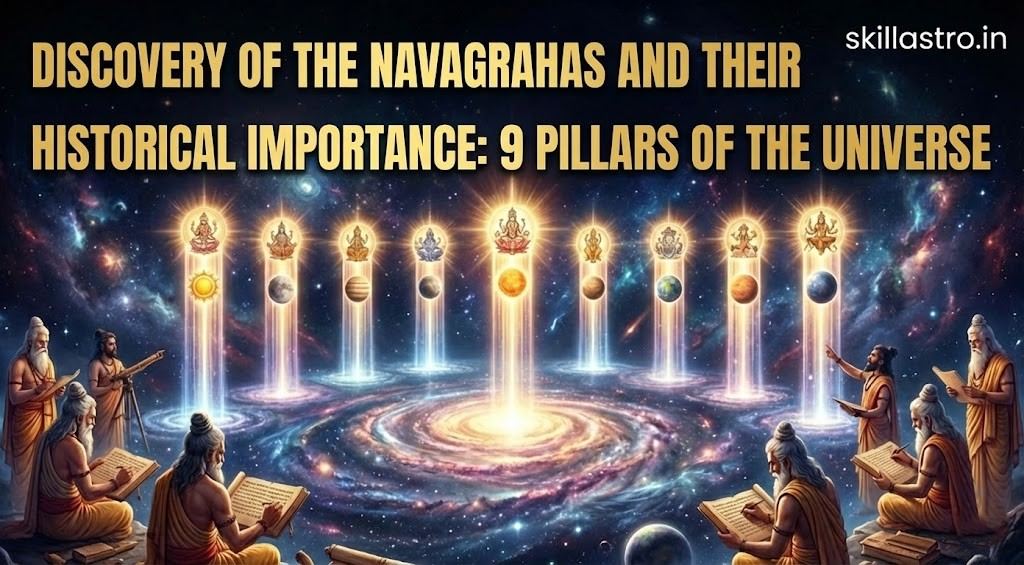
Since time immemorial, when humans first looked up at the night sky, they noticed certain special bodies moving among the twinkling stars. These were not stationary; they were traveling on a fixed path. Indian sages, with their divine vision and mathematical calculations, identified them and named them 'Graha' (Planets).
The 'Navagrahas' (Nine Planets) are the cornerstone of Indian astrology and astronomy. But have you ever wondered how our ancestors discovered them thousands of years ago without any modern telescopes? How did they detect the slow motion of Saturn and invisible shadow planets like Rahu and Ketu?
In today's detailed article, we will embark on the exciting journey of the discovery of the Navagrahas and understand their historical, religious, and scientific significance.
Part 1: Meaning and Definition of the Word 'Graha'
First, it is essential to understand that the meaning of 'Graha' in Indian astrology differs from the modern scientific definition of a 'Planet'.
Etymology: Derived from the Sanskrit root 'Grah', which means 'To Seize' or 'To Grasp'.
Definition: Celestial bodies or points that influence (or seize) the consciousness and karma of beings living on Earth are called Grahas.
This is why the Sun (which is a star) and the Moon (which is a satellite) are also categorized as 'Grahas' in Indian astrology, as they have the most significant impact on Earth.
Part 2: History of the Discovery of Navagrahas – From Vedic to Siddhanta Era
The discovery of the Navagrahas did not happen in a day. It is the result of centuries of observation and mathematical austerity.
1. Vedic Era: Direct Observation
The Rigveda and Atharvaveda contain clear references to the Sun, Moon, and Nakshatras (constellations). At that time, sages lived under the open sky, and nature itself was their laboratory.
Sun and Moon: Being the brightest, they were identified first. The Sun was considered the significator of the 'Soul' (Atma) and the Moon of the 'Mind' (Mana).
Jupiter (Brihaspati): The Rigveda mentions Brihaspati as the priest of the gods. It was identified as an extremely bright star in the sky.
2. Epic Era: Personification of Planets
By the time of the Ramayana and Mahabharata, planets were seen not just as celestial bodies but as deities.
During the Mahabharata war, there is a description of the Conjunction of Saturn and Mars, proving that by then, precise knowledge of planetary movements existed.
3. Siddhanta Era: Mathematical Proof (Golden Era of Astronomy)
Around the 5th century AD, when great astronomers like Aryabhata and Varahamihira emerged, precise calculations of the positions of the Navagrahas were established.
Aryabhata's Contribution: In his book 'Aryabhatiya', he clarified that planets shine by reflecting the light of the Sun; they do not have their own light (except the Sun).
Varahamihira's Vision: In 'Panchasiddhantika', he calculated planetary orbits and diameters. He gave a scientific form to the eclipse theory involving Rahu and Ketu.
Part 3: Detailed Introduction to Navagrahas and the Story of Their Discovery
Let us now deeply understand the discovery and significance of the nine planets one by one.
1. The Sun (Surya) – King of Planets
Discovery: The Sun is obvious, so the question of its discovery doesn't arise. However, whether it is stationary or the Earth revolves around it was a subject of varying Indian opinions over time. Ultimately, astrology adopted the 'Geocentric' system because we view the sky from Earth.
Significance: It is called the 'Soul of the Kalapurusha' (Time Personified). The Sun signifies health, father, kingdom, and power.
2. The Moon (Chandra) – Queen of Planets
Discovery: The Lord of the Night. The Indian calendar (Panchang) and months were created based on its phases (Tithis).
Significance: The Moon signifies the mind. Tides in the ocean are caused by the Moon's gravity, and since the human body is also roughly 70% water, it controls our emotions.
3. Mars (Mangal) – The Commander
Discovery: Ancient astronomers noticed a red star moving strangely in the sky (Vakra Gati or Retrograde Motion). Due to its blood-red color, it was named the god of war or 'Mangal'.
Significance: It signifies energy, courage, blood, and land.
4. Mercury (Budha) – The Prince
Discovery: Mercury is closest to the Sun, making it very difficult to see. It is visible only just before sunrise or just after sunset. Discovering it required extremely keen observation.
Significance: It signifies intellect, speech, business, and mathematics.
5. Jupiter (Brihaspati/Guru) – The Mentor
Discovery: It appears very stable and grand in the sky. Its yellowness and vastness distinguish it from other stars. Indian sages named it 'Guru' (Heavy), as it is the heaviest planet in the solar system.
Significance: Signifies wisdom, progeny, wealth, and righteousness (Dharma).
6. Venus (Shukra) – The Minister
Discovery: It is the brightest planet in the sky. It is also called the 'Morning Star'. Being a descendant of Sage Bhrigu, it is also called Bhargava.
Significance: Signifies beauty, art, marriage, and material comforts.
7. Saturn (Shani) – The Servant/Judge
Discovery: Saturn is the last planet visible to the naked eye. Its discovery was the most interesting because it moves very slowly. It takes two and a half years to cross one zodiac sign. In Sanskrit, 'Shanaih' means 'slowly'. Hence, it was named 'Shanaishchar' (Slow Mover).
Significance: Signifies karma, justice, sorrow, longevity, and service.
8. Rahu and Ketu (The Shadow Planets) – The Greatest Discovery
This was the greatest achievement of Indian astronomy. While the world was looking only at physical bodies, Indian sages had discovered 'Mathematical Points'.
Secret of Discovery: Sages observed that eclipses do not occur on every Full Moon and New Moon. Eclipses happen only when the paths of the Sun and Moon intersect at specific points. These intersection points (Nodes) were named the North Node (Rahu) and South Node (Ketu).
Mythology: The story of the churning of the ocean (Samudra Manthan), where the demon Swarbhanu was beheaded (becoming Rahu) and the torso (becoming Ketu), is a symbolic description of this astronomical event.
Significance: They signify sudden events, illusion, research, and liberation (Moksha).
Part 4: Days of the Week and Their Connection to Navagrahas
Have you ever wondered why there are only 7 days in a week and why their order (Monday, Tuesday, Wednesday...) is the way it is? This is entirely based on the discovery of the Navagrahas and their 'Hora' (Hour).
In Indian astrology, the order of planets was arranged based on their speed and distance from Earth, giving birth to 'Hora Shastra'.
Sunday (Sun)
Monday (Moon)
Tuesday (Mars) ...and so on. This system later spread to the whole world through the Arabs and Greeks. The calendar the entire world uses today has its roots in Indian astrology.
Part 5: Navagrahas and Indian Culture
The significance of Navagrahas is not limited to astrology; it is woven into our architecture and daily life.
Temple Architecture: Almost every major temple in India (especially in South India) has a 'Navagraha Mandala' established outside the sanctum sanctorum. The Sun Temple of Konark and the Navagraha Temple in Kumbakonam are direct proofs of this.
Gemology: A specific gemstone is prescribed for each planet (e.g., Ruby for Sun, Blue Sapphire for Saturn), based on Color Therapy.
Part 6: Is Navagraha Science or Superstition?
This question is often asked in the modern era.
Gravity and Tides: Science accepts that the Moon pulls the ocean. Astrology argues that since the human brain is also made of fluid and electrical impulses (neurons), planets influence it too.
Statistics: Astrology is a collection of thousands of years of data. When sages observed that a person born under a specific position of Mars tends to be angry, and this happened thousands of times, they made it a rule.
Therefore, the influence of Navagrahas is not 'superstition', but a science that modern instruments have not yet fully measured.
Frequently Asked Questions (FAQs)
Q1: Why is Earth not included in the Navagrahas?
Answer: Astrology is 'Geocentric', meaning we are observing the universe standing on Earth. Since we are on Earth itself, the position of Earth is not studied in our horoscope, but the positions of other planets relative to Earth are.
Q2: Why are Rahu and Ketu considered planets when they are not visible?
Answer: In Indian astrology, 'Graha' does not mean a 'physical body', but a 'force that influences'. Rahu and Ketu are the points where the paths of the Sun and Moon intersect, causing eclipses. Their effect is to block (eclipse) the light of the Sun and Moon, hence they are considered 'Shadow Planets'.
Q3: Why are Navagrahas worshipped?
Answer: This is symbolic. Worshipping planets means harmonizing with those cosmic energies. For example, worshipping Saturn means adopting discipline and justice in life.
Q4: Who discovered the planet Saturn?
Answer: It is difficult to name a single person, but Vedic sages identified it thousands of years ago. They named it 'Shanaishchar' solely because of its slow motion.
Q5: Are Pluto, Neptune, and Uranus included in the Navagrahas?
Answer: No. Traditional Vedic astrology only includes planets visible to the naked eye (up to Saturn). Pluto, Neptune, and Uranus were discovered by modern telescopes and their effects are considered very subtle and generational, so they are not counted in the traditional Navagrahas, although modern astrologers now study them as well.
Conclusion
The discovery of the Navagrahas was the intellectual pinnacle of human history. The picture of the universe drawn by our ancestors without satellites and supercomputers remains accurate today. The discovery of Rahu and Ketu is nothing short of a miracle even for modern astronomy.
This history teaches us that we are not separate from the universe. We are made of the same 'Stardust' and driven by the energy of these planets. The Navagrahas were discovered not to scare us, but to give direction to our lives and improve our karma.