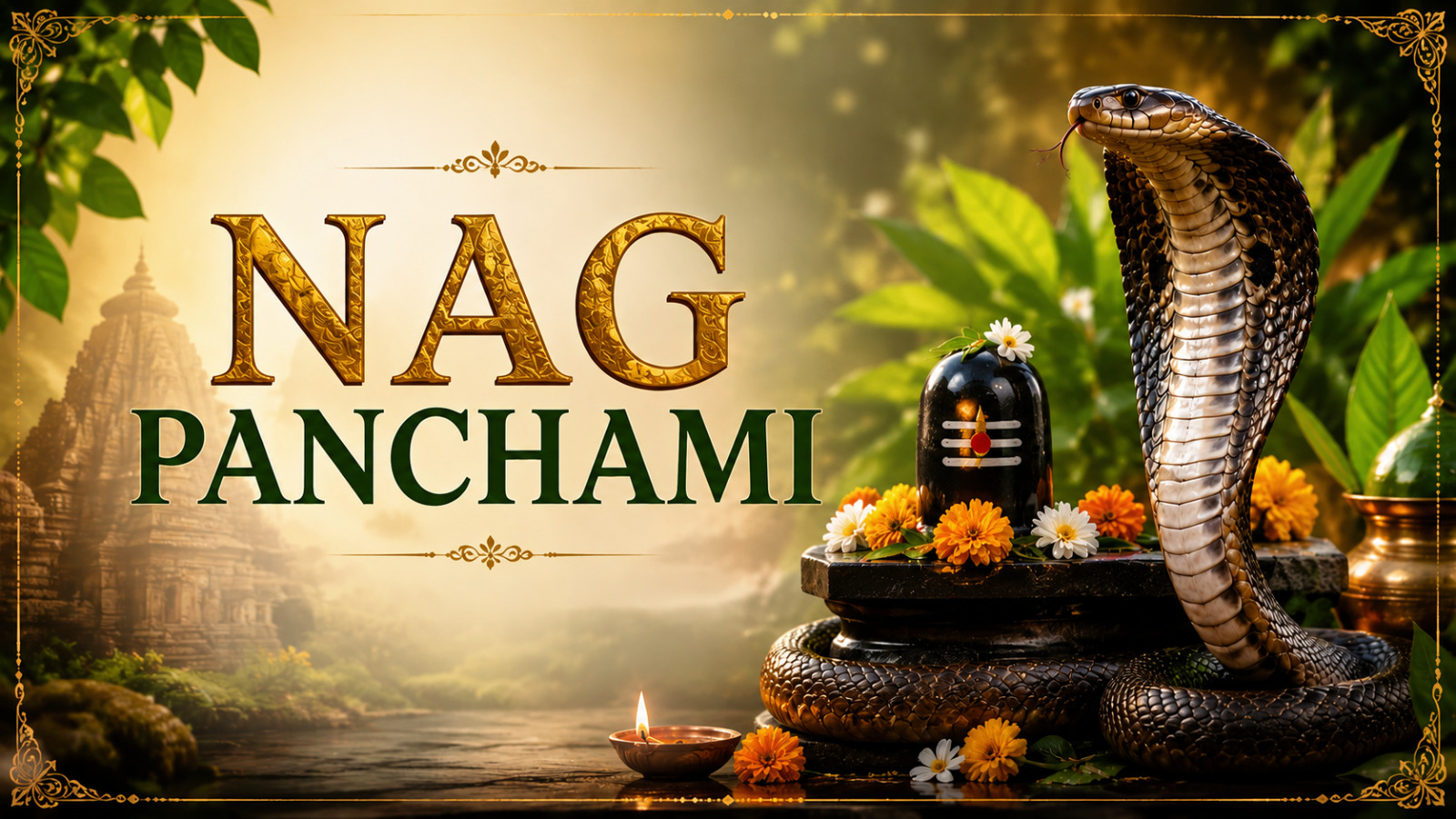
 Significance and Mythological Story of Nag Panchami: Why is Nag Devta Worshipped?
Have you ever wondered why human beings bow down and pray to the very creature they fear the most? This is the greatest beauty of Sanatan Dharma. We do not only see the Divine in those who grant us happiness, but we also revere the aspects of nature and creatures that possess destructive powers.
As an astrologer, when I analyze birth charts, I find that human life is deeply influenced by 'Rahu' and 'Ketu' (which are considered the head and tail of the serpent in astrology). Nag Panchami is not merely a day to feed milk to snakes; it is a highly powerful cosmic opportunity to transform our fear into devotion, harmonize with nature, and pacify the karmas of our past lives (Kaal Sarp Dosh).
Let us dive deep into the significance of this mysterious and sacred festival, its wonderful mythological stories, and the infallible remedies to overcome life's obstacles.
Panchang and Auspicious Timing (Panchang Chart)
The holy festival of Nag Panchami is celebrated every year on the Panchami Tithi (fifth day) of the Shukla Paksha (bright half) of the Shravan (Sawan) month. The month of Sawan is extremely dear to Lord Shiva, and since the serpent is the ornament adorning his neck, the rewards of worshipping Nag Devta multiply manifold during this time.
| Panchang Details | Information |
| Month | Shravan (Sawan) |
| Paksha | Shukla Paksha (Bright Fortnight) |
| Tithi | Panchami Tithi (Fifth Day) |
| Main Deity | Ashtanag (Ananta, Vasuki, Padma, Mahapadma, Takshak, Kulir, Karkat, Shankh) and Lord Shiva |
| Planetary Pacification | Rahu and Ketu |
| Dosh Nivaran (Remedies for) | Kaal Sarp Dosh, Pitra Dosh, Vish Yoga |
(Note: The starting and ending times of the Panchami Tithi vary every year, therefore, the puja should always be performed in the morning according to the auspicious muhurat of your local Panchang.)
Astrological and Spiritual Significance of Nag Panchami
In astrology, snakes are considered directly related to Rahu and Ketu. Rahu represents the mouth of the serpent, and Ketu is its tail. When all the main planets in a person's birth chart are trapped between Rahu and Ketu, it forms the Kaal Sarp Dosh. This dosh causes struggles, mental stress, delays in marriage, and financial hardships in life.
Worshipping Nag Devta and Lord Shiva on the day of Nag Panchami pacifies this dreadful affliction. Spiritually, the serpent is also a symbol of the Kundalini energy, which lies dormant, coiled three and a half times at the base of our spine (Muladhara Chakra). Snake worship signifies the awakening of this dormant spiritual energy within us.
Mythological Story: Why is Nag Devta Worshipped After All?
Our Puranas describe several thrilling stories related to Nag Panchami. Two of the most prominent ones are as follows:
1. Astika Muni and Janamejaya's Nagdaha Yajna (Snake Sacrifice)
This dates back to the Mahabharata era. King Parikshit of the Kuru dynasty died from a bite by the Takshak snake. Angered by this, his son King Janamejaya organized a 'Sarp Satra' (Nagdaha Yajna) to completely wipe out all snakes from the earth. All the snakes in the universe were being drawn into the fire of this massive yajna and reduced to ashes.
To protect the serpents, Astika Muni, the son of Maharishi Jaratkaru and Nagmata Mansa Devi, arrived there. Through the power of his penance and mantras, he halted the yajna on the day of Sawan Shukla Panchami. He saved the burning snakes by pouring raw milk over their bodies, which soothed their burns. The tradition of celebrating Nag Panchami and offering milk to snakes began on that very day.
2. Lord Krishna and Kaliya Nag
According to another famous legend, during the Dwapar Yuga, a fearsome snake named Kaliya made his home in the Yamuna River in Vrindavan. His venom poisoned the river's water, causing distress among the people of Gokul. Child Krishna jumped into the river, fought a fierce battle with Kaliya Nag, and finally shattered his ego by dancing on his hoods. Kaliya Nag begged the Lord for forgiveness and promised to leave Vrindavan. That day was also Shravan Shukla Panchami.
From the Astrologer's Diary: Infallible Remedies for Nag Panchami
If you are continuously facing obstacles in life, as an astrologer, I highly recommend performing these special remedies on the day of Nag Panchami:
For Pacifying Kaal Sarp Dosh: Have a pair of silver snakes (male and female) made on the day of Nag Panchami. Bathe them in Panchamrit, and after chanting 'Om Namah Shivaya' 108 times, immerse them in flowing water (like a river). This is the most accurate remedy to negate the ill effects of Rahu and Ketu.
For Financial Growth: In the scriptures, snakes are regarded as the guardians of Patala Lok (the underworld) and hidden wealth. On this day, draw the figure of Nag Devta using cow dung or vermilion (sindoor) on both sides of the main entrance of your home. This blocks negative energy from entering and increases wealth and prosperity.
Rudrabhishek: Nag Devta is not easily pleased alone; they are the devoted servants of Lord Shiva. Therefore, on Nag Panchami, you must perform Rudrabhishek by offering milk, belpatra, datura, and bhang on the Shivling.
Rahu-Ketu Mantra Chanting: After sunset, sit on a Kusha grass mat and chant one rosary (mala) each of the Rahu mantra "Om Ram Rahave Namah" and the Ketu mantra "Om Kem Ketave Namah".
Frequently Asked Questions (FAQs)
Question 1: Should we really feed milk to snakes on Nag Panchami?
Answer: Scientifically, snakes are reptiles, not mammals; they cannot digest milk. Milk entering their lungs can be fatal for them. Therefore, instead of feeding milk to a live snake, you should offer milk over a copper or silver snake placed on a Shivling.
Question 2: Why is it prohibited to cook food in earthen pots on the day of Nag Panchami?
Answer: According to ancient beliefs, activities like digging the ground, plowing, or placing earthen pots on a fire are prohibited on this day. Doing so carries the risk of harming the snakes and their burrows located underground. This reflects our cultural sensitivity towards nature.
Question 3: What are the main symptoms of Kaal Sarp Dosh?
Answer: Ongoing tasks suddenly failing, experiencing terrifying dreams of snakes while sleeping at night, suffering from unexplainable mental depression, and not achieving success despite immense hard work are considered the primary symptoms of Kaal Sarp Dosh.
Conclusion
The sacred festival of Nag Panchami is not merely a ritual; it carries a profound message that we must respect every creature in this creation. Astrologically, this day serves as a golden opportunity to purify our karmas and pacify the planets. When you fold your hands before Nag Devta, you are bowing to the mysterious cosmic energy that holds the potential for both destruction and creation.
On this Nag Panchami, worship Lord Shiva and Nag Devta with pure devotion and a fearless heart. I pray that the Ashtanag protects you and that all the inauspicious effects of Rahu and Ketu are eliminated from your life forever.
Om Namah Shivaya! All hail Nag Devta!