 Join WhatsApp Channel
What is a Birth Chart in Vedic Astrology? (A Complete Guide)
Hello astrology lovers! Whenever there is talk about knowing the future or untangling the complexities of life, the 'Birth Chart' (Janam Kundli) is the first name that comes up. But what exactly is this birth chart? How does it work?
Vedic astrology is an extremely ancient and precise science. In it, the birth chart is considered the mirror of a person's life. In today's special article, we will understand in very simple language the true meaning of a birth chart and what its main components are.
The True Meaning of a Birth Chart
In simple words, a birth chart (also known as Janmang Chakra or Janam Patrika) is an exact picture (or map) of the celestial sphere at the precise time and place of your birth.
The exact moment you took your first breath on this earth, whichever zodiac sign was rising in the eastern horizon, and the specific positions and signs in which the nine planets (Navagrahas) like the Sun, Moon, and Mars were transiting in the sky—mathematically plotting all these celestial positions on a piece of paper is called a birth chart. It is the blueprint of your life, representing your destiny (karmas of past lives) and the possibilities of this current birth.
Talk to India's Best Astrologer at ₹1/min Only
Expert guidance for Career, Love & Marriage. Get accurate predictions instantly from verified Vedic Astrologers.
Chat Now »
Talk to India's Best Astrologer at ₹1/min Only
Expert guidance for Career, Love & Marriage. Get accurate predictions instantly from verified Vedic Astrologers.
Chat Now »
The Three Main Pillars of a Birth Chart
To understand any birth chart, it is absolutely essential to understand its three main components:
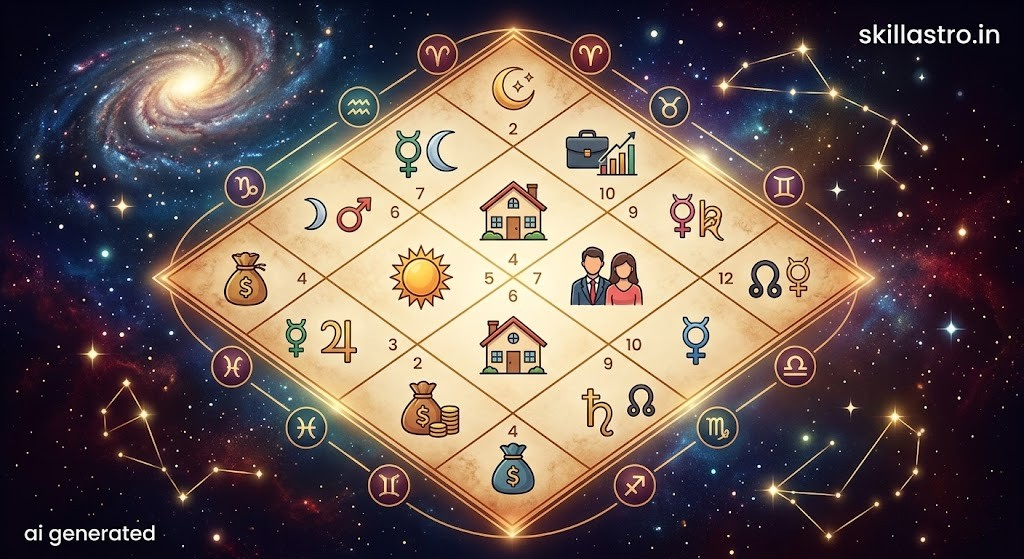
1. The Twelve Houses (Different Areas of Life) The entire birth chart is divided into twelve boxes. In the language of astrology, these boxes are called 'Houses' (Bhavas). These twelve houses never change their position and represent every single aspect of human life:
1st House (Ascendant/Lagna): Your physical body, nature, health, and overall personality.
2nd House: Accumulated wealth, immediate family, and your speech.
3rd House: Valor, courage, and younger siblings.
4th House: Happiness from the mother, land, property/buildings, and mental peace.
5th House: Intellect, education, love affairs, and happiness from children.
6th House: Diseases, debts, enemies, and competition.
7th House: Marriage, life partner, and business partnerships.
8th House: Longevity, cause of death, secrets, and sudden obstacles or events.
9th House: Luck/fortune, religion, spirituality, and long journeys.
10th House: Karma (actions), livelihood/career, happiness from the father, and respect in society.
11th House: Income, gains, fulfillment of desires, and elder siblings.
12th House: Expenses, losses, salvation (Moksha), and foreign travel.
2. The Twelve Zodiac Signs (Nature and Qualities) The numbers from 1 to 12 written inside the twelve houses of the Kundli represent the Zodiac Signs (Rashis). There are a total of twelve signs, from Aries to Pisces. The sign that rises in the first house is called the Ascendant Sign (Lagna Rashi), and the sign in which the Moon is seated is called the person's Moon Sign (Chandra Rashi). Zodiac signs determine the nature or manner in which the results of a specific house will manifest.
3. The Nine Planets (Directors of Life) In Vedic astrology, the Sun, Moon, Mars, Mercury, Jupiter (Guru), Venus, Saturn, Rahu, and Ketu—these nine planets (Navagrahas) are considered the directors of life. Every planet has its own specific element and significations. For example, the Sun represents self-confidence, the Moon represents the mind, and Venus represents marital bliss and material comforts. These planets provide auspicious or inauspicious results based on the house and sign they are seated in.
Why is the Birth Chart Important?
Self-Identification: It introduces you to your true capabilities, strengths, and weaknesses.
Accurate Decision Making: It helps you choose the right direction at crucial turning points in life, such as education, career, and marriage.
Timing of Events: In Vedic astrology, through periods (Mahadasha) and transits (Gochar), one can know exactly when an auspicious or inauspicious event will occur in life.
Removal of Obstacles: If there is continuous struggle in life, studying the Kundli helps identify planetary flaws (like Manglik Dosh, Kaal Sarp Dosh) so that their proper remedies can be performed.
Frequently Asked Questions (FAQs)
Q1. What information is required to create a birth chart?
To cast a highly accurate birth chart, three precise details are required: the exact date of birth, the exact time of birth, and the place of birth (name of the city or village).
Q2. Can a Kundli be made without a birth time?
If the exact birth time is completely unknown, the future can be estimated in Vedic astrology by casting a Horary Chart (Prashna Kundli) or a Moon Chart (Chandra Kundli) based on the first letter of the person's name. However, a chart based on the exact birth time is always the most accurate.
Q3. Can the bad effects of a birth chart be changed?
The celestial positions of the planets cannot be changed, but through donations, chanting mantras, wearing gemstones, and performing good deeds, their negative impacts can certainly be reduced to a great extent.
Conclusion
A birth chart is not magic or superstition; rather, it is a wonderful and precise confluence of time, astronomy, and mathematics. It is a guiding instrument given by the divine that acts as a ray of light in the darkness of life. By understanding your Kundli, you can boldly face the challenges of your life and pave your way to success.