
 Join WhatsApp Channel
The Roots of Jyotish in the Vedas: The Ultimate Guide to the Science of Light
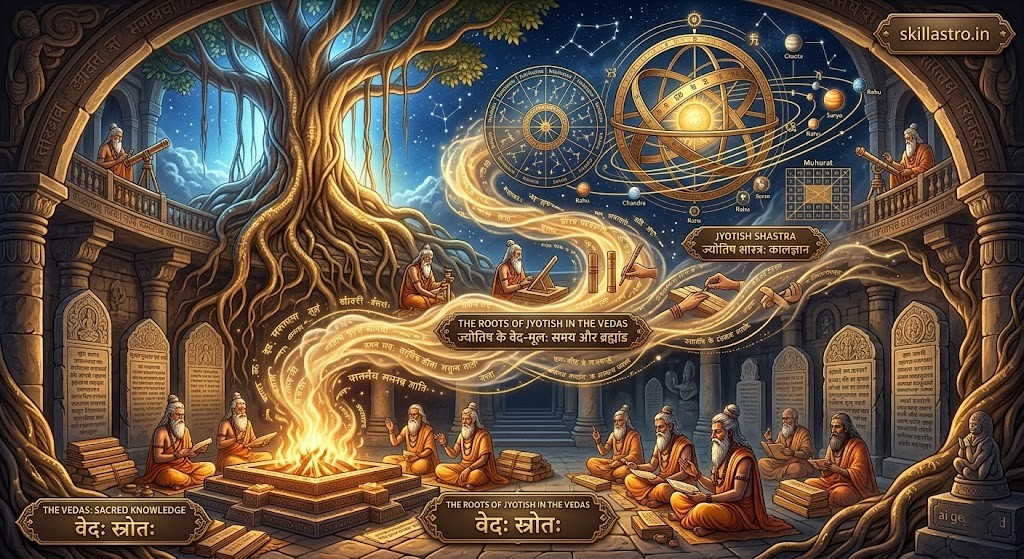
The roots of Jyotish in the Vedas represent the spiritual and scientific awakening of ancient human civilization. Far from being a modern invention or a system of mere superstition, Vedic astrology—traditionally known as Jyotish Shastra, or the "Science of Light"—is an integral part of the oldest existing literature known to humanity. To understand the true depth, accuracy, and power of a birth chart (Kundli), one must trace its lineage back to these sacred Sanskrit texts. The Vedas are not just religious hymns; they are a vast repository of cosmic laws, quantum philosophy, and precise astronomical data.
Exploring the roots of Jyotish in the Vedas requires us to look at how the ancient sages (Rishis) viewed the universe. They did not see a separation between the physical world and the spiritual realm. Instead, they understood that the macrocosm of the stars and planets perfectly mirrored the microcosm of human existence. By decoding the light of the celestial bodies, they believed they could read the cosmic mind. This comprehensive guide will take you deep into the Vedic origins of astrology, exploring how this ancient science evolved into the highly specialized branches of Medical Astrology, Career Astrology, and the powerful remedial measures we still use today.
Talk to India's Best Astrologer at ₹1/min Only
Expert guidance for Career, Love & Marriage. Get accurate predictions instantly from verified Vedic Astrologers.
Chat Now »
Talk to India's Best Astrologer at ₹1/min Only
Expert guidance for Career, Love & Marriage. Get accurate predictions instantly from verified Vedic Astrologers.
Chat Now »
Jyotish as a Vedanga: The Eye of the Cosmic Being
The Architecture of Vedic Knowledge
To comprehend the roots of Jyotish in the Vedas, we must first understand the structure of ancient Indian knowledge. The Vedic literature is vast, primarily consisting of the Rig Veda, Yajur Veda, Sama Veda, and Atharva Veda. However, to properly read, understand, and apply the wisdom contained within these profound texts, the ancient scholars developed six auxiliary disciplines known as the Vedangas (the limbs of the Vedas).
These six limbs are Shiksha (Phonetics), Kalpa (Rituals), Vyakaran (Grammar), Nirukta (Etymology), Chhanda (Meter), and Jyotisha (Astrology and Astronomy).
The Eye of the Veda Purusha
In ancient philosophical texts, the entire body of Vedic knowledge is personified as the Veda Purusha (the Cosmic Being). Among all the limbs, Jyotish was given the highest, most revered status: it was designated as the Eye of the Veda Purusha. Just as a human being cannot navigate the physical world without sight, the ancient sages declared that one cannot navigate the spiritual or physical dimensions of karma without the guiding light of Jyotish. It provided the vision necessary to see past karmic debts, understand the present circumstances, and illuminate the future path.
The Original Purpose: Timing the Sacred Yagyas
In its earliest Vedic inception, Jyotish was primarily observational and mathematical. The text known as the Vedanga Jyotisha, compiled by Sage Lagadha, is the earliest formal text on this subject. Its primary purpose was not to cast individual birth charts or predict personal wealth. Instead, it was used strictly for Muhurta—calculating the flawless astronomical timing for massive societal fire rituals (Yagyas) and agricultural cycles. The sages mathematically mapped the solstices, equinoxes, and lunar phases to ensure that earthly actions were perfectly synchronized with the energetic breath of the cosmos.
The Evolution into Specialized Astrological Branches
As time progressed, the roots of Jyotish in the Vedas grew into a massive, multi-branched tree. The realization that the mathematical alignment of the planets influenced massive earthly events led to the understanding that these same planets deeply influence individual human lives.
Medical Astrology (Ayur Jyotish) and the Atharva Veda
The deep connection between human health and the cosmos is firmly rooted in the Atharva Veda, which also serves as the foundation for Ayurveda (ancient Indian medicine). Ayur Jyotish, or Medical Astrology, emerged from this synergy. The ancient healers mapped the 12 signs of the zodiac and the 9 planets to the human anatomy. The Sun governed the heart and bones, the Moon governed bodily fluids and the mind, and the 6th house of a Kundli became the primary indicator of disease. By analyzing these placements, ancient physicians could diagnose karmic predispositions to illnesses long before physical symptoms arose, making Jyotish a profound tool for preventative healthcare.
Decoding Dharma through Career Astrology
The concept of Dharma—righteous duty and cosmic purpose—is a central theme in the Vedas. Naturally, the roots of Jyotish in the Vedas extended into helping individuals find their specific life path. Career astrology was developed to ensure that a person's daily labor was aligned with their soul's evolutionary needs. By examining the 10th house (Karma Bhava) and utilizing precise mathematical sub-charts like the Dashamsha (D-10), astrologers could decode whether a person was cosmically wired for intellectual pursuits, administrative leadership, or healing professions, ensuring societal harmony and individual fulfillment.
Numerology and the Evolution of Lal Kitab
The Vedic emphasis on sound and vibration naturally paved the way for numerical astrology (Ank Jyotish). The ancient seers understood that numbers hold specific frequencies that resonate with planetary energies. Over centuries, these core Vedic principles interacted with other cultures, giving rise to specialized, highly practical texts like the Lal Kitab. While classical Vedic astrology relied on complex fire rituals to appease the planets, Lal Kitab distilled this ancient wisdom into accessible, behavior-based remedies, proving the dynamic, ever-evolving nature of Jyotish.
Chart: The Four Vedas and Their Astrological Significance
To clearly illustrate how deeply integrated astrology is within the ancient texts, below is a chart detailing the four primary Vedas and their specific contributions to the science of Jyotish:
| The Sacred Text | Primary Nature | Contribution and Connection to Jyotish Shastra |
| Rig Veda | The Book of Mantras | Contains the earliest astronomical observations. It introduces the concept of the 360-degree cosmic wheel and explicitly mentions the lunar mansions (Nakshatras). |
| Yajur Veda | The Book of Rituals | Provides the foundational logic for Muhurta (electional astrology). It mathematically details the lunar months and the exact timing required for sacred fire sacrifices. |
| Sama Veda | The Book of Song/Chant | Establishes the science of sound vibration. The chanting meters correspond mathematically to planetary frequencies, laying the groundwork for astrological Mantra therapy. |
| Atharva Veda | The Book of Spells/Life | The direct foundation for Medical Astrology (Ayur Jyotish). It details remedies, the use of herbs, and the connection between planetary afflictions and physical diseases. |
Ancient Vedic Remedies: Healing the Karmic Blueprint
The roots of Jyotish in the Vedas confirm that astrology was never meant to be a fatalistic doctrine. The Vedas heavily emphasize human free will and the ability to alter one's karma through conscious action. Therefore, diagnosing a planetary flaw (Dosha) is only half the science; the other half is the application of powerful remedies (Upayas).
The Science of Gemstones (Ratnas)
Vedic texts describe the universe as an interplay of light and energy. The use of natural gemstones is deeply rooted in this understanding. The ancient seers observed that the nine planets (Navagrahas) transmit specific cosmic rays. When a person's birth chart reveals a deficiency in a beneficial planetary energy—perhaps stalling their career or weakening their health—wearing a flawless, natural gemstone acts as an optical receiver. A Ruby harnesses the vital solar energy of the Sun, while an Emerald channels the intellectual frequency of Mercury, physically anchoring the cosmic light into the wearer's aura.
Sound Frequencies and Yagyas
Because the universe was spoken into existence through the primordial sound Om, the Vedas prescribe the chanting of precise Sanskrit Beej (seed) mantras as the ultimate remedy for planetary afflictions. These sound vibrations restructure the neural pathways and alter the body's frequency. Furthermore, the performance of Yagyas (Vedic fire rituals) using specific herbs corresponding to afflicted planets is a practice that dates back thousands of years, designed to purify the environment and appease turbulent cosmic forces.
Frequently Asked Questions (FAQs)
Where is the word 'Jyotish' first mentioned?
The earliest systematic text entirely dedicated to astronomy and astrology is the Vedanga Jyotisha, composed by Sage Lagadha. However, astronomical concepts, planetary deities, and the Nakshatras are heavily referenced throughout the older Rig Veda.
Did the Vedas predict the future?
The Vedas themselves are philosophical and ritualistic texts, not books of prophecy. However, they provided the mathematical, astronomical, and philosophical framework (the laws of Karma and reincarnation) that allowed later sages like Parashara to develop the predictive tools of the Kundli.
Is Vedic astrology a religion?
No. While it is deeply rooted in the ancient Hindu scriptures, Jyotish is a spiritual science. Its principles of karma, planetary frequencies, and astronomical tracking of the sidereal zodiac are universal laws of nature, applicable to anyone regardless of their religious beliefs.
Why are remedies so important in Vedic astrology?
In the Vedic worldview, your birth chart is simply a map of your past karma. Remedies (such as mantras, gemstones, and Lal Kitab interventions) represent your current free will. They are the active steps you take to navigate around the karmic obstacles shown on the map.
Conclusion
The roots of Jyotish in the Vedas reveal a breathtaking cosmic vision that has guided humanity for thousands of years. Far beyond the simple newspaper horoscopes of today, ancient Vedic astrology is a profound, mathematically precise, and deeply spiritual science. It is the brilliant "Eye of the Vedas," allowing us to peer into the fabric of space and time to understand our deepest karmic patterns. From the advanced diagnostic capabilities of Medical Astrology to the precise guidance of Career Astrology, and the powerful, vibratory remedies of authentic gemstones and numerology, Jyotish remains the ultimate tool for human optimization.