
 Join WhatsApp Channel
The Origin of Vedic Astrology in Ancient India: A Journey Through Time
The origin of Vedic astrology in ancient India is a fascinating journey that takes us back thousands of years into the spiritual and intellectual heart of human civilization. Known traditionally as "Jyotish Shastra," which translates to the "Science of Light," Vedic astrology is not merely a method of fortune-telling; it is a profound cosmic science intricately woven into the fabric of the ancient Vedic texts. For centuries, seekers, sages, and scholars have turned to the alignment of the stars and planets to understand the deep connections between the macrocosm of the universe and the microcosm of human existence.
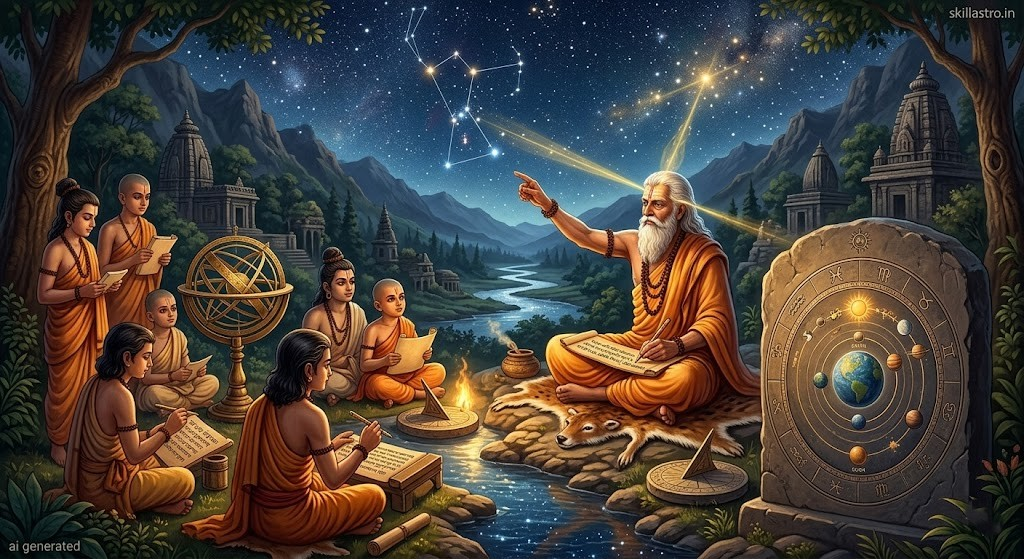
To understand the origin of Vedic astrology in ancient India, we must look beyond modern interpretations and dive deep into the spiritual discipline of the ancient Rishis (sages). They observed the celestial bodies with the naked eye, relying on an elevated state of consciousness and rigorous mathematical calculations. Through their profound meditation and astronomical observations, they decoded the blueprint of the cosmos, giving birth to an astrological system that remains highly revered and incredibly accurate even today.
Talk to India's Best Astrologer at ₹1/min Only
Expert guidance for Career, Love & Marriage. Get accurate predictions instantly from verified Vedic Astrologers.
Chat Now »
Talk to India's Best Astrologer at ₹1/min Only
Expert guidance for Career, Love & Marriage. Get accurate predictions instantly from verified Vedic Astrologers.
Chat Now »
The Historical Roots and the Vedangas
The Science of Light in the Vedas
Vedic astrology finds its earliest references in the Vedas, the oldest sacred texts of India, which are estimated to have been composed between 1500 and 1000 BCE, though the oral traditions date back much further. Jyotish is classified as one of the six Vedangas, which are the auxiliary disciplines required to understand and practice the teachings of the Vedas. Specifically, Jyotish was considered the "eye" of the Veda Purusha (the cosmic being). Its primary purpose in ancient times was to determine the most auspicious dates and times (Muhurta) for performing sacred Vedic rituals, fire sacrifices (Yagyas), and agricultural activities.
The Contribution of the Great Sages
The true codification and expansion of Vedic astrology as a comprehensive predictive science were carried out by enlightened sages. Sage Bhrigu is often celebrated as the father of Hindu astrology, having compiled the Bhrigu Samhita, a massive astrological treatise containing the birth charts of millions of individuals. Similarly, Sage Parashara's monumental work, the Brihat Parashara Hora Shastra, serves as the foundational pillar of modern Vedic astrology. It detailed the complex calculations of planetary periods (Dashas), planetary aspects (Drishti), and the formation of various divisional charts. Over time, specialized branches began to emerge from these ancient teachings, evolving into complex systems that address specific human concerns—ranging from medical astrology for physical well-being to precise career astrology guiding an individual's dharma. Later traditions even saw the emergence of unique offshoots like the Lal Kitab, expanding the horizons of traditional predictive methods.
Core Principles Established in Ancient Times
The Law of Karma and Reincarnation
At the heart of Vedic astrology lies the philosophy of Karma and reincarnation. The ancient sages believed that a soul takes multiple births to exhaust its karmic debts and fulfill its desires. The planetary alignments at the exact moment of an individual's birth are not random; they are a cosmic mirror reflecting the accumulated karma of past lives. The planets (Grahas) are viewed not as forces that compel us, but as divine agents delivering the results of our past actions.
The Cosmic Blueprint: Planets, Signs, and Constellations
The ancient Indian system is fundamentally built upon nine astrological planets (Navagrahas), twelve zodiac signs (Rashis), and twenty-seven lunar constellations (Nakshatras). The inclusion of the Nakshatras is uniquely Indian and demonstrates the ancient astronomers' incredible precision. The moon's transit through these twenty-seven constellations forms the basis of the Vimshottari Dasha system, a highly accurate predictive timeline used to map out the unfolding events of a person's life.
The Ancient Vedic Birth Chart (Kundli)
Understanding the origin of Vedic astrology in ancient India requires an understanding of its primary tool: the birth chart, or Kundli. Unlike Western astrology, which is solar-based, ancient Indian astrology is deeply lunar-centric and utilizes the sidereal zodiac (Nirayana), which accounts for the precession of the equinoxes.
Below is a representation of the 12 Bhavas (Houses) as established by ancient astrologers, detailing what each cosmic sector governs in a human life:
| House (Bhava) | Ancient Sanskrit Name | Key Significations Derived from Ancient Texts |
| 1st House | Tanu Bhava | Physical body, self, appearance, vitality, general life path. |
| 2nd House | Dhana Bhava | Wealth, accumulated assets, speech, family, early education. |
| 3rd House | Sahaja Bhava | Courage, siblings, short journeys, communication, self-effort. |
| 4th House | Matru Bhava | Mother, home, property, vehicles, inner peace, emotional heart. |
| 5th House | Putra Bhava | Children, intellect, creativity, past-life karma (Purva Punya). |
| 6th House | Ari Bhava | Diseases, debts, enemies, daily service, obstacles. |
| 7th House | Kalatra Bhava | Marriage, spouse, business partnerships, foreign travel. |
| 8th House | Ayur Bhava | Longevity, sudden transformations, hidden wealth, occult sciences. |
| 9th House | Dharma Bhava | Religion, fortune, higher education, father, long journeys. |
| 10th House | Karma Bhava | Profession, public standing, fame, ambition, karma in society. |
| 11th House | Labha Bhava | Gains, large networks, elder siblings, fulfillment of desires. |
| 12th House | Vyaya Bhava | Liberation (Moksha), losses, foreign settlement, spirituality, sleep. |
Traditional Remedies (Upayas) from Ancient Texts
When the ancient seers decoded the karmic patterns of human life, they also provided powerful remedies to mitigate planetary afflictions and enhance positive cosmic energies. The concept of remedies (Upayas) is central to the origin of Vedic astrology in ancient India, transforming it from a fatalistic doctrine into an empowering spiritual tool.
The Power of Gemstones (Ratnas)
One of the most profound remedies passed down through the ages is the use of natural gemstones. Ancient texts intricately detail the energetic correspondence between the Navaratnas (nine primary gems) and the nine planets. By wearing a specific, flawless gemstone—such as a ruby for the Sun or a yellow sapphire for Jupiter—an individual can attract and absorb the cosmic frequencies of a benefic planet. The ancient sages placed immense importance on the precise weight, quality, and purification rituals required before wearing a gemstone to unlock its full astrological significance.
Mantras, Yantras, and Rituals
Alongside gemstones, the chanting of specific Sanskrit Mantras creates sound vibrations that harmonize the mind with planetary frequencies. Yantras, which are geometric representations of the divine, were utilized to focus cosmic energy into a physical space. Furthermore, acts of selfless charity (Daan), specific fasting (Vrat) on days ruled by afflicted planets, and performing fire rituals (Homas) were heavily prescribed to burn negative karma and restore spiritual balance.
Frequently Asked Questions (FAQs)
How old is Vedic astrology?
Vedic astrology is considered to be over 5,000 years old. Its fundamental concepts were first documented in the Rig Veda, with its most comprehensive rules established later by sages like Parashara and Jaimini.
What makes ancient Indian astrology different from Western astrology?
The primary difference lies in the zodiac system. Vedic astrology uses the sidereal (Nirayana) zodiac, which calculates planetary positions against the fixed background of stars. Western astrology uses the tropical (Sayana) zodiac, which is based on the seasons and the vernal equinox. Additionally, Vedic astrology places a massive emphasis on the Moon and the Nakshatras (lunar mansions).
Can Vedic remedies actually change one's destiny?
In the ancient Vedic tradition, remedies are not magic spells that completely erase destiny. Instead, they are spiritual tools that help mitigate the intensity of negative karmic periods and strengthen the mind's ability to navigate challenges. They modify the impact of karma, much like an umbrella protects you from heavy rain.
Who were the founders of this ancient science?
While it is an eternal science revealed through cosmic consciousness, Sage Bhrigu and Sage Parashara are widely regarded as the foundational fathers who organized and structured the vast knowledge into the astrological systems we study today.
Conclusion
The origin of Vedic astrology in ancient India represents one of humanity's most profound intellectual and spiritual achievements. What began thousands of years ago as an observational science to time sacred rituals evolved into a highly sophisticated system of understanding human destiny, psychology, and karma. From the deep wisdom of the Vedas and the meticulous calculations of the ancient sages to the profound application of traditional remedies like powerful gemstones and mantras, Jyotish Shastra remains an invaluable guide. By studying the celestial bodies, the ancient Indians did not just map the physical universe; they provided a timeless blueprint for navigating the spiritual journey of the human soul. Embracing this ancient wisdom allows us to align our lives with the natural rhythms of the cosmos, empowering us to achieve harmony, purpose, and spiritual growth.