 Join WhatsApp Channel
The History of Nakshatras in Vedic Astrology: Decoding the 27 Lunar Mansions
The history of Nakshatras in Vedic astrology is perhaps the most defining and unique feature of the ancient Indian astrological system. While Western astrology relies heavily on the 12 sun signs to define a person's character, Jyotish Shastra (the Science of Light) dives infinitely deeper, anchoring its predictive power in the 27 lunar mansions known as Nakshatras. To truly understand human consciousness, karmic patterns, and ultimate destiny, one must explore these ancient star clusters. They are the microscopic DNA of a Vedic birth chart, revealing the exact cosmic frequencies at play the moment a soul enters the physical world.
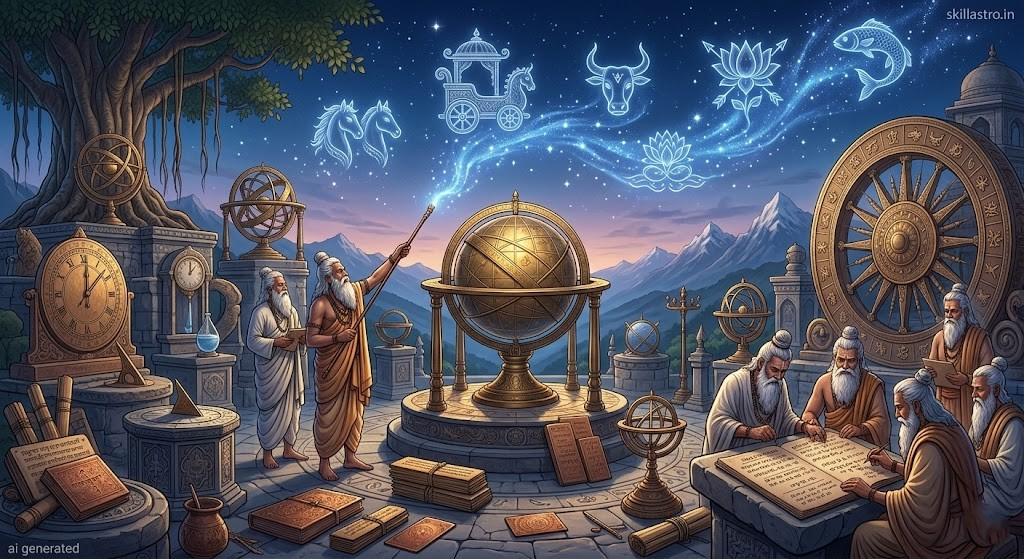
Understanding the history of Nakshatras in Vedic astrology requires us to trace the steps of the ancient Rishis (sages). They observed that the Moon—which governs the mind, emotions, and perception—moves much faster than the Sun, traversing the entire 360-degree zodiac in approximately 27.3 days. By dividing the sky into 27 distinct sectors to track the Moon's daily transit, the sages unlocked an incredibly precise method for timing life events and decoding human psychology. This comprehensive guide explores the ancient origins, structural mathematics, and powerful remedies associated with the 27 Nakshatras.
Talk to India's Best Astrologer at ₹1/min Only
Expert guidance for Career, Love & Marriage. Get accurate predictions instantly from verified Vedic Astrologers.
Chat Now »
Talk to India's Best Astrologer at ₹1/min Only
Expert guidance for Career, Love & Marriage. Get accurate predictions instantly from verified Vedic Astrologers.
Chat Now »
The Ancient Origins: Mythology and Astronomical Precision
The Earliest References in the Vedas
The term "Nakshatra" translates to "that which does not decay" or "approaching the stars." The earliest historical references to the Nakshatras are found in the Rig Veda and the Yajur Veda, texts that date back thousands of years. In these ancient scriptures, the Nakshatras were not merely astronomical markers; they were revered as celestial deities. The ancient Indians used these 27 lunar mansions to perfectly time their sacred fire rituals (Yagyas), agricultural plantings, and societal ceremonies, ensuring that every earthly action was in perfect harmony with the energetic vibration of the cosmos.
The 27 Wives of the Moon God
In Vedic mythology, the history of Nakshatras is beautifully encapsulated in the story of Lord Chandra (the Moon God) and King Daksha Prajapati. King Daksha had 27 beautiful daughters, representing the 27 constellations, and he gave all of them in marriage to Chandra. However, Chandra favored one wife, Rohini, above all others, spending most of his time in her constellation. This caused jealousy among the other wives and led to a curse from Daksha, causing the Moon to wax and wane. Astronomically, this mythology perfectly describes the Moon's elliptical orbit and its varying luminous intensity as it spends roughly one day transiting through each of the 27 lunar mansions.
The Mathematics of the Lunar Mansions
Subdividing the Zodiac for Microscopic Accuracy
The true brilliance of the ancient sages is evident in the mathematics of the Nakshatras. The 360-degree zodiac wheel is first divided into the 12 familiar signs (Rashis) of 30 degrees each. However, to achieve predictive precision, it is further divided into 27 Nakshatras. Mathematically, 360 divided by 27 equals 13 degrees and 20 minutes. Therefore, each Nakshatra spans exactly 13°20' of the zodiac.
To go even deeper, each Nakshatra is divided into four Padas (quarters) of 3 degrees and 20 minutes each. This microscopic division forms the basis of the Navamsha (D-9) chart, a crucial divisional chart used to predict marriage and the latter half of life. Furthermore, the exact degree of the Moon in a specific Nakshatra at birth dictates the starting point of the Vimshottari Dasha—the 120-year planetary timeline that predicts exactly when certain life events will unfold.
Nakshatras in Specialized Branches of Jyotish
The history of Nakshatras in Vedic astrology extends far beyond general personality traits; they are the backbone of specialized astrological disciplines.
Applications in Medical and Career Astrology
In the realm of Medical Astrology, the Nakshatras are essential for diagnosing physical vulnerabilities. Every lunar mansion governs a specific body part. For instance, Ashwini rules the head and brain, while Bharani governs the reproductive organs. If malefic planets are transiting or placed in these specific Nakshatras in a birth chart, it signals potential health issues in those corresponding areas.
Similarly, in Career Astrology, the Nakshatras refine professional predictions. While the 10th house shows the general career environment, the Nakshatra of the 10th lord reveals the specific flavor of the profession. A person with their 10th lord in the Nakshatra of Pushya (ruled by Saturn and associated with nourishment) makes an excellent teacher, counselor, or hospitality expert. When writing books or creating content for platforms like Skill Astro, integrating Nakshatra analysis provides the deepest layer of astrological insight.
Chart: The 27 Nakshatras and Their Planetary Rulers
To organize this vast cosmic system, ancient sages grouped the 27 Nakshatras by their ruling planets. This rulership is what dictates the sequence of the planetary periods (Dashas) in a person's life.
| Ruling Planet | The 3 Ruled Nakshatras | Core Energy / Motivation |
| Ketu (South Node) | Ashwini, Magha, Mula | Beginnings, deep roots, sudden transformations, ancestral karma. |
| Venus (Shukra) | Bharani, Purva Phalguni, Purva Ashadha | Creativity, luxury, relationships, purification, earthly desires. |
| Sun (Surya) | Krittika, Uttara Phalguni, Uttara Ashadha | Leadership, cutting through ignorance, authoritative power, fame. |
| Moon (Chandra) | Rohini, Hasta, Shravana | Nurturing, growth, craftsmanship, listening, emotional depth. |
| Mars (Mangal) | Mrigashira, Chitra, Dhanishta | Searching, dynamic action, architectural creation, musical rhythm. |
| Rahu (North Node) | Ardra, Swati, Shatabhisha | Storms, independence, innovation, deep healing, breaking boundaries. |
| Jupiter (Guru) | Punarvasu, Vishakha, Purva Bhadrapada | Renewal, achieving goals, dual paths, philosophical wisdom. |
| Saturn (Shani) | Pushya, Anuradha, Uttara Bhadrapada | Nourishment, devotion, friendship, deep structural foundation. |
| Mercury (Budh) | Ashlesha, Jyeshtha, Revati | Mysticism, intellectual superiority, culmination, crossing over. |
Traditional Remedies (Upayas) Based on Nakshatras
Because the Nakshatras represent deeply ingrained karmic patterns, ancient texts provide specific traditional remedies to harmonize a person's energy with their birth star.
Gandmool Dosha and Nakshatra Shanti
Certain Nakshatras that sit at the precise junctions between water signs and fire signs (Ashwini, Ashlesha, Magha, Jyeshtha, Mula, and Revati) are known as Gandmool Nakshatras. Being born in these sensitive degrees often brings turbulence in early childhood or health challenges for the parents. The primary remedy prescribed in ancient texts is the Nakshatra Shanti Puja, performed 27 days after birth when the Moon returns to the natal star, to pacify the intense karmic energy.
The Synergy of Gemstones and Nakshatras
Gemstone therapy is highly effective when aligned with Nakshatra rulership. If a person's Ascendant lord or Moon is situated in a challenging Nakshatra, wearing the gemstone of the Nakshatra's ruling planet can provide immense stability. However, this must be calculated carefully. Exploring the astrological significance of gemstones requires understanding whether the Nakshatra ruler is a functional benefic or malefic in the specific Kundli.
Nature and Lal Kitab Remedies
Every Nakshatra is associated with a specific tree or plant, an animal, and a deity. A deeply rooted ancient practice involves planting, watering, or protecting the specific tree associated with your birth star to ground your energy. Furthermore, Lal Kitab and numerology (Ank Jyotish) often prescribe simple, behavior-based remedies—like feeding the animal associated with your Nakshatra or donating items aligned with its ruling planet—to clear blockages in your daily life.
Frequently Asked Questions (FAQs)
What is a Janma Nakshatra?
Your Janma Nakshatra is the specific lunar mansion the Moon was transiting at the exact moment of your birth. It determines your emotional nature, your inherent psychological patterns, and the starting point of your life's Dasha timeline.
Are Nakshatras more important than Zodiac Signs (Rashis)?
They are equally important but serve different purposes. The Rashi (Zodiac Sign) shows the broader environment or the "house" a planet sits in, while the Nakshatra reveals the specific "room" and the underlying micro-energy directing that planet's behavior.
Can Nakshatras determine marriage compatibility?
Yes. In the ancient Indian system of Kundli Milan (horoscope matching), Nakshatras form the entire basis of the Ashtakoota or 36-point matching system. The compatibility between the bride and groom's birth stars determines their mental resonance, emotional harmony, and physiological compatibility.
How many total Nakshatras are there?
There are 27 primary Nakshatras used for predictive astrology. However, an intercalary 28th Nakshatra, known as Abhijit, is sometimes used in specific Muhurta (electional astrology) calculations, representing highly auspicious cosmic energy.
Conclusion
The history of Nakshatras in Vedic astrology is a testament to the unparalleled observational brilliance and profound spiritual depth of ancient India. While the 12 zodiac signs paint the broad strokes of human life, the 27 lunar mansions provide the microscopic details, revealing the intricate tapestry of our karma, health, and true professional calling. From the mythological journey of the Moon God to the highly advanced mathematical calculations used in medical and career astrology, the Nakshatras are the ultimate key to unlocking a Vedic birth chart. By understanding your birth star and applying authentic traditional remedies—whether through the specific frequencies of gemstones or the practical wisdom of the Lal Kitab—you can consciously align your life with the rhythms of the universe. Continuing to explore these profound celestial secrets through dedicated study and platforms like Skill Astro empowers you to master the intricate science of light and guide others toward their ultimate cosmic destiny.