
 Join WhatsApp Channel
The Birth of Kundli in Ancient India: Charting the Cosmic Blueprint of the Soul
The birth of Kundli in ancient India represents a monumental leap in human consciousness, marking the exact point where terrestrial life met celestial mathematics. A Kundli, also known as a Janam Patrika or birth chart, is not merely a piece of paper with geometric shapes and planetary symbols; it is a profound cosmic map. In the vast and rich tradition of Vedic astrology (Jyotish Shastra), the Kundli serves as the foundational document that outlines an individual's past karma, present tendencies, and future potentials.
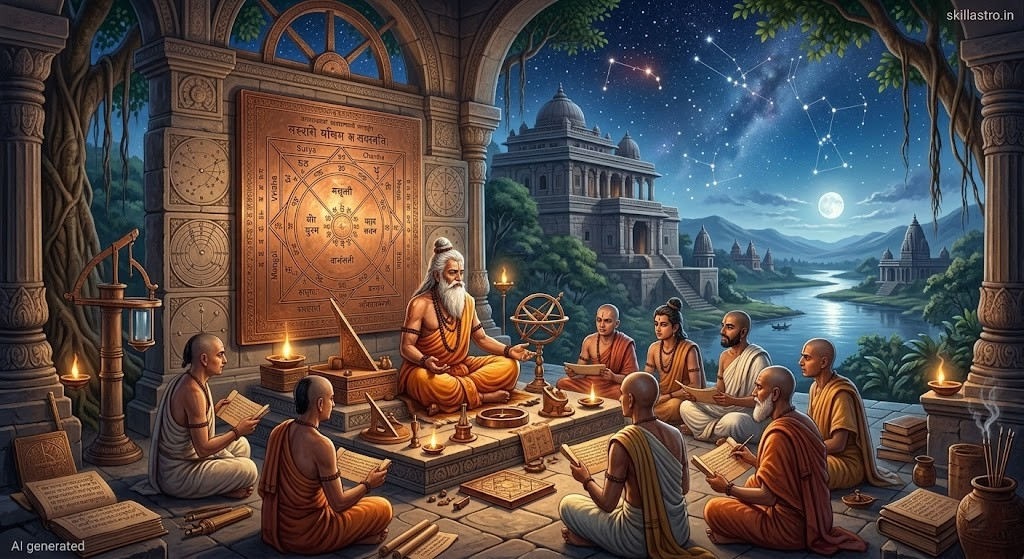
To fully appreciate the birth of Kundli in ancient India, we must travel back thousands of years to the Vedic era, a time when sages and seers sought to understand the hidden mechanics of the universe. They recognized that the macrocosm (the universe) and the microcosm (the human soul) were deeply intertwined. By mapping the exact positions of the stars and planets at the precise moment of a person's first breath, these ancient scientists created a dynamic blueprint of human destiny. This comprehensive guide delves deep into the origins, structural logic, and profound remedies associated with the ancient Indian birth chart, designed to offer unparalleled insight into this timeless science.
Talk to India's Best Astrologer at ₹1/min Only
Expert guidance for Career, Love & Marriage. Get accurate predictions instantly from verified Vedic Astrologers.
Chat Now »
Talk to India's Best Astrologer at ₹1/min Only
Expert guidance for Career, Love & Marriage. Get accurate predictions instantly from verified Vedic Astrologers.
Chat Now »
The Historical Origins and the Vision of the Sages
The Era of Observational Astronomy
Long before the invention of telescopes, modern software, or digital ephemerides, the ancient Indian Rishis (sages) were master astronomers. The earliest roots of the Kundli can be traced back to the Vedanga Jyotisha, an ancient text that primarily focused on tracking the movements of the Sun and Moon to determine auspicious times (Muhurtas) for massive agricultural and spiritual rituals. During this early period, the focus was collective rather than individual. The sky was watched meticulously, and the mathematical patterns of eclipses, solstices, and lunar phases were recorded with astonishing accuracy over centuries.
Sage Parashara and the Mathematical Blueprint
The true transition from observational astronomy to the highly personalized, predictive science of the Kundli is largely attributed to the great Sage Parashara. His monumental compilation, the Brihat Parashara Hora Shastra, is the bedrock upon which all modern Kundli casting is based. Sage Parashara introduced the rigorous mathematical framework required to freeze the cosmos into a two-dimensional chart. He detailed the intricate calculations needed to determine the Ascendant (Lagna)—the exact zodiac sign rising on the eastern horizon at the specific latitude and longitude of a person's birth. This mathematical precision birthed the personalized Kundli, transforming Jyotish into a predictive tool capable of outlining every facet of a human life, from medical predispositions to career trajectories.
Decoding the Structure of the Ancient Kundli
The birth of Kundli in ancient India brought forth a highly sophisticated geometric system. A standard Vedic birth chart is divided into 12 houses (Bhavas), each representing a specific domain of human existence. The planets (Grahas) are placed within these houses based on their astronomical positions at the time of birth, interacting with the 12 zodiac signs (Rashis) and the 27 lunar mansions (Nakshatras).
Below is a detailed chart breaking down the 12 houses of the Kundli, demonstrating how ancient astrologers categorized the entirety of human experience into this cosmic diagram:
| House (Bhava) | Astrological Name | Core Life Domains Governed | Medical & Karmic Significance |
| 1st House | Lagna / Tanu Bhava | Self, physical appearance, personality, ego. | Vitality, overall health, the brain, physical resilience. |
| 2nd House | Dhana Bhava | Wealth, accumulated savings, family lineage, speech. | Face, teeth, throat, right eye, early childhood nutrition. |
| 3rd House | Sahaja Bhava | Courage, siblings, short travels, communication skills. | Nervous system, hands, arms, shoulders, mental fortitude. |
| 4th House | Matru Bhava | Mother, inner peace, vehicles, real estate, homeland. | Heart, chest, lungs, deep emotional psychology and comfort. |
| 5th House | Putra Bhava | Children, intellect, creativity, romance, speculation. | Stomach, digestion, past-life karma (Purva Punya), intelligence. |
| 6th House | Ari Bhava | Enemies, debts, daily routines, conflicts, service. | Acute diseases, immune system, intestines, overcoming obstacles. |
| 7th House | Kalatra Bhava | Marriage, spouse, business partnerships, legal bindings. | Lower back, reproductive organs, harmony with the external world. |
| 8th House | Ayur Bhava | Longevity, sudden changes, inheritances, occult knowledge. | Chronic illnesses, transformation, longevity, hidden psychological fears. |
| 9th House | Dharma Bhava | Religion, fortune, higher education, father, gurus. | Thighs, hips, spiritual inclinations, divine grace and luck. |
| 10th House | Karma Bhava | Career, public status, authority, fame, ambition. | Knees, joints, societal impact, professional dharma and public life. |
| 11th House | Labha Bhava | Gains, large networks, elder siblings, fulfillment of desires. | Calves, ankles, left ear, realization of long-term ambitions and wealth. |
| 12th House | Vyaya Bhava | Losses, foreign lands, spirituality, isolation, expenditures. | Feet, sleep quality, subconscious mind, ultimate liberation (Moksha). |
Traditional Remedies (Upayas) in the Ancient Kundli System
The birth of Kundli in ancient India was not meant to trap individuals in a fatalistic destiny. On the contrary, the ancient sages developed the Kundli as a diagnostic tool. Once a karmic block or planetary flaw (Dosha) was identified within the chart, they prescribed powerful remedies (Upayas) to neutralize the negative energy and amplify the positive forces. The ultimate goal was to empower the individual to navigate their karma consciously.
The Power of Navaratna (Gemstones)
One of the most scientifically and spiritually profound remedies derived from the Kundli is gemstone therapy. Ancient texts identified that the nine planets emit specific cosmic rays and light frequencies. When a Kundli reveals that a beneficial planet is weak—perhaps hindering one's career or health—astrologers prescribe a specific, flawless gemstone to act as a cosmic receiver. By wearing a carefully chosen gem, such as an Emerald to strengthen Mercury's intellect or a Blue Sapphire to harness Saturn's discipline, the individual continuously absorbs the required planetary frequency into their subtle energy body, correcting the energetic imbalance.
Lal Kitab Remedies and Karmic Alignment
As the science of the Kundli evolved, specialized branches emerged to offer accessible solutions to complex planetary alignments. The Lal Kitab, a legendary astrological text, brought a unique flavor to Kundli remedies. Instead of relying solely on expensive gemstones or elaborate fire rituals, Lal Kitab focuses on practical, behavioral corrections and simple karmic acts. If a Kundli shows a malefic placement of Mars, a Lal Kitab remedy might involve donating sweet bread to stray animals or avoiding the acceptance of free gifts. These highly effective, logic-based remedies work by subtly shifting a person's psychological and karmic footprint, clearing obstacles in their day-to-day life.
Sound Vibrations and Mantras
The ancient sages understood the universe as a manifestation of sound. If the Kundli indicates a turbulent planetary period (Dasha), chanting specific Sanskrit mantras is highly prescribed. These phonetic formulas create neuro-linguistic vibrations that calm the nervous system, alter brainwave states, and align the individual's internal frequency with the harmonizing aspects of the afflicted planet.
Frequently Asked Questions (FAQs)
What is the exact meaning of the word 'Kundli'?
The word 'Kundli' is derived from the Sanskrit word 'Kundala', which means a coil or a circle. It symbolically represents the coiled path of the planets in the 360-degree zodiac wheel, mapped mathematically at the exact moment of an individual's birth.
How did ancient sages calculate a Kundli without modern software?
Ancient astrologers were highly advanced mathematicians. They relied on a Panchang (an astronomical ephemeris) that contained centuries of meticulously recorded celestial data. Using spherical trigonometry and complex manual calculations, they determined the exact degree of the Ascendant and the precise longitude of every planet.
Can a Kundli really predict my future?
A Kundli maps out your karmic tendencies, potentials, and the timeline of planetary energies you will experience. It acts as a cosmic weather forecast. It does not predict a fixed, unchangeable future, because your free will and your conscious actions (including the use of remedies) play a massive role in shaping the final outcome.
What is a Dosha in a Kundli?
A Dosha is an astrological flaw or imbalance in the birth chart caused by the unfavorable positioning of certain planets (such as Rahu, Ketu, Mars, or Saturn). Common examples include Mangal Dosha or Kaal Sarp Dosha. These indicate specific areas of life where you carry difficult karma, which can be mitigated through dedicated remedies.
Conclusion
The birth of Kundli in ancient India remains one of the most brilliant intersections of astronomy, mathematics, and spiritual philosophy in human history. Far from a superstitious artifact, the Kundli is a highly logical, deeply empowering map of the soul's journey. By meticulously calculating the positions of the cosmic bodies, the ancient seers provided us with a profound tool to understand our health, decode our career paths, and navigate our relationships. Beyond mere prediction, the true genius of the Kundli lies in its prescriptive nature—offering powerful, transformative remedies through the wisdom of gemstones, the practical magic of the Lal Kitab, and the vibratory power of mantras. Embracing this ancient science allows us to take charge of our destiny. For those seeking to unlock the mysteries of their own cosmic blueprint, dedicated platforms like Skill Astro provide the authentic insights and expert guidance necessary to navigate the profound and beautiful complexities of the ancient Indian birth chart.