
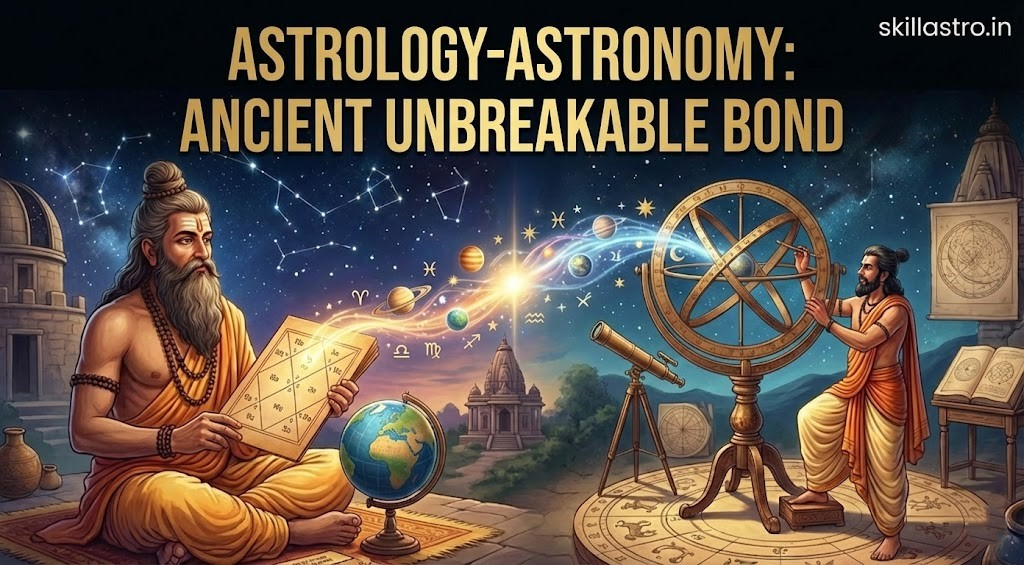
In today's modern era, we view 'Astrology' and 'Astronomy' as two separate poles. One finds a place in scientific laboratories, while the other remains in the realm of faith and belief. However, did you know that for a vast period of history, these two were not different?
In ancient India, the study of the sky itself was called 'Jyotish'. The astrologer of that time was the astronomer, and the astronomer was the astrologer. This was an era when there were no telescopes, yet our sages calculated the movement of planets, the precise timing of solar eclipses, and the circumference of the Earth.
The "Ancient Connection Between Astrology and Astronomy" was not a coincidence but the foundation of human civilization's intellectual journey. In today's detailed article, we will dive into the depths of history and see how these two disciplines were born from the same womb and walked together for thousands of years.
Part 1: Literal Meaning and Place in the Vedas
To understand this connection, we must first understand the root meaning of the word 'Jyotish'.
The Real Meaning of 'Jyotish'
According to Sanskrit grammar, the word 'Jyotish' is derived from 'Jyoti', which means light or celestial body. Thus, the literal meaning of Jyotish Shastra is—"The science that studies the movement and position of celestial bodies." In ancient times, it was called 'Ganita Jyotish' (Mathematical Astrology), which was synonymous with today's Astronomy.
The Eye of the Vedas (Vedanga)
The Vedas hold the highest place in the Indian tradition of knowledge. To understand the meaning of the Vedas and determine the correct timing for rituals (Yagyas), six limbs (Vedangas) were created: Shiksha, Kalpa, Vyakaran, Nirukta, Chhanda, and Jyotish.
Among these, Jyotish is called "Vedasya Chakshuh" (The Eye of the Vedas). In the 'Vedanga Jyotish' composed by Lagadha Muni, it is stated:
"Yatha shikha mayuranam, naganam manayo yatha. Tadvad vedangashastranam, jyotisham murdhani sthitam."
Meaning: Just as the crest is at the top of peacocks and the gem is at the head of cobras, similarly, Jyotish (Astronomy) stands at the top of all Vedanga scriptures.
This verse proves how significant astronomy was in ancient India. It was not just an art of fortune-telling, but a science to understand Time and Space.
Talk to India's Best Astrologer at ₹1/min Only
Expert guidance for Career, Love & Marriage. Get accurate predictions instantly from verified Vedic Astrologers.
Chat Now »
Talk to India's Best Astrologer at ₹1/min Only
Expert guidance for Career, Love & Marriage. Get accurate predictions instantly from verified Vedic Astrologers.
Chat Now »
Part 2: The Basis of the Connection – Necessity is the Mother of Invention
This ancient connection between astrology and astronomy did not stem from superstition but from practical necessities. Why did early humans and Vedic sages need astronomy?
1. Rituals and Timekeeping (Yagyas)
Vedic culture was centered around 'Yagya'. The Vedas clearly instructed that Yagyas must be performed in a specific season, month, fortnight, and Nakshatra. If the time was wrong, the Yagya would not yield results. To know the correct time, a subtle study of the Sun and Moon's movement was mandatory.
Ayana: The Sun's northward and southward movement.
Maas: Determining the month by the Moon's phases.
Nakshatra: The Moon's position in the sky. This necessity led to the creation of the 'Panchang' (Calendar), which is purely an astronomical calculation.
2. Agriculture and Seasons
India has been an agrarian country. When to sow and when to harvest depended entirely on the monsoon and seasons. Ancient astronomers linked the rising and setting of stars (Nakshatras) to rainfall. For example, the Sun's entry into the 'Ardra' Nakshatra was considered a sign of the rainy season. This was the astronomical side of astrology that kept society alive.
3. Navigation
To avoid getting lost during sea voyages or desert travel, knowledge of the 'Pole Star' (Dhruva Tara) and the Ursa Major constellation (Saptarishi Mandal) was essential. This was also a practical form of astronomy.
Part 3: Siddhanta Era – The Science of the Golden Age
The period from the early centuries AD to the 12th century is called the 'Siddhanta Era' or the Golden Era of Indian Astrology and Astronomy. During this time, mathematics and astronomy were at their peak. The great masters of this era gave a scientific basis to the unbreakable bond between astrology and astronomy.
1. Aryabhata (476 AD) – The Father of Revolution
The great mathematician Aryabhata of Pataliputra (Patna) composed the text 'Aryabhatiya' at the young age of 23. Refuting prevailing beliefs, he presented purely scientific facts:
Rotation of Earth: He clearly stated that the stars are fixed and the Earth rotates on its axis, causing day and night.
Cause of Eclipses: He rejected the mythological story of demons named Rahu and Ketu swallowing the Sun and Moon and proved that eclipses are caused by the Shadows of the Earth and Moon.
Length of Year: He calculated the length of a solar year as 365.25868 days, which is extremely close to modern calculation.
Aryabhata was primarily an astronomer, but his calculations were used to create astrological Panchangs.
2. Varahamihira (505 AD) – The Great Classifier
The scholar of Ujjain, Varahamihira, organized the relationship between astrology and astronomy. He divided astrology into three Skandhas (Pillars):
Tantra (Siddhanta): Covers planetary movements, calculations, and astronomy.
Hora (Jatak): Covers birth charts and individual future.
Samhita: Covers Vastu, Omens, and Mundane Astrology (Future of the nation).
In his book 'Panchasiddhantika', Varahamihira described five astronomical theories prevalent before his time (Paulisa, Romaka, Vasistha, Surya, Pitamaha), showing that India's astronomical knowledge was in global contact.
3. Bhaskaracharya (1114 AD) – Hint at Gravity
Centuries before Newton, Bhaskaracharya mentioned the Earth's attractive force (Gravity) in his text 'Siddhanta Shiromani'. He wrote that the Earth pulls celestial bodies towards itself. This was a monumental discovery in astronomy that formed the basis of astrological calculations.
Part 4: Astronomical Instruments and Observatories
In ancient India, astrology and astronomy were not limited to papers (palm leaves). Advanced laboratories and instruments were also developed. This proves it was an Experimental Science.
Shanku Yantra (Gnomon): The simplest and oldest instrument to know time and latitude by measuring the Sun's shadow during the day.
Nadi Valaya: An instrument to determine the Equinox.
Sawai Jai Singh's Observatories (Jantar Mantar): In the 18th century, King Sawai Jai Singh II built massive stone observatories in Delhi, Jaipur, Ujjain, Mathura, and Varanasi. The 'Samrat Yantra' (the world's largest sundial) tells time accurately to the fraction of a second even today.
The purpose of these instruments was to measure the 'Visual Position' of planets and correct the Panchang.
Part 5: The Split – When Did Astrology and Astronomy Separate?
After walking together for thousands of years, a time came when the paths of astrology and astronomy began to diverge.
1. Greek Influence
With Alexander's invasion and subsequent contacts, the influence of 'Horoscopic Astrology' increased in Indian astrology. Until now, the main purpose of astrology was 'Time Calculation', but now it started focusing on 'Individual Fate'. The clear division of 12 Zodiac signs and predictive techniques developed. From here, a fine line began to be drawn between 'Ganita' (Astronomy) and 'Falita' (Prediction).
2. Western Scientific Revolution
In the 17th century, after the arrival of Galileo, Kepler, and Newton in Europe, astronomy relied on telescopes and Physics. They considered planets only as 'Matter'. On the other hand, astrology continued to view planets as 'Energy' and 'Deity'. This division in the West eventually affected the whole world, categorizing astronomy as 'Science' and astrology as 'Pseudoscience'.
Part 6: Is Astrology Unscientific? An Analysis
Modern science often questions astrology, but we must not forget the ancient context.
Statistics: Ancient astrology was based on observation. Sages observed for thousands of years that when Mars is close to Earth, wars or accidents increase. This was Data Collection.
Environmental Impact: Astronomy accepts that the Moon causes tides in the ocean. Astrology argues that since the human body is also 70% water, the Moon influences it too (at a psychological level).
Colors and Metals of Planets: Ancient sages described Mars as red and Saturn as black/blue. When modern science took photos of these planets, Mars was found to be red (Iron Oxide) and Saturn blue/pale yellow. This precise knowledge without telescopes is proof of their astronomical skills.
Thus, ancient astrology was not superstition, but the 'Cutting-edge Science' of that time.
Part 7: Modern Scenario and Conclusion
Today, when we watch scientists from NASA or ISRO launching satellites, we must remember that the foundation was laid by those ancient sages who measured the sky with naked eyes.
The ancient connection between astrology and astronomy teaches us that:
The universe is one, and we are not separate from it (Yatha Pinde Tatha Brahmande).
Knowledge has no boundaries; religion and science were not opposing but complementary in ancient times.
Our traditions stand on a scientific foundation.
Today, there is a need to discard the 'superstitious' part of astrology and re-adopt its 'Mathematical and Astronomical' core. When we check the time of a solar eclipse in the Panchang, it is the result of that same unbreakable bond between astrology and astronomy that began thousands of years ago.
This connection is India's intellectual property, of which every Indian should be proud.
Frequently Asked Questions (FAQs)
Q1: Were astrology and astronomy the same in ancient times?
Answer: Yes, in ancient India, the word 'Jyotish' was primarily used for Astronomy. Its purpose was to calculate planetary movements and time. The predictive part (Falita) was just one limb of it, which became more prevalent later.
Q2: Who is considered the father of Indian Astronomy?
Answer: The great mathematician and astronomer Aryabhata (I) can be considered the grandfather of Indian astronomy. His text 'Aryabhatiya' provided a mathematical basis for astronomy.
Q3: Who composed Vedanga Jyotish and when?
Answer: Vedanga Jyotish was composed by Lagadha Muni around 1400 BC. It is the oldest available text on astrology, entirely based on time calculation and Panchang.
Q4: What is the importance of mathematics in astrology?
Answer: Mathematics is the backbone of astrology. Without precise mathematical calculations, neither planetary positions can be determined nor a horoscope can be made. In ancient times, being a mathematician was a mandatory condition for being an astrologer.
Q5: What is Surya Siddhanta?
Answer: 'Surya Siddhanta' is the most prominent and authentic text of Indian astronomy. It contains extremely precise formulas for the circumference of the Earth, planetary movements, eclipses, and calculations of Yugas. It is still the basis for Panchang creation today.
Q6: Does modern science accept ancient Indian astronomy?
Answer: Yes, modern science acknowledges discoveries like the Earth's rotation, explanation of eclipses, and the value of Pi (π) given by Aryabhata. Many Western scholars have accepted that many formulas of astronomy and mathematics reached Europe from India via the Arabs.