 Join WhatsApp Channel
The 5000-Year-Old History of Astrology: The Journey from the Vedas to Modern Astrology
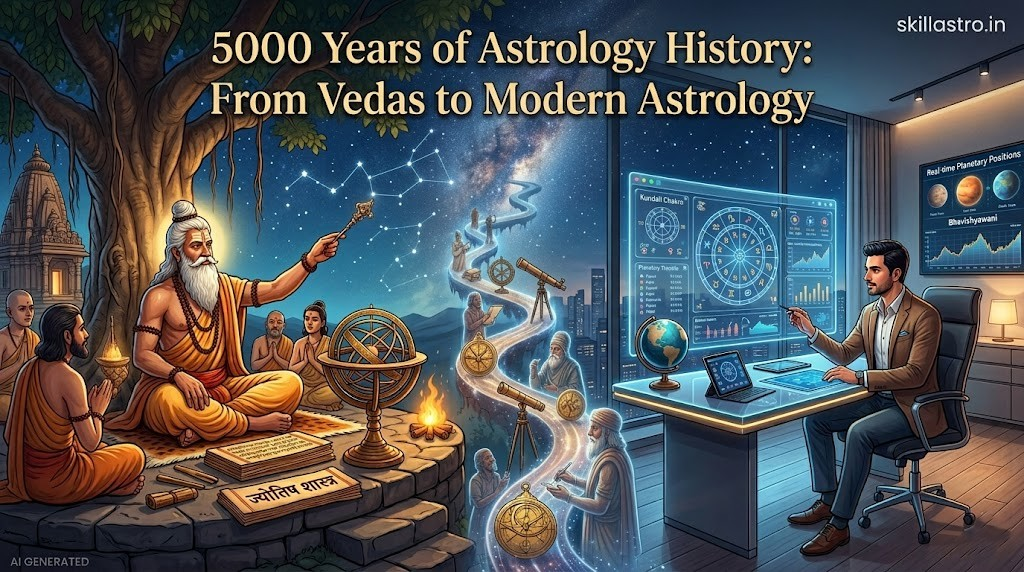
Astrology is not merely a method of fortune-telling; it is an incredibly ancient science dedicated to calculating time, observing the movements of celestial bodies, and understanding their profound impact on human life. In India, the history of astrology is considered to be over 5,000 years old. While other civilizations around the world were still in their developmental stages, the great sages of India had already unraveled the deepest mysteries of the sky. This incredible journey, which began with the sacred hymns of the Vedas, has now seamlessly integrated with modern software and Artificial Intelligence (AI).
In this special article, we will analyze this golden journey of astrology that has guided human civilization for millennia.
The Vedic Period: The Emergence of Astrology and the Eye of the Vedas
In the Indian tradition, astrology is referred to as a 'Vedanga'. This translates to the 'limb of the Vedas' that imparts the knowledge of time. The Rigveda, which is the oldest text in the world, contains detailed descriptions of planets, constellations (Nakshatras), and eclipses.
The Science of Yagya and Time Calculation In ancient times, sages required highly precise timings (Shubh Muhurat) to perform Yagyas (fire rituals). Over 5,000 years ago, they developed a sophisticated calendar based on the dynamic movements of the Sun and the Moon. The primary objective of astrology during that era was to measure time accurately so that religious rituals could be completed under the correct Nakshatras.
Vedanga Jyotisha and Sage Lagadha Authored by Maharishi Lagadha, the 'Vedanga Jyotisha' is considered the most critical text of this era. It laid down the foundational rules for calculating the solar year, the lunar month, and the five-year Yuga cycle. This text conclusively proves the profound depth of mathematical and astronomical knowledge possessed by ancient Indians.
Talk to India's Best Astrologer at ₹1/min Only
Expert guidance for Career, Love & Marriage. Get accurate predictions instantly from verified Vedic Astrologers.
Chat Now »
Talk to India's Best Astrologer at ₹1/min Only
Expert guidance for Career, Love & Marriage. Get accurate predictions instantly from verified Vedic Astrologers.
Chat Now »
The Marvelous Evolution of the Constellations (Nakshatras) and the Zodiac
In the history of astrology, the knowledge of the Nakshatras is the most ancient. It was India that introduced the concept of the 27 Nakshatras to the world, a system entirely based on the Moon's daily orbital motion around the Earth.
The Ancient System of 27 Nakshatras The discovery and mapping of the Nakshatras from Ashwini to Revati was the crowning achievement of the Vedic period. The sages divided the sky into 27 distinct segments, linking each part to a specific ruling deity and cosmic energy. This intricate division remains the core foundation of predictive astrology today.
The Emergence and Integration of Zodiac Signs As time progressed, the 12 Zodiac signs (from Aries to Pisces) were developed alongside the Nakshatras. Ancient Indian astronomers observed that the Sun passes through different segments of the sky over the course of 12 months. These 12 segments were classified as the Rashis (Zodiac signs), which initiated the complex process of casting birth charts (Kundlis).
The Zenith from the Puranic Period to the Classical Era
During the eras of the Ramayana and the Mahabharata, astrology had reached its full maturity. The detailed descriptions of the birth charts of Lord Rama and Shri Krishna indicate that the calculation of planetary degrees and positions was extremely precise even in that ancient epoch.
The Revolutionary Era of Maharishi Parashara Around 5,000 years ago, Maharishi Parashara composed the monumental 'Brihat Parashara Hora Shastra'. He propounded groundbreaking principles such as the 'Vimshottari Dasha' (planetary periods) and 'Shodashvarga' (16 divisional charts). The principles laid down by Sage Parashara are still considered paramount by modern astrologers globally.
Bhrigu Samhita and the Account of the Future Maharishi Bhrigu compiled millions of birth charts to create the legendary 'Bhrigu Samhita'. This massive text serves as an astonishing testament to the vast repository of statistical data and future predictions that was available in ancient India.
The Golden Age: The Confluence of Astronomy and Mathematics
The period stretching from BCE into the medieval era is widely regarded as the golden age of Indian astrology. During this time, brilliant mathematicians firmly established astrology as a pure, calculating science.
The Contributions of Aryabhata and Varahamihira In his groundbreaking book 'Aryabhatiya', Aryabhata explained the actual scientific and astronomical causes behind solar and lunar eclipses. Simultaneously, Varahamihira, through his masterwork 'Brihat Samhita', explained that the influence of planets is not limited to humans alone, but also profoundly impacts weather patterns, earthquakes, and the destinies of entire nations.
Bhaskaracharya and Siddhanta Shiromani Bhaskaracharya precisely calculated planetary gravity and the exact distances of their orbits. By seamlessly connecting mathematical astronomy (Ganita) with predictive astrology (Phalita), he transformed it into a complete and flawless scripture.
Modern Astrology: The Meeting of Technology and Ancient Wisdom
Today, we are living in a brand new era of astrology. The complex calculations that were done by hand 5,000 years ago are now completed in fractions of a second using advanced computers.
Software and Accurate Calculations In the modern era, the importance of 'Drik-Paksha' (Actual Observation) has significantly increased. By blending NASA's astronomical data with ancient Vedic principles, modern birth charts are more accurate than ever before. Today's astrology is heavily supported by 'data mining' and 'pattern recognition'.
Global Acceptance and Research Vedic astrology is no longer confined to the borders of India. Extensive research on 'Vedic Astrology' is currently being conducted in prominent universities across America and Europe. Psychologists and scientists are now seriously analyzing the deep relationship between planetary cosmic rays and human behavior.
Remedies to Overcome the Negative Effects of Planets
The ancient sages did not just predict problems; they also developed an entire 'Science of Healing' (Upchar Vigyan) to provide tangible solutions.
Mantra Therapy and the Science of Sound Every planet emits a specific frequency or vibration. The sages discovered special 'Bija' (seed) mantras that can alter and harmonize those vibrations in our favor. Chanting these mantras purifies and strengthens our Aura.
The Science of Gemstones and Metals For over 5,000 years, gemstones have been utilized to compensate for the deficiency of specific planetary rays in the human body. Gems like Yellow Sapphire, Blue Sapphire, and Coral act as cosmic filters, channeling the exact required rays into the body.
The Secret of Charity (Daan) and Yagya Performing charity helps in depleting our accumulated negative karmas. Donating specific items according to planetary alignments is actually a profound way of healing and improving our relationship with cosmic energy.
Frequently Asked Questions (FAQs)
Q1: Is astrology still relevant after 5,000 years?
Ans: Yes, absolutely. The movements of the planets and the laws of nature are immutable. Even today, the Sun transits through the exact same Nakshatras just as it did 5,000 years ago.
Q2: Does modern science believe in astrology?
Ans: Modern science acknowledges the physical effects of celestial bodies (such as gravity and magnetic waves). Astrology simply takes it a step further by studying the subtle, psychological, and karmic aspects of these very effects.
Q3: Which is the most accurate system of astrology?
Ans: While there are numerous systems, the 'Parashari System' given by Maharishi Parashara is globally recognized as the most reliable, detailed, and accurate system even today.
Conclusion
The 5,000-year-old history of astrology is truly the story of humanity's unquenchable thirst to understand its own origin and ultimate destiny. This profound knowledge, which originated from the sacred hymns of the Vedas, has become even sharper and more accessible today when combined with modern technology. The heritage bestowed upon us by the sages of ancient India is not blind superstition, but rather the mirror of time in which we can clearly see our tomorrow. This science was the ultimate truth 5,000 years ago, and it continues to brilliantly illuminate our lives today.