
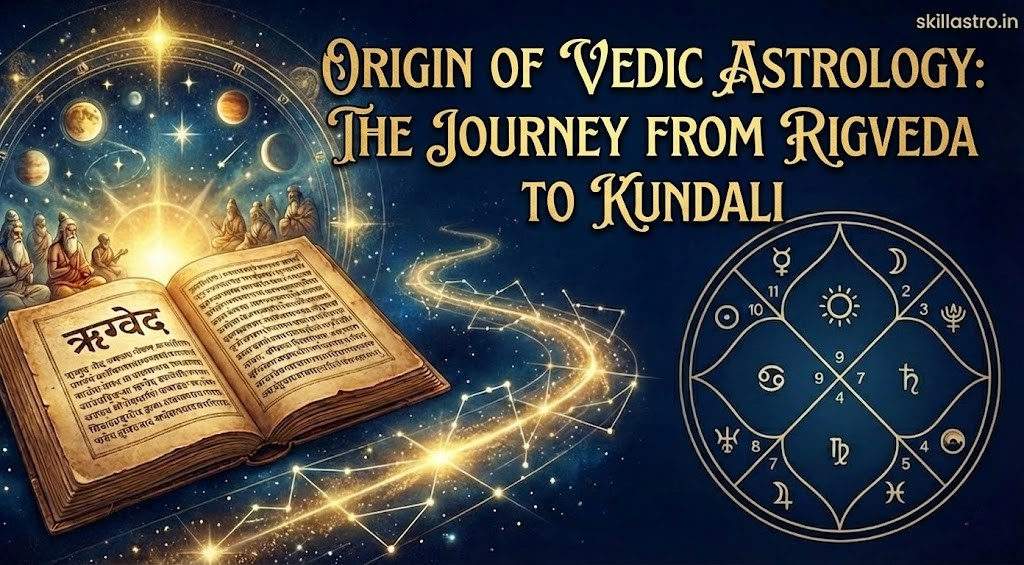
In the Indian tradition of knowledge, where philosophy and science meet in a unique confluence, 'Vedic Astrology' shines like a pole star. Have you ever wondered how the foundation of the 'Birth Chart' (Kundali)—which is used today to assess the future—was laid thousands of years ago?
This journey is not just about stargazing; it is about understanding the Rhythm of the Universe. Vedic Astrology, known as 'Jyotish Shastra' or 'Vedanga', is one of the oldest intellectual endeavors of human civilization. In this detailed article, we will dive into the womb of time to understand how this science, starting from the mantras of the Rigveda, has become an integral part of our lives today.
Part 1: The Essence of 'Jyotish' and the Vedic Foundation
To understand astrology, it is essential to understand the literal meaning of the word. 'Jyotish' is composed of two words—'Jyoti' (Light) and 'Isha' (Lord or God). It translates to—"The study of the light of celestial bodies." For ancient sages, this was the light that guided them through the darkness.
The Eye of the Vedas (Vedanga)
Ancient Indian seers preserved knowledge in the form of 'Vedas'. To understand the Vedas properly, six limbs (Vedangas) were created: Shiksha (Phonetics), Kalpa (Ritual), Vyakaran (Grammar), Nirukta (Etymology), Chhanda (Meter), and Jyotish (Astrology/Astronomy).
Among these, Jyotish is called "Vedasya Chakshu" (The Eye of the Vedas). Just as a human cannot see the path without eyes, knowledge of Time (Kaal) is impossible without Jyotish.
The Seeds of Astrology in the Rigveda
The roots of Vedic Astrology are found in the Rigveda, considered the oldest text in the world. While the Rigveda (approx. 1500-2000 BC or older) does not explicitly mention 'horoscopes', it contains precise descriptions of astronomical events.
Mentions of the movements of the Sun, Moon, and Nakshatras (constellations) are found in the Rigveda.
The sages observed that the Sun's northward (Uttarayana) and southward (Dakshinayana) movements change the seasons on Earth.
The calculation of a Samvatsara (Year) consisting of 360 days and 12 months is mentioned in the Vedas.
Initially, the main purpose of astrology was to determine the correct time for 'Yagya' (Sacrificial Rituals). Vedic society was entirely dependent on nature and deities, and they believed that if a Yagya was not performed at the correct Muhurta (auspicious time), it would not yield results.
Talk to India's Best Astrologer at ₹1/min Only
Expert guidance for Career, Love & Marriage. Get accurate predictions instantly from verified Vedic Astrologers.
Chat Now »
Talk to India's Best Astrologer at ₹1/min Only
Expert guidance for Career, Love & Marriage. Get accurate predictions instantly from verified Vedic Astrologers.
Chat Now »
Part 2: Vedanga Jyotish – The First Systematic Text
As time passed, the need to organize astronomical calculations was felt. This necessity gave birth to 'Vedanga Jyotish'. It was composed by Lagadha Muni around 1400 BC. This is the oldest available independent text on astrology.
The Rise of Mathematical Astrology
Vedanga Jyotish was primarily 'Ganita Jyotish' (Astronomy). It had less emphasis on prediction (Falita) and more on Timekeeping. Lagadha Muni explained:
"Veda hi yagyarthamabhipravritta, Kalanupurvya vihitashcha yagyah. Tasmadidam kalavidhanashastram, Yo jyotisham veda sa veda yagyam."
Meaning: The Vedas are revealed for the purpose of Yagyas, and Yagyas are dependent on time. Therefore, he who knows the science of time (Jyotish) knows the secret of the Yagya.
During this era, a period of 5 years was considered a 'Yuga', in which the movement of the Moon was measured based on 27 Nakshatras. This was a time when "What is the time?" was more important than "What will happen in the future?"
Part 3: Nakshatras – The Soul of Indian Astrology
While Western astrology focuses on the 'Sun' (Sun Sign), the foundation of Vedic astrology is the 'Moon' and the 'Nakshatras'. In this journey from Rigveda to Kundali, the contribution of Nakshatras is the most significant.
The Science of 27 Nakshatras
Ancient sages considered the sky as a circle of 360 degrees. They observed that the Moon takes approximately 27.3 days to revolve around the Earth. Therefore, they divided the sky into 27 equal parts, which were called Nakshatras (Lunar Mansions).
Each Nakshatra was assigned a specific deity, a specific energy, and a specific nature. For example:
Ashwini Nakshatra: Symbol of beginnings and healing.
Bharani Nakshatra: The star of Yama, symbolizing restraint and death.
This system was so subtle that it allowed for the understanding of a person's Mental Makeup, because the Moon is the significator of the 'Mind' (Chandrama Manaso Jatah - Rigveda).
Part 4: The Siddhanta Era and the Rise of Rashis
After the Mahabharata period and in the early centuries of the Common Era, a revolutionary change occurred in Indian astrology. This is called the 'Siddhanta Era'. It was during this time that the 12 Rashis (Aries to Pisces) were clearly incorporated into Indian astrology.
Although the knowledge of Zodiac signs was refined through contact with Babylonian and Greek civilizations, Indian sages gave it a unique form by linking it with the 'Law of Karma'.
Contribution of Great Acharyas
Aryabhata (476 AD): He calculated the rotation of the Earth, the scientific causes of eclipses, and the precise positions of planets. Without him, creating a Kundali would have been impossible.
Varahamihira (505 AD): The great scholar of Ujjain wrote the 'Brihat Samhita'. He divided astrology into three Skandhas (branches):
Tantra: Mathematics/Astronomy
Hora: Birth Chart/Predictive Astrology
Samhita: Mundane Astrology/Omens
Maharishi Parashara: He is considered the father of modern 'Hora Shastra'. His text, 'Brihat Parashara Hora Shastra', is still like the Gita for Vedic astrologers. In it, he explained how planetary aspects, the Dasha system, and Yogas affect human life.
Part 5: Construction of the Kundali – A Map of the Sky
The hymns of the Rigveda and the calculations of the Vedanga eventually took the form of the 'Janma Kundali' (Horoscope). A Kundali is nothing but a 'screenshot' of the exact moment you were born.
How Does a Kundali Work?
Vedic astrology believes in "Yat Pinde Tat Brahmande" (Whatever is in the body, is in the Universe).
Lagna (Ascendant): The Zodiac sign rising on the eastern horizon at the time of birth becomes the person's 'Lagna'. This represents the person's body and personality.
Grahas (Planets): In Vedic astrology, planets are not just physical bodies. They are called 'Graha', which means 'to grasp' or 'to seize'. These are energy centers that "seize" us according to our karma.
Bhavas (Houses): The 12 houses of the Kundali represent 12 areas of life (Wealth, Family, Disease, Marriage, Death, Career, Gains, etc.).
The Theory of Karma and Reincarnation
The biggest philosophical turn in the journey from Rigveda to Kundali was the integration of the Karma Theory. Vedic astrology is not Fatalistic; it is Karmic.
The Kundali is a map of your 'Prarabdha' (that portion of accumulated karma which is ready to bear fruit in this life). It tells what circumstances the soul has chosen to pay off its past debts.
Part 6: Vedic Astrology vs. Western Astrology
In this journey, it is essential to understand how Vedic astrology diverged from Western astrology.
Nirayana (Sidereal) vs. Sayana (Tropical): Western astrology is based on the 'Tropical' system, which depends on the Sun and seasons. Vedic astrology is based on the 'Sidereal' system, which relies on Fixed Stars.
Ayanamsa: The Earth tilts and wobbles slightly on its axis (Precession of Equinoxes). Vedic astrology includes this tilt (Ayanamsa) in its calculations, whereas Western astrology ignores it. This is why Vedic astrology is considered Astronomically Accurate.
Dasha System: A unique feature of Vedic astrology is the 'Vimshottari Dasha'. This is a timetable that indicates which planet will exert its influence during which year of life. This does not exist in Western astrology.
Part 7: Vedic Astrology in the Modern Era
Today, in the 21st century, when science is at its peak, the relevance of Vedic astrology has increased. In the time of the Rigveda, it was for 'Collective Welfare' (Yagya); today, it is a tool for 'Personal Guidance'.
Psychology and Astrology are converging. Today, the Kundali is used not just for marriage matching, but for career counseling, health analysis, and finding remedies for mental peace. While NASA explores the physical state of planets, Vedic astrology explores the influence of those planets on human consciousness.
Frequently Asked Questions (FAQs)
1. How old is Vedic Astrology?
The roots of Vedic astrology are in the Vedas, which are considered to be at least 5000 years old. In written form, Vedanga Jyotish (1400 BC) is its oldest evidence.
2. Are the 12 Zodiac signs mentioned in the Rigveda?
Not explicitly. The Rigveda mainly mentions Nakshatras and solar/lunar months. The clear division and naming of the 12 Zodiac signs developed later in the Vedanga and Siddhanta eras.
3. Which is more accurate: Vedic Astrology or Western Astrology?
Vedic astrology is considered more astronomically accurate because it takes into account the 'Ayanamsa' (Earth's tilt) and is based on fixed stars. It uses the Dasha system for the Timing of events, which is extremely precise.
4. What is the importance of 'Lagna' in a Kundali?
The Lagna (Ascendant) is the most important point in the Kundali. It is the sign that was on the eastern horizon at the time of your birth. It determines your body, personality, nature, and outlook on life.
Conclusion
The origin and journey of Vedic Astrology is a magnificent saga of human curiosity. Starting from the sanctity of Rigvedic mantras, passing through the calculations of Lagadha Muni, the astronomy of Aryabhata, and the foresight of Maharishi Parashara, it has reached the computer-generated horoscopes of today.
This journey teaches us that we are not separate from the universe. We are made of stardust and connected to this vast existence by an invisible thread. The Kundali is not just a tool to know the future, but a mirror for 'Self-Realization'. That ancient wisdom of the Rigveda reminds us even today that if we respect Time (Kaal), we can make our lives meaningful.