 Join WhatsApp Channel
Meaning of Vedic Birth Chart: Navagraha, Twelve Houses, and Zodiac Signs
Hello astrology lovers! Vedic astrology is an extremely ancient and profound science that unveils the deep connection between human life and the universe. To truly understand anyone's future, core nature, and life events, the 'Birth Chart' (Janam Patrika or Janmang Chakra) is studied.
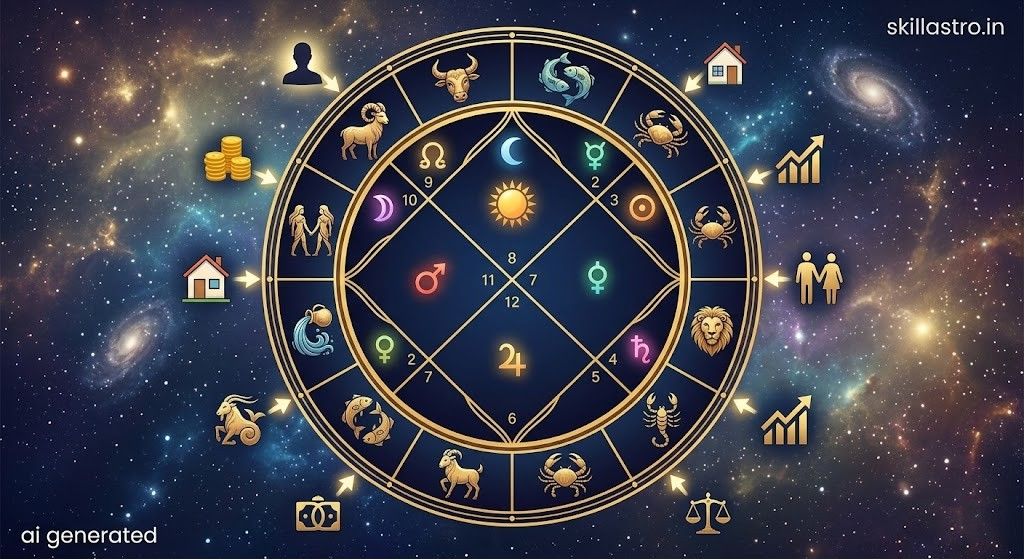
A birth chart primarily rests on three vital pillars— the Nine Planets (Navagraha), the Twelve Houses (Bhavas), and the Twelve Zodiac Signs (Rashis). If you can understand the meaning of these three and their mutual relationship, the deep secrets of astrology will open up before you like an open book. Let's understand these three components in detail.
1. Navagraha (The Directors of Life)
Vedic astrology recognizes nine planets. These planets represent the various energies and tendencies of our lives. Just as a play has different characters, these planets are the main characters in the grand play of our lives:
Sun (Surya): The significator of the soul, father, self-confidence, respect, leadership ability, and royal authority.
Moon (Chandra): The significator of the mind, mother, emotions, imagination, and mental peace.
Mars (Mangal): The significator of valor, courage, physical energy, anger, younger brothers, and land/property.
Mercury (Budh): The significator of intellect, speech, logical reasoning, business, and communication.
Jupiter (Guru): The significator of wisdom, religion, luck, children, expansion, and spiritual progress.
Venus (Shukra): The significator of love, beauty, worldly comforts, arts, and marital bliss.
Saturn (Shani): The significator of karma, justice, strict discipline, longevity, sorrow, detachment, and hard work.
Rahu: A shadow planet that represents materialistic desires, illusions, hidden secrets, and sudden events.
Ketu: Another shadow planet that signifies salvation (Moksha), detachment, deep research, and spiritual depth.
Skill Astro - Fixed Centering Banner Talk to India's Best Astrologer at ₹1/min Only
Expert guidance for Career, Love & Marriage. Get accurate predictions instantly from verified Vedic Astrologers.
Chat Now »
Skill Astro - Fixed Centering Banner Talk to India's Best Astrologer at ₹1/min Only
Expert guidance for Career, Love & Marriage. Get accurate predictions instantly from verified Vedic Astrologers.
Chat Now »
2. Twelve Houses (Different Areas of Life)
There are a total of twelve boxes in a birth chart, known as 'Houses' (Bhavas). These twelve houses represent twelve different areas of our lives where the Navagrahas display their effects. These houses always remain fixed in their positions:
1st House (Lagna): The person's physical body, complexion, core nature, and overall personality.
2nd House: Accumulated wealth, speech, and family happiness.
3rd House: Valor, younger siblings, and the capacity to struggle.
4th House: Mother, land, building, vehicles, and mental peace.
5th House: Education, intellect, love affairs, and children.
6th House: Diseases, debts, enemies, and competition.
7th House: Marriage, life partner, and business partnerships.
8th House: Longevity, nature of death, hidden wealth, and sudden obstacles.
9th House: Luck, religion, spirituality, and long journeys.
10th House: Karma, livelihood, father, authority, and social prestige.
11th House: Gains, sources of income, fulfillment of desires, and elder siblings.
12th House: Expenses, losses, salvation, charity, and foreign travel.
3. Twelve Zodiac Signs (Nature and Way of Working)
The celestial sphere is divided into 360 degrees, which is further divided into twelve equal parts of 30 degrees each, called Zodiac Signs (Rashis). These signs start from Aries and go all the way to Pisces (Aries, Taurus, Gemini, Cancer, Leo, Virgo, Libra, Scorpio, Sagittarius, Capricorn, Aquarius, Pisces).
Zodiac signs determine the 'nature' or manner in which a planet will deliver its results. Let's understand this with an example: If Mars (the planet of courage) is sitting in the 10th House (the area of karma/career), the person will be highly courageous in their work. But if that Mars is seated in the 'Cancer' sign (which is a watery and gentle sign), their courage will be a bit calm and defensive. However, if that same Mars is in the 'Aries' sign (which is a fiery and aggressive sign), the person will be extremely aggressive and fearless in their work.
The Wonderful Confluence of the Three
The accurate prediction of a birth chart depends entirely on the blending of these three (Planet, House, and Sign).
The House tells you in which 'area' of life the event will occur.
The Zodiac Sign tells you the 'manner or nature' in which the event will occur.
The Planet is the 'force or power' that executes that event.
Frequently Asked Questions (FAQs)
Q1. Which is the most powerful planet in a birth chart?
The most important planet in a birth chart is the 'Lagnesh' or Ascendant Lord (the ruling planet of the sign placed in the 1st House). If the Ascendant Lord is strong, the person can overcome even the biggest difficulties in life.
Q2. Do Rahu and Ketu always give inauspicious results?
No, this is a very big misconception. If Rahu and Ketu are in a favorable position in the chart (such as the 3rd, 6th, or 11th house), they can grant a person immense success, high positions in politics, and sudden, massive financial gains.
Q3. What is the meaning of an exalted and debilitated planet?
When a planet is in its most favorite and comfortable zodiac sign, it is called 'Exalted' (Uchcha) and yields highly auspicious results. Conversely, when it is in its least favorite sign, it is called 'Debilitated' (Neech), and its positive effects are significantly reduced.
Conclusion
The Vedic birth chart is an incredibly intricate and mathematical web of the Navagrahas, the twelve houses, and the twelve zodiac signs. By deeply understanding these three core elements, any person can accurately analyze their life's purpose, strengths, and weaknesses. This knowledge is a divine path that leads a human being from darkness to brilliant light.