The sky is the same, the planets are the same, and the stars are the same. Then why is it that the same person can be a 'Capricorn' in Indian (Vedic) Astrology, while in Western Astrology, they are considered an 'Aquarius'?
This question confuses almost everyone interested in astrology. are both correct? Or is one of them wrong?
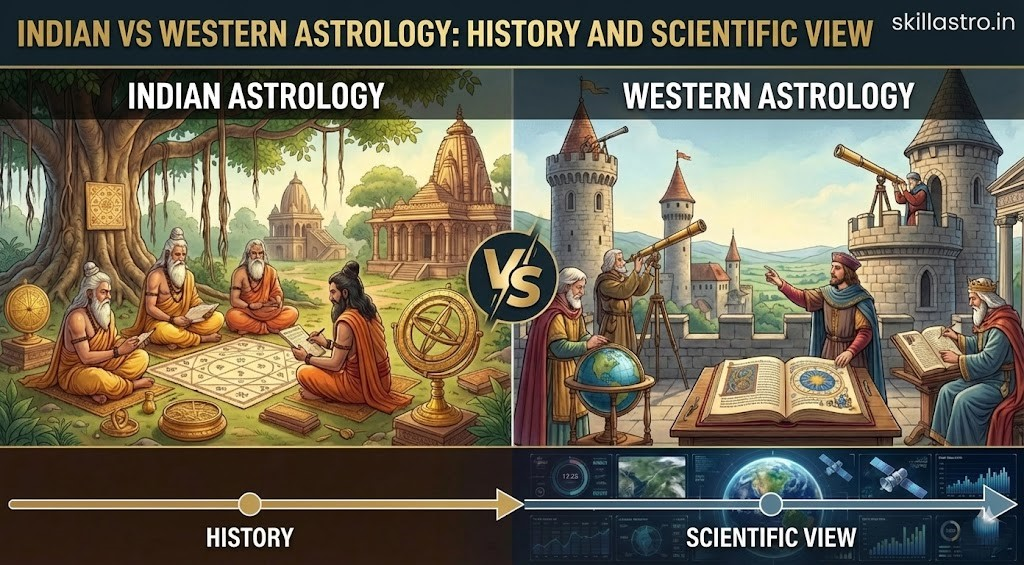
In reality, this difference is one of 'Perspective' and 'Mathematics'. While Indian Astrology (Vedic Astrology) is based on "Fixed Stars", Western Astrology focuses on the "Sun and Seasons". History bears witness that both systems developed in different civilizations for different purposes.
In today's detailed article, we will unravel this historical knot of Indian vs. Western Astrology and discover which system is more accurate and scientific.
Part 1: Origins and Historical Background
Both systems have roots in ancient civilizations, but they developed in different directions.
1. Indian (Vedic) Astrology: The Eye of the Vedas
Indian Astrology, known as 'Vedic Astrology' or 'Jyotish Vidya', is arguably the world's oldest continuously practiced system.
Origin: Its roots are in the Vedas (especially the Rigveda), believed to be 5000-7000 years old.
Purpose: Its original purpose was to determine the correct time (Muhurta) for 'Yagyas' (rituals) and ceremonies. The sages observed the Nakshatras with their divine vision and threaded them into mathematical formulas. It is based on the philosophy of the 'Law of Karma' and 'Reincarnation'.
2. Western Astrology: From Babylon to Greece
Western Astrology originated in ancient Mesopotamia (Babylon) and was later developed by Greek scholars.
Origin: In the 2nd century, Claudius Ptolemy wrote the text 'Tetrabiblos', which codified the laws of Western Astrology.
Purpose: Its initial purpose was to predict the fate of kings and the weather. Modern Western astrology focuses more on 'Psychological Profiling'.
Skill Astro - Fixed Centering Banner Talk to India's Best Astrologer at ₹1/min Only
Expert guidance for Career, Love & Marriage. Get accurate predictions instantly from verified Vedic Astrologers.
Chat Now »
Skill Astro - Fixed Centering Banner Talk to India's Best Astrologer at ₹1/min Only
Expert guidance for Career, Love & Marriage. Get accurate predictions instantly from verified Vedic Astrologers.
Chat Now »
Part 2: The Biggest Difference – Sidereal vs. Tropical (Sayana vs. Nirayana)
This is the point where the two paths diverge. Understanding this is crucial.
1. Western Astrology: Tropical Zodiac (Sayana)
Western Astrology uses the 'Sayana' system. It is based on the position of the Sun relative to the Earth's seasons.
They believe that every year on March 21st (Vernal Equinox), the Sun enters the sign of Aries. Whether the stars of the Aries constellation are actually present in the sky at that time or not, they will consider it 'Aries'.
This is a 'Moving Zodiac' that changes with the Earth's tilt.
2. Indian Astrology: Sidereal Zodiac (Nirayana)
Indian Astrology uses the 'Nirayana' system. It is based on the actual Fixed Stars visible in the sky against the backdrop of the planets.
Indian sages knew that the Earth wobbles on its axis like a spinning top (Precession of Equinoxes). Due to this wobble, the position of the Sun shifts backward by 1 degree every 72 years.
Indian Astrology includes this shift in its calculations. This is called 'Ayanamsa'.
The Result: Currently, there is a difference of approximately 24 degrees between the Tropical and Sidereal systems. This is why the sign you have in Western Astrology is often the sign preceding it in Indian Astrology.
Part 3: Sun Sign vs. Moon Sign
The Center of Focus for both systems is different.
| Feature | Western Astrology | Indian (Vedic) Astrology |
| Basis | Sun Sign | Moon Sign |
| Philosophy | The Sun is the significator of the 'Soul' and 'Ego'. It tells "how you appear to the world." | The Moon is the significator of the 'Mind' and 'Emotions'. Indian sages believed that life is experienced through the mind. |
| Prediction | It better describes your Personality and character traits. | It better describes the Events of your life and your mental state. |
Conclusion: If you want to know "how you are from the inside," look at Indian Astrology. If you want to know "how you project yourself externally," look at Western Astrology.
Part 4: Nakshatras – The Microscope of Indian Astrology
In Western Astrology, the sky is divided only into 12 parts (Zodiac signs). However, Indian Astrology has divided it much more deeply.
Nakshatra Mandala: Indian Astrology divides the sky into 27 parts, known as 'Nakshatras' (Lunar Mansions).
Precision: Within one Zodiac sign (30 degrees), there are two and a quarter (2.25) Nakshatras.
Significance: This system is so precise that the destiny of two people born in the same sign (e.g., Aries) can be completely different because their Nakshatras (Ashwini or Bharani) might be different. Western Astrology lacks this level of Granularity.
Part 5: Timing – Dasha System vs. Transits
How do both systems determine time for predictions?
1. Indian: Vimshottari Dasha
This is the greatest strength of Indian Astrology. It is a specific Timeline based on the Nakshatra at birth.
It tells which planet will be Active during which year of your life.
For example, if you are running the 'Mahadasha of Venus', then for 20 years, Venus (Love, Wealth, Luxury) will influence your life, regardless of where Venus is in the sky at that moment.
2. Western: Transits & Progressions
Western Astrology relies mainly on 'Transits'—i.e., where the planets are in the sky right now.
They also use 'Progressions', which is a symbolic method (day-for-a-year).
Drawback: It is difficult to derive exact timing (Timing of Events) using only transits. The Dasha system is unmatched in timing events.
Part 6: Planets and Aspects
1. Inclusion of Modern Planets
Western: Modern Western Astrology has included Uranus, Neptune, and Pluto in its system. They consider these important for deep psychological dimensions and generational changes.
Indian: Traditional Vedic Astrology uses only those planets visible to the naked eye (up to Saturn). However, the importance of Rahu and Ketu (Shadow Planets) in Indian Astrology is far greater than in Western Astrology (where they are called Nodes). Rahu-Ketu are indicators of karmic bonds.
2. Aspects (Drishti)
Western: Here, planets form aspects at specific angles (e.g., 90 degrees - Square, 120 degrees - Trine, 180 degrees - Opposition).
Indian: Here, every planet aspects the 7th house from itself, but Mars (4, 8), Jupiter (5, 9), and Saturn (3, 10) have Special Aspects. This makes the analysis more complex and detailed.
Part 7: Karma vs. Psychology
The philosophical basis of both systems is entirely different.
Indian Astrology: Karma and Destiny
Indian Astrology believes that your birth is the result of your 'Accumulated Karma'. The horoscope is a map of your 'Prarabdha' (Destiny).
It also suggests Remedies for problems—such as gemstones, mantras, charity, and worship. It is Corrective.
Western Astrology: Growth and Free Will
Modern Western Astrology places less emphasis on 'Fate' and more on 'Free Will'.
It does not view problems as 'Karma', but as 'Psychological Challenges'.
It is excellent for counseling. It tells you "what your potential is," not necessarily "what will happen to you."
Comparison Table
| Feature | Indian Astrology (Vedic) | Western Astrology |
| Zodiac | Nirayana (Sidereal) - Fixed Stars | Sayana (Tropical) - Season Based |
| Focal Point | Moon (Mind) | Sun (Personality) |
| Sub-division | 27 Nakshatras | Only 12 Signs |
| Prediction Method | Dasha System | Transits |
| Calculation Difference | Ayanamsa (Approx. 24 degrees back) | No Ayanamsa |
| Approach | Karmic and Spiritual | Psychological and Evolutionary |
| Remedies | Mantras, Gems, Worship | Counseling, Crystals (Less common) |
Frequently Asked Questions (FAQs)
1. Why is my Zodiac sign different in Western and Indian Astrology?
This is due to the 'Ayanamsa'. Due to the Earth's tilt, there is a difference of about 24 degrees between Western and Indian calculations. If you are a 'Pisces' born on March 15th in Western Astrology, the Sun might be 24 degrees behind in 'Aquarius' in Indian Astrology.
2. Which system is more accurate?
For predictions and Timing of Events, Indian Astrology is considered more accurate because it uses the 'Dasha System' and 'Nakshatras'. Western Astrology is good for psychological analysis.
3. Can we use both together?
Yes, many modern astrologers use 'KP Astrology' or mixed methods. However, the rules for both are different, so mixing them blindly can create confusion. It is better to view them independently.
4. Does Western Astrology have Rahu and Ketu?
In Western Astrology, they are called the 'North Node' and 'South Node'. They have significance there, but not as much as in Indian Astrology, where they are treated as actual planets.
5. Is the Sun not important in Indian Astrology?
It is important. The Sun is the significator of the 'Soul'. But Indian sages believed that our experience on Earth is controlled by our 'Mind' (Moon), so the birth sign is based on the Moon, not the Sun.
Conclusion
Both Indian and Western Astrology are attempts to understand the infinite universe of which we are a small part.
Indian Astrology is like a Microscope. If you need to know when a marriage will happen, when a disease will be cured, or what the purpose of life is, its mathematical precision and Dasha system have no match. It is best for 'Events'.
Western Astrology is like a Telescope. If you need to understand your behavior, your hidden talents, and your psychological makeup, it is wonderful. It is excellent for 'Personality Development'.
Final Verdict: From a historical and astronomical perspective, Indian Astrology is more 'Factual' because it bases itself on the Real Stars in the sky. Western Astrology is 'Symbolic', representing the journey of the Sun and the cycle of seasons.
Both have their own importance, but if you are looking for Accuracy in prediction, the scale definitely tips in favor of Vedic Astrology.