 Join WhatsApp Channel
How Was Astrology Discovered? Unveiling Cosmic Secrets and Ancient Truths
In the history of human civilization, 'Jyotish Shastra' (Astrology) has been the most ancient and awe-inspiring science. In the modern era, curiosity often arises: how was astrology actually discovered? Thousands of years ago, when there were no telescopes or computers, how did our ancestors know that planets sitting millions of miles away were influencing our lives? Astrology is not merely a tool for fortune-telling; rather, it is a profound synthesis of time, light, and the complex mathematics of celestial bodies.
In this special article, we will discuss the real facts and ancient history behind the origin of astrology, which will acquaint you with the ultimate truth of this great scripture.
Minute Observation of the Sky: The First Discovery of Astrology
The very first step in the discovery of astrology was 'Observation'. In ancient times, when early humans lived under the open sky, they noticed that everything in nature occurred in a specific, repetitive cycle.
The Rhythm of the Sun and the Moon The ancient sages first understood the motion of the Sun and the Moon. They observed that the rising and setting of the Sun caused day and night, and the changing phases of the Moon brought tides in the ocean and affected the menstrual cycle of women. This observation marked the beginning of the 'discovery'—if two celestial bodies could have such a massive physical impact on Earth, other planets must certainly have a profound effect as well.
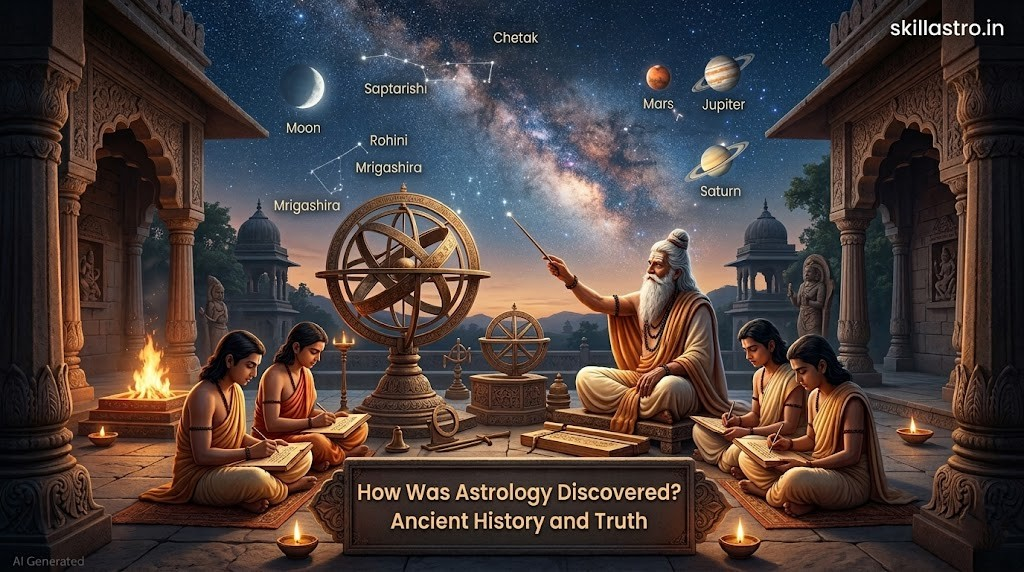
The Divine Vision and Meditation of the Sages According to the Indian tradition, the discovery of astrology was not made merely by seeing with the physical eyes, but in the heightened state of 'Samadhi' (deep meditation). Through meditation, the Saptarishis (Seven Great Sages) felt the cosmic vibrations of the universe and meticulously wove them into mathematical formulas.
Talk to India's Best Astrologer at ₹1/min Only
Expert guidance for Career, Love & Marriage. Get accurate predictions instantly from verified Vedic Astrologers.
Chat Now »
Talk to India's Best Astrologer at ₹1/min Only
Expert guidance for Career, Love & Marriage. Get accurate predictions instantly from verified Vedic Astrologers.
Chat Now »
Origin from the Vedas: The Authentic History of Astrology
The roots of Jyotish Shastra are found in the 'Vedas', the oldest texts in the world. The history of astrology begins concurrently with the dating of the Vedic period.
Vedanga Jyotisha: The Oldest Scripture Astrology is called a 'Vedanga', meaning the eye of the Vedas. More than 5,000 years ago, Sage Lagadha composed the 'Vedanga Jyotisha'. For the very first time, this text provided a scientific description of time calculation, the position of constellations, and the cycle of the seasons. It remains the most important document in the history of astrology.
The Eighteen Great Founders History bears witness that astrology is not the discovery of a single person. It was brought to perfection collectively by 18 great sages. These include monumental names like Surya, Pitamaha, Vyasa, Vashistha, Atri, Parashara, Kashyapa, Narada, and Bhrigu. These sages discovered different principles (Siddhantas) that remain infallible to this day.
The Scientific Construction of the Zodiac and Nakshatras
The creation of the 'Zodiac' (Rashi Chakra) was a revolutionary step in the discovery of astrology. Our sages considered the sky as an imaginary 360-degree circle and divided it into 12 distinct parts.
Discovery of the 27 Nakshatras Based on the Moon's daily motion, Indian sages divided the sky into 27 star clusters, which were called 'Nakshatras' (lunar mansions). They found that the Moon stays in one Nakshatra for approximately one day. This discovery of the Nakshatras is ancient India's greatest gift to global astronomy.
Classification of the Twelve Zodiac Signs The orbital path of the Sun was divided into 12 signs of 30 degrees each. The names of these signs were based on the shapes of those specific star clusters (e.g., Aries meaning ram, Leo meaning lion). The sages discovered the truth that when a planet passes through a specific zodiac sign, the impact of its cosmic rays changes entirely.
The Rise of Predictive Astrology: The Impact of Planets on Human Life
Initially, astrology was limited only to the calculation of time and seasons for agricultural and ritualistic purposes. However, Maharishi Parashara later connected it with 'Phalita' (predictive astrology).
The Contribution of Maharishi Parashara About 5,000 years ago, through his monumental text 'Brihat Parashara Hora Shastra', Maharishi Parashara revealed the truth that a human's birth is the direct result of the karmas of their past lives. The position of the planets at the exact time of birth acts like a 'celestial map', which perfectly reflects the nature and destiny of the person.
Bhrigu Samhita: An Ancient Form of Data Science Maharishi Bhrigu studied the lives and charts of millions of people and composed the 'Bhrigu Samhita'. This is considered the greatest discovery in the history of astrology, where future predictions were made using an advanced statistical method.
The Truth of Astrology: Science or Superstition?
In the modern era, there is often a debate about the validity of astrology, but its underlying scientific basis simply cannot be denied.
The Theory of Light and Gravity The fundamental truth of astrology is 'Light'. Every planet reflects the light of the Sun differently. These various filtered cosmic rays have a distinct chemical and biological effect on the bodies, brains, and nervous systems of humans living on Earth.
Modern Science and Astrology Today's science fully acknowledges that the Moon's gravitational pull causes tidal turbulence in the ocean. Taking this scientific principle forward, astrology states that since the human body is also made up of about 70% water, the Moon and other planets undoubtedly affect our brains, hormones, and emotions.
Ancient Methods of Overcoming Astrological Afflictions
The ancient sages did not merely discover cosmic problems; they also developed the highly effective science of their solutions.
Mantras and the Science of Sound During the discovery of astrology, it was found that the sound waves produced by the pronunciation of specific words (Mantras) could cut through and neutralize the negative rays of the planets. This concept is entirely based on the modern understanding of 'Sound Healing'.
Gemology and Metallurgy Gemstones were discovered and utilized because they naturally absorb cosmic rays of a specific color from the planets and safely transmit them into the human body. This is a highly advanced, ancient form of 'Color Therapy'.
The Importance of Charity and Karma The greatest truth of astrology is that it is 'Karma-oriented'. Through acts of charity, kindness, and service, a person can make their internal energy positive, thereby significantly reducing the impact of adverse planetary alignments.
Frequently Asked Questions (FAQs)
Q1: Was astrology discovered only in India?
Ans: Evidence of early astrology is also found in ancient Babylon and Egypt. However, 'Vedic Astrology'—which is deeply based on the Nakshatras and the predictive 'Dasha system'—was invented and perfected exclusively in ancient India.
Q2: How old is Jyotish Shastra?
Ans: According to astronomical, archaeological, and literary evidence, Indian astrology is at least 5,000 to 7,000 years old.
Q3: Is the history of astrology associated with superstition?
Ans: No, its history is deeply connected with pure Mathematics and Astronomy. In ancient times, an astrologer and an astronomer were the exact same person.
Conclusion
The discovery of Jyotish Shastra is the absolute pinnacle of human knowledge, where mankind was able to mathematically and spiritually understand its connection with celestial bodies located millions of miles away from Earth. The scripture that the sages of ancient India created through their deep spiritual practice, mathematics, and microscopic observation continues to challenge and inspire modern science even today. The real history of astrology is a beautiful story of struggle, research, and the ultimate quest for cosmic truth. It teaches us that we are an integral part of this infinite universe, and the strings of our lives are forever tied to celestial energies.