 Join WhatsApp Channel
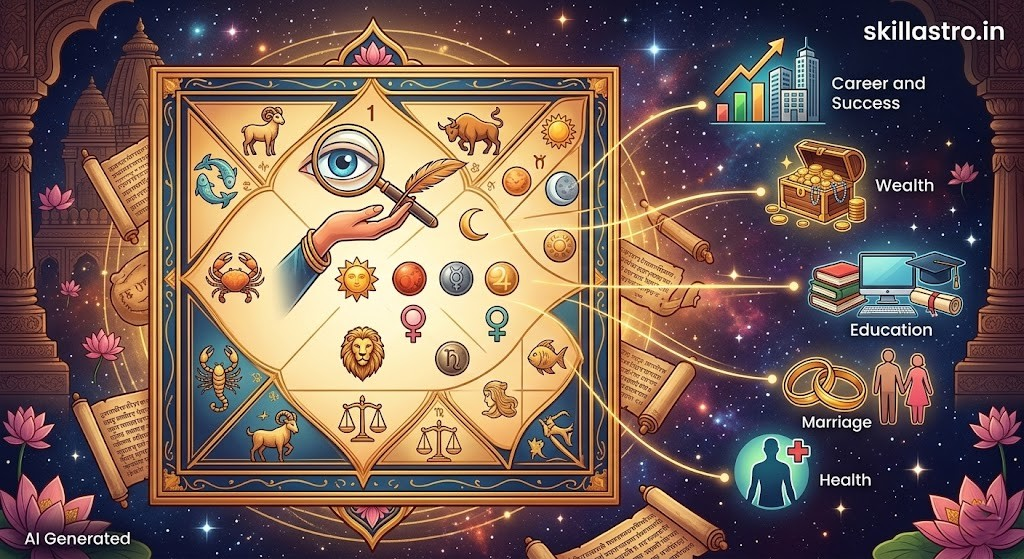
Vedic astrology is an extremely ancient and authentic science that gives us a clear glimpse of our past, present, and future. A birth chart (also known as Janam Patrika) is essentially an astronomical map of the specific time and place when a person took their first step into this world. Sometimes people feel that reading a Kundli is extremely difficult, but if understood in the right sequence and with a scientific approach, this knowledge is very logical.
If you want to know how a birth chart is analyzed in Vedic astrology, today we will tell you in detail about its most important and basic rules.
Main Steps of Kundli Analysis
To read any birth chart and make accurate predictions, it is mandatory to follow certain steps.
1. Study of the Ascendant (Lagna) and Ascendant Lord (Lagnesh)
The reading of a Kundli always begins with the 'Lagna' (First House). The Ascendant represents your physical body, your nature, your personality, and your thinking. Which zodiac sign is placed in the Ascendant and in which house of the Kundli the lord of that sign (Lagnesh) is sitting determines the entire direction of a person's life. If the Ascendant lord is in a strong position (exalted or in its own sign), the person is capable of firmly facing every major challenge in life.
Talk to India's Best Astrologer at ₹1/min Only
Expert guidance for Career, Love & Marriage. Get accurate predictions instantly from verified Vedic Astrologers.
Chat Now »
Talk to India's Best Astrologer at ₹1/min Only
Expert guidance for Career, Love & Marriage. Get accurate predictions instantly from verified Vedic Astrologers.
Chat Now »
2. Understanding the Twelve Houses of the Kundli
There are a total of twelve houses (Bhavas) in a birth chart, and each house represents a specific part of human life:
First House: Body, appearance, and self-confidence.
Second House: Accumulated wealth, speech, and early education.
Third House: Valor, courage, and younger siblings.
Fourth House: Happiness from mother, land, property, and vehicles.
Fifth House: Intellect, children, love affairs, and higher education.
Sixth House: Diseases, debts, enemies, and competition.
Seventh House: Marriage, life partner, and business partnerships.
Eighth House: Longevity, cause of death, sudden obstacles, and occult sciences.
Ninth House: Luck, religion, long journeys, and Guru.
Tenth House: Karma, livelihood (career), respect, and father.
Eleventh House: Income, gains, and elder siblings.
Twelfth House: Expenses, foreign travel, losses, and liberation (Moksha).
3. Analysis of Planetary Positions and Their Aspects (Drishti)
After understanding the twelve houses, one has to see in which houses the nine planets (Sun, Moon, Mars, Mercury, Jupiter, Venus, Saturn, Rahu, and Ketu) are positioned.
Exalted and Debilitated Planets: It is necessary to check which planet is extremely strong by sitting in its exalted sign and which planet has become weak due to being in its debilitated sign.
Aspects of Planets (Drishti): In Vedic astrology, every planet aspects (looks at) other houses from its position. For example, the aspect of Jupiter is considered extremely auspicious and nectar-like, whereas the house on which the aspect of Saturn or Mars falls, experiences increased struggles.
4. Identification of Important Yogas and Doshas
The conjunction of planets (sitting together) and their mutual relationships create various types of auspicious Yogas (like Raj Yoga, Dhan Yoga, Gajakesari Yoga) and inauspicious Doshas (like Kaal Sarp Dosha, Manglik Dosha, Grahan Dosha) in the Kundli. No accurate prediction can be made without closely studying these Yogas and Doshas.
5. The Principle of Dasha and Transit (Gochar)
Despite having a Raj Yoga in the Kundli, a person does not get its results until the 'Mahadasha' (major period) or 'Antardasha' (sub-period) of that planet arrives. The Dasha indicates at what time an event will happen in life. Along with this, it is also extremely important for predictions to see what relationship the current planetary positions in the sky (Gochar/Transit) are forming with the planets in the birth chart.
Astrological Knowledge and Proper Guidance
Astrology is not just a miraculous tool to know the future, but it is a profound science to give the right direction to life. Proper guidance is needed to learn this science deeply and scientifically. For those who want to learn and understand this ancient knowledge closely, platforms like Skill Astro provide excellent and authentic content. On the other hand, if you want a deep and personalized analysis of your birth chart or are looking for a solution to a specific confusion in your life, taking a consultation from qualified and experienced astrologers through Naksmarg is the best and safest path.
Frequently Asked Questions (FAQs)
Q1: Where should one start reading any birth chart first?
Ans: The reading of any chart should always begin with the first house, i.e., the 'Lagna' (Ascendant), and the position of the Moon (Moon sign), because these two are the foundation of a person's body and mind.
Q2: Which planet is considered the most auspicious and fruitful in a birth chart?
Ans: In Vedic astrology, Devguru Brihaspati (Jupiter) and Venus are considered the most naturally auspicious planets. Their presence in the Kendra (angles) or Trikona (trines) houses brings immense success and wisdom in life.
Q3: Is it really possible to mitigate the inauspicious flaws (Doshas) of the planets?
Ans: Yes, the ill effects of planets can be reduced and pacified to a great extent through true devotion to God, chanting mantras, charity, and making positive improvements in one's actions (Karma).
Conclusion
Making an accurate and logical analysis of a birth chart is not a one-day job; rather, it is a matter of continuous practice and deep study. Houses, zodiac signs, planets, their aspects, and Mahadasha—all these are links in the same chain. The clear and true picture of life emerges only when all these links are connected and viewed together. If you follow all the basic rules and steps mentioned above in a systematic manner, you can easily understand the essence of this mysterious and wonderful science.