 Join WhatsApp Channel
How Astrology Guided Ancient Kings: The Divine Strategy of Statecraft
The history of India’s great empires is not just a tale of swords and diplomacy; it is a profound chronicle of how astrology guided ancient kings to build civilizations that lasted for centuries. In the royal courts of ancient India, from the Mauryas to the Guptas and the Rajputs, astrology—or Jyotish Shastra—was considered the most vital pillar of governance. A King was seen as the representative of the divine on Earth, and his primary duty was to align his kingdom’s destiny with the cosmic order.
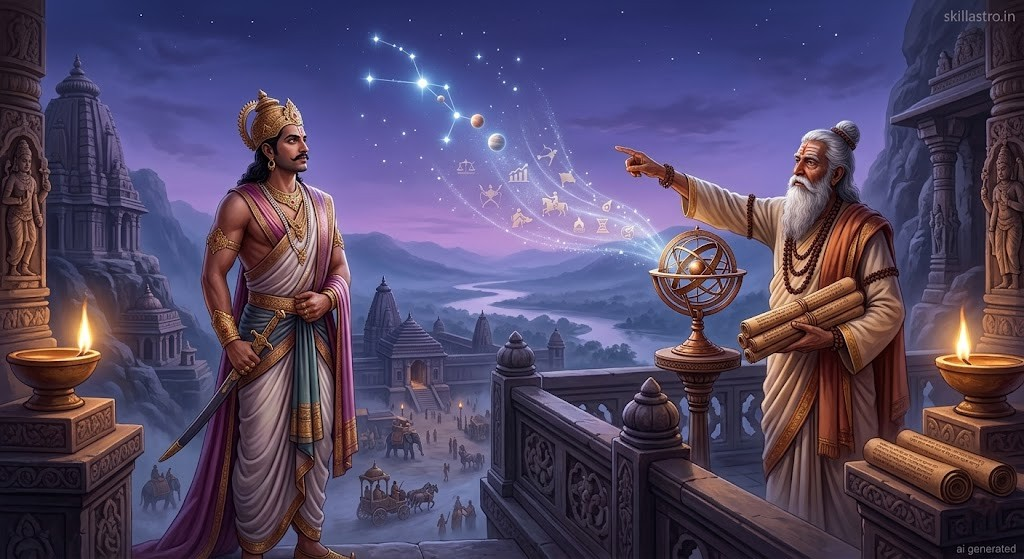
To understand how astrology guided ancient kings, we must look at the role of the Raj-Jyotish (Royal Astrologer). This was not merely a priest but a strategic advisor who held a status equal to the Prime Minister. Every major decision, from the timing of a military invasion to the coronation of an heir, was dictated by the movement of the stars. This blog explores the secret astrological practices of the royals, the science behind their success, and the powerful remedies they used to maintain their empires.
Talk to India's Best Astrologer at ₹1/min Only
Expert guidance for Career, Love & Marriage. Get accurate predictions instantly from verified Vedic Astrologers.
Chat Now »
Talk to India's Best Astrologer at ₹1/min Only
Expert guidance for Career, Love & Marriage. Get accurate predictions instantly from verified Vedic Astrologers.
Chat Now »
The Role of Raj-Jyotish: The Architect of Empires
The Coronation and the Power of Muhurta
The most critical moment in a King's life was his Rajyabhishek (coronation). Ancient texts like the Brihat Samhita detail how astrology guided ancient kings to select a "Pushya Nakshatra" or other highly auspicious Muhurtas for this ceremony. It was believed that if a King was crowned during a specific planetary alignment, his reign would be marked by prosperity, health, and a lack of rebellions. The coronation was essentially a ritual to sync the King's personal birth chart (Kundli) with the collective destiny of the land.
War Strategy and Planetary Transits
In the theater of war, astrology was the ultimate intelligence tool. Ancient Kings never marched their armies without consulting the planetary transits. For instance, a strong placement of Mars (Mangal) was essential for victory. If the Raj-Jyotish observed a "Grah Yuddha" (planetary war) or a malefic transit over the King's 10th house of authority, the military campaign would be delayed. Astrology provided the psychological and strategic edge, ensuring that the King only fought when the "cosmic weather" was in his favor.
Specialized Branches of Royal Astrology
The guidance provided to the throne was not limited to war; it covered every department of ancient life through specialized branches of Jyotish.
Mundane Astrology (Samhita)
Ancient Kings relied heavily on Mundane Astrology to predict national events. This branch focused on predicting rainfall, droughts, epidemics, and the economic prosperity of the kingdom. By studying solar and lunar eclipses, the Raj-Jyotish could warn the King about upcoming natural disasters, allowing the state to store grain and manage resources—an early form of disaster management guided by the stars.
Career Astrology for the Royal Lineage
Just as we use career astrology today to find our path, ancient royals used it to determine the "Dharma" of the princes. Not every prince was destined to be a warrior-king; some were found to be better suited for administration, spirituality, or the arts based on their Dashamsha (D-10) charts. This ensured that the right person was assigned to the right role, maintaining the stability of the dynasty.
Chart: Astrological Indicators for Ancient Royalty
The ancient sages identified specific planetary combinations (Yogas) that marked the birth of a King. These are known as Raja Yogas.
| Planetary Combination | Ancient Sanskrit Name | Effect on the King’s Reign |
| Jupiter in a Quadrant | Gaj-Kesari Yoga | Brings immense fame, wisdom, and a long-lasting reputation for justice. |
| Saturn in Exaltation | Sasa Yoga | Grants the King the ability to rule over vast territories and command a loyal army. |
| Sun in the 10th House | Dig Bala (Directional Strength) | Gives the King absolute authority, high energy, and the power to defeat enemies. |
| Venus in a Quadrant | Malavya Yoga | Ensures the kingdom is wealthy, artistic, and prosperous in trade. |
| Mars in the 10th House | Kul-Deepak Yoga | Marks a King who brings great glory to his lineage through military conquest. |
Royal Remedies: The Protection of the Throne
Because the King's health and fortune were synonymous with the kingdom's survival, the Raj-Jyotish utilized the most potent remedies to shield the monarch from "Doshas" (afflictions).
The Crown Jewels and Gemstone Therapy
The famous "Crown Jewels" were not just for show; they were carefully selected based on the King's horoscope. How astrology guided ancient kings is best seen in their use of Navaratnas. A King would wear a high-carat, flawless Ruby (Manik) to strengthen his Sun (authority) or a Yellow Sapphire (Pukhraj) to ensure Jupiter's wisdom. These gems acted as energetic shields, filtering cosmic rays to maintain the King's physical and mental vitality.
Lal Kitab and Karmic Debt (Rin)
While the classical Vedas focused on Yagyas, many royal families followed traditions that mirror the modern Lal Kitab. They believed in settling "Pitri Rin" (ancestral debts) through specific acts of charity. Kings would build public wells, plant massive banyan groves, or feed the poor on specific lunar days to clear the "Doshas" in the royal bloodline.
Numerology in Naming Cities
Even the names of capital cities and forts were often determined through Ank Jyotish (Numerology). The vibrational frequency of the city's name had to harmonize with the King's birth number to ensure that the capital remained unconquerable.
Frequently Asked Questions (FAQs)
Did every Indian King have an astrologer?
Yes. From the smallest Chieftain to the Samrat (Emperor), the Purohit or Raj-Jyotish was a mandatory member of the royal council. No major state document was sealed without checking the planetary hour.
How did astrology help in preventing rebellions?
Astrologers monitored the "Gochar" (transits) of Saturn and Rahu. If these planets were affecting the King’s 4th house (representing the public and heart), it was a sign of impending public dissatisfaction. The King would then perform acts of charity or policy shifts to appease the people and the planets simultaneously.
Can royal astrology principles be used for business today?
Absolutely. Modern business leaders use the same principles of Muhurta for launching products and Career Astrology for hiring executive teams. In many ways, a modern CEO is the "King" of their corporate empire.
What is a Raja Yoga in a common man's chart?
A Raja Yoga indicates that even if a person is born in humble circumstances, they have the planetary potential to rise to a position of great power, wealth, and influence, much like the great Kings of the past.
Conclusion
The story of how astrology guided ancient kings is a testament to the sophisticated intellectual heritage of India. It shows that leadership, when aligned with the laws of the universe, leads to stability and greatness. The Raj-Jyotish ensured that the King's power was balanced with wisdom, using the tools of the birth chart, the precision of gemstones, and the strategic timing of the stars.