 Join WhatsApp Channel
How Ancient Indians Studied the Stars: The Dawn of Cosmic Science
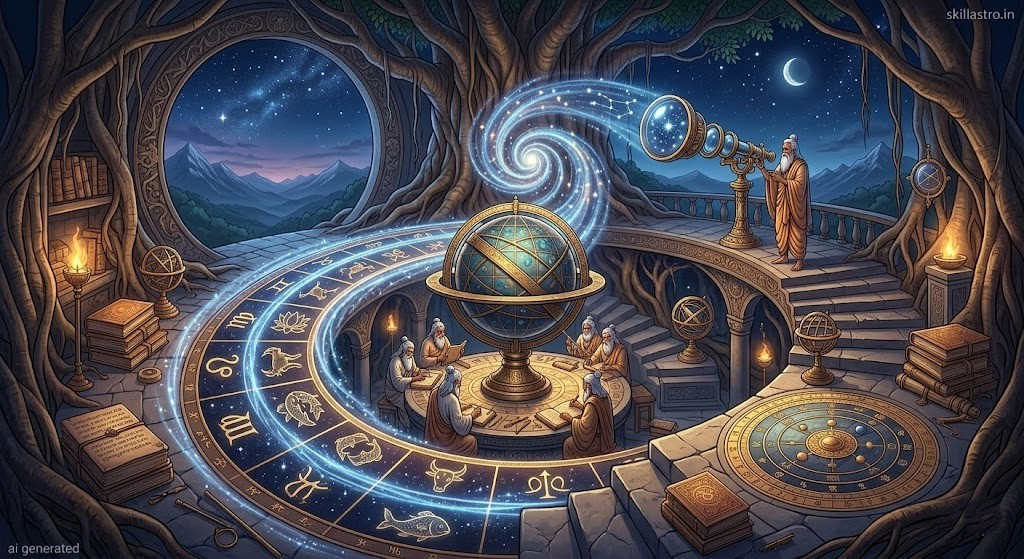
How ancient Indians studied the stars is a story of unparalleled human brilliance, deep spiritual meditation, and astonishing mathematical prowess. Long before the invention of the telescope, satellite imaging, or digital ephemerides, the sages of the Indian subcontinent mapped the cosmos with a level of precision that continues to baffle modern astronomers. They looked up at the night sky not merely with wonder, but with a rigorous scientific inquiry that sought to uncover the hidden mechanics of the universe. In doing so, they gave birth to Jyotish Shastra (the Science of Light), a system so profoundly accurate that it remains the backbone of Indian culture, spirituality, and predictive astrology today.
To truly understand how ancient Indians studied the stars, we must dispel the myth that early astrology was based on mere guesswork or superstition. The Rishis (sages) were, first and foremost, brilliant astrophysicists and mathematicians. They understood that the macrocosm of the swirling galaxies and the microcosm of human existence were fundamentally interconnected. By tracking the exact trajectories of celestial bodies, predicting eclipses centuries in advance, and mapping the lunar mansions, they created an eternal blueprint for humanity. This comprehensive guide explores the brilliant ancient techniques, instruments, and mathematical frameworks used to decode the universe, paving the way for advanced disciplines like medical astrology, career mapping, and traditional remedial sciences.
Talk to India's Best Astrologer at ₹1/min Only
Expert guidance for Career, Love & Marriage. Get accurate predictions instantly from verified Vedic Astrologers.
Chat Now »
Talk to India's Best Astrologer at ₹1/min Only
Expert guidance for Career, Love & Marriage. Get accurate predictions instantly from verified Vedic Astrologers.
Chat Now »
The Naked-Eye Observers and Ancient Instruments
In the earliest Vedic period, the primary tool for studying the stars was the human eye, aided by a pristine, unpolluted atmosphere and an elevated state of consciousness. However, as the need for microscopic precision grew, ancient Indian astronomers developed ingenious physical instruments.
One of the most foundational tools was the Shanku, a precisely calibrated gnomon (a vertical stick or pillar). By measuring the length and angle of the Shanku’s shadow cast by the Sun throughout the day, astronomers could determine the exact cardinal directions, the latitude of their location, and the precise time of day. To calculate the exact moment of a person's birth—which is absolutely critical for establishing the Ascendant (Lagna) in a birth chart—they utilized the Ghatika Yantra (a water clock). This consisted of a hemispherical copper bowl with a tiny hole at the bottom, placed in a larger vessel of water. The time it took for the bowl to sink provided a standardized unit of time measurement, allowing ancient astrologers to freeze the cosmic sky mathematically at the moment of a child's first breath.
The Mathematical Mastery of the Surya Siddhanta
The true secret to how ancient Indians studied the stars lies in their mastery of advanced mathematics. Texts like the Surya Siddhanta, composed thousands of years ago, contain the roots of modern trigonometry (the concepts of sine and cosine were first conceptualized in India as Jya and Koti-jya).
These ancient scholars calculated the Earth’s diameter, the distance from the Earth to the Moon, and the exact length of the solar year (365.25636 days) with staggering accuracy. They mathematically mapped the Nirayana (sidereal) zodiac, accounting for the precession of the equinoxes—the slight wobble of the Earth's axis that causes the constellations to shift backward over thousands of years. This mathematical rigor ensured that the planetary positions used to cast a Kundli reflected the actual, physical sky, a fundamental scientific standard that separates Vedic astrology from other global systems.
From Astronomy to Advanced Predictive Astrology
Once the sky was mathematically mapped, the sages applied this data to the human condition, birthing highly specialized branches of Jyotish that continue to guide millions.
Decoding the Body (Medical Astrology): By tracking how the shifting stars corresponded with seasonal changes and human biological rhythms, the ancients developed Ayur Jyotish (Medical Astrology). They observed that specific planetary alignments triggered specific physiological responses. For instance, the Moon’s phases strictly govern bodily fluids and mental states. By mapping these celestial mechanics, they could diagnose physical vulnerabilities and potential diseases based purely on a person's birth chart, allowing for powerful preventative care.
Decoding Destiny (Career Astrology): The rigorous study of the stars also led to the perfection of Career Astrology. The ancients realized that the exact mathematical point of the midheaven (the 10th house) at the time of birth dictated a soul's societal impact and professional Dharma. By utilizing advanced mathematical sub-divisions of the sky, such as the Dashamsha (D-10 chart), astrologers could decode whether a person possessed the cosmic frequency required for technical engineering, spiritual leadership, or dynamic entrepreneurship.
Chart: Ancient Astronomical Concepts and Their Astrological Impact
Below is a chart illustrating how the purely scientific astronomical observations of the ancient Indians were translated directly into powerful astrological principles:
| Ancient Astronomical Observation | Sanskrit Term / Concept | Astrological Application in Jyotish |
| The 27.3-day elliptical orbit of the Moon around the Earth. | Nakshatras (27 Lunar Mansions) | Forms the basis of the Vimshottari Dasha system (120-year life timeline) and deeply maps human psychology. |
| The intersection points of the solar and lunar orbital paths. | Rahu (North Node) & Ketu (South Node) | Represents karmic debts, past-life baggage, psychological shadows, and spiritual liberation (Moksha). |
| The precession of the equinoxes (Earth's axial wobble). | Ayanamsha (Sidereal adjustment) | Ensures the birth chart reflects the actual real-time positions of the stars, guaranteeing predictive accuracy. |
| The orbital speed and varying luminosity of the 5 visible planets. | Tara Grahas (Mars, Mercury, Jupiter, Venus, Saturn) | Dictates the timing of career shifts, medical events, and the maturity of different life domains. |
| The specific mathematical angles between planets in the sky. | Drishti (Planetary Aspects) | Reveals how different areas of a person's life (e.g., career and health) interact and influence each other. |
The Evolution of Remedies and Hidden Sciences
Understanding how ancient Indians studied the stars is incomplete without exploring how they used this knowledge to heal and empower humanity. The sages did not just predict the weather; they built the ultimate shelter.
The Logic of Lal Kitab: As the mathematical observation of the stars evolved, so did the methodology for correcting planetary imbalances. The Lal Kitab emerged as a revolutionary system that tied the astronomical positions of the planets directly to practical, everyday karma. Instead of complex rituals, it provided rapid remedies based on behavioral shifts, proving that by changing our daily actions, we can alter our alignment with the stars.
The Synergy of Numerology (Ank Jyotish): The ancient Indians also recognized that the geometry of the stars was intrinsically linked to the vibration of numbers. By studying the cosmos, they assigned specific numerical values to planetary frequencies. This birthed the science of Numerology, allowing people to harmonize their names, business endeavors, and major life decisions with the numeric pulse of the universe.
The Physics of Gemstones: Through deep observation, ancient seers matched the light frequencies of the visible planets with the crystalline structures of natural gems. This led to the profound science of Gemstone therapy (Ratna Dharana). They understood that wearing a specific, flawless gem acts as an optical filter, drawing the exact cosmic ray of a beneficial planet into the human aura to heal medical ailments and clear career blockages.
Frequently Asked Questions (FAQs)
Did ancient Indians know the Earth was round?
Yes, absolutely. The ancient Sanskrit word for geography is Bhugol, where "Bhu" means Earth and "Gol" means round or spherical. Texts like the Surya Siddhanta explicitly describe the Earth as a sphere suspended in space.
How did they track the planets without telescopes?
The five classical planets (Mercury, Venus, Mars, Jupiter, and Saturn) are visible to the naked eye. Ancient astronomers used elevated platforms, highly calibrated shadow instruments (gnomons), and centuries of meticulously recorded data to track their orbital speeds, retrogrades, and exact mathematical positions.
What makes ancient Indian astronomy different from Greek astronomy?
While both cultures made massive contributions, the ancient Indians developed the concept of zero, the decimal system, and advanced trigonometry. This allowed Indian astronomers to create much more precise calculations regarding massive cycles of time (Yugas) and the micro-divisions of the zodiac used in creating divisional birth charts.
Can the ancient study of stars really impact my modern life?
Yes. The gravitational, electromagnetic, and subtle cosmic energies mapped by the ancient sages still govern the physical universe today. Whether you are seeking to optimize your health through medical astrology or align your professional path, the mathematical logic of the stars remains a flawless guide.
Conclusion
The story of how ancient Indians studied the stars is a profound reminder of the limitless potential of the human mind. Through a magnificent blend of spiritual dedication and unmatched mathematical genius, the Rishis decoded the heavens, leaving behind a legacy that continues to heal and guide humanity. They transformed the chaotic night sky into the structured, deeply logical, and highly predictive science of Jyotish. Today, this ancient wisdom is more vital than ever, offering unparalleled insights into our karmic debts, our physical well-being, and our ultimate life purpose.