 Join WhatsApp Channel
The History of Vedic Astrology: Divine Eyes of the Vedas and the Science of Time Calculation
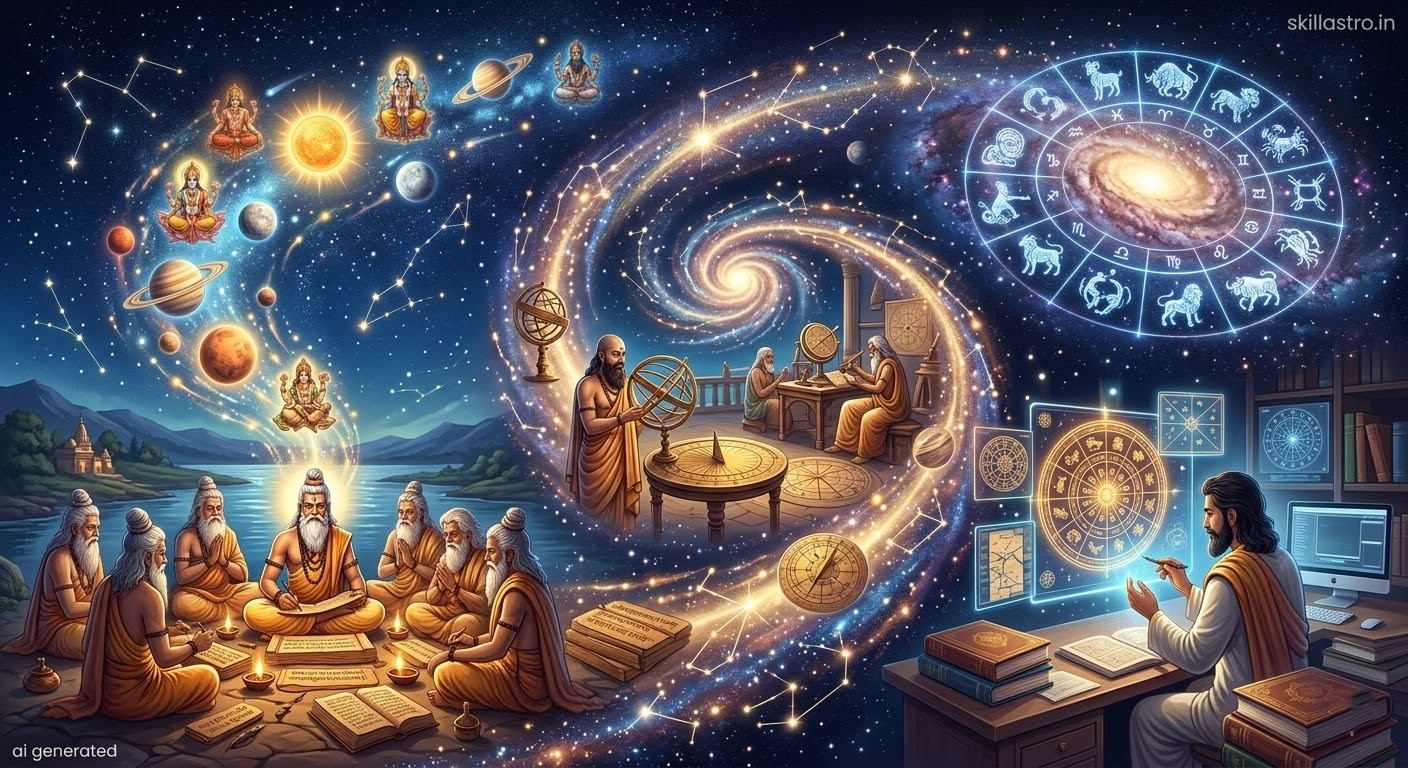
In the infinite repository of knowledge within Indian culture, 'Vedic Astrology' (Jyotish) holds the highest and most sacred position. It is not merely a scripture that denotes the positions of planets and constellations; it is a beacon of light that introduces a human being to their destiny, Karma, and life's purpose. When our ancestral sages felt the vibration of the universe in the depths of meditation, they realized that the massive bodies moving in the sky have a direct connection with the human subtle body and fortune.
Vedic Astrology is called 'Vedanga', meaning a limb of the Vedas. Just as eyes are the most important part of the human body, astrology is called 'Veda Chakshu' or the eyes of the Vedas to understand their profound mysteries. Let us cast a deep look at the historical journey of this sacred knowledge.
The Antiquity of Vedic Astrology: Knowledge Embedded in the Vedas
The history of Vedic Astrology is far older than the known history of human civilization. Its first and most powerful evidence is found in the Rigveda. The verses of the Rigveda contain wonderful descriptions of the 12 months, 360 days, and the cycle of seasons. In that era, the primary form of astrology was 'Kaal Ganana' (Time Calculation).
For ancient sages, Yagnas and rituals were the center of life. The success of any Yagna depended on the time at which it was performed. This search for 'Auspicious Time' or 'Muhurta' gave birth to astrology as a systematic scripture. The Yajurveda and Atharvaveda contain lists of Nakshatras, describing the 27 constellations from Krittika to Bharani in detail.
Talk to India's Best Astrologer at ₹1/min Only
Expert guidance for Career, Love & Marriage. Get accurate predictions instantly from verified Vedic Astrologers.
Chat Now »
Talk to India's Best Astrologer at ₹1/min Only
Expert guidance for Career, Love & Marriage. Get accurate predictions instantly from verified Vedic Astrologers.
Chat Now »
The Eighteen Proponents: Divine Creators of Astrology
According to Indian tradition, the knowledge of Vedic Astrology is not the gift of a single individual; rather, it reached the sages through a divine lineage. Scriptures mention 18 main proponents (Founders) who codified this knowledge for the welfare of humanity:
"Surya, Pitamaha, Vyasa, Vashistha, Atri, Parasara, Lomasa, Yavana, Bhrigu, Chyavana, Kasyapa, Narada, Saunaka, Angira, Garga, Chyavana, Yavana, and Bhrigu—these eighteen are the profound proponents of the science of light (Jyotish Shastra)."
Among these, the names of Pitamaha (Brahma), Surya, Vashistha, Atri, Parasara, Kasyapa, Narada, Garga, and Bhrigu are prominent. These sages explained through various theories how celestial bodies influence human consciousness.
Major Phases of Development: From Parasara to Varahamihira
The history of Vedic Astrology can be divided into three major phases:
Siddhanta Kaal (Mathematics): This was the era when the most work was done on planetary motion, eclipse calculation, and the creation of the Panchang (almanac). The Surya Siddhanta is considered the most authentic text of this period and remains the basis for Panchang calculations today.
Hora Kaal (Predictive): Sage Parasara strengthened the foundation of predictive astrology by composing the Brihat Parasara Hora Shastra. He provided amazing rules for 'Vimshottari Dasha' and 'Divisional Charts' (Varga Kundalis) to calculate human happiness, sorrow, longevity, wealth, and salvation.
Samhita Kaal: This involved the study of Mundane Astrology—predicting the future of nations, rainfall, famine, and natural events like earthquakes.
Sages Parasara and Bhrigu: Two Pillars of Astrology
When we talk about the history of Vedic Astrology, the names of Sage Parasara and Sage Bhrigu are written in golden letters. Sage Parasara is considered the father of modern predictive astrology. The formulas provided by him are as accurate today as they were thousands of years ago.
Meanwhile, Sage Bhrigu composed the Bhrigu Samhita, which can be considered the world's first astrological dictionary. It is said that this text contains the past, future, and present of every human being in the universe. This is evidence of the divine vision of the sages that could transcend the boundaries of time.
Major Branches of Vedic Astrology
The history of Vedic Astrology becomes even richer due to its diversity. It primarily has three branches:
| Branch Name | Description and Significance |
| Siddhanta | Involves the mathematical calculation of planets, motion of constellations, and subtle divisions of time. |
| Samhita | Describes collective events, weather, politics, and the impact of planets on the entire Earth. |
| Hora | Based on individual birth charts (Horoscopes), through which the ups and downs of a person's life are observed. |
Karma, Destiny, and Vedic Astrology
The history of Vedic Astrology teaches us a great philosophy of life. Our sages never said to leave everything to fate. They said, "Phalani Graha Charena Suchayanti Manishinah", meaning the planets only provide 'information' about upcoming events.
The birth chart is a mirror of the actions of our past lives. If we have done good deeds in past lives, the planets become favorable and grant happiness. If actions were poor, planets become unfavorable to give us an opportunity to improve. Astrology prepares us mentally for those difficult times and inspires us to perform 'Purushartha' (effort).
Vedic Remedies to Turn Misfortune into Good Fortune
Vedic Astrology does not just describe problems; it also provides extremely effective and Sattvic remedies for their resolution. These remedies are the result of the research of our ancient sages:
Mantra Power: The sound waves of Mantras possess the capability to transform negative planetary energy into positivity. The 'Mahamrityunjaya Mantra' and 'Gayatri Mantra' are the greatest examples.
Yagnas and Rituals: Sending prayers to deities and planets through the medium of fire has been the primary remedy since the Vedic era.
Gemstones: Specific gemstones are used to balance the seven colors of the sun's rays within the body.
Charity and Service: Selfless charity and service are considered the most effective ways to calm unfavorable planets.
Frequently Asked Questions (FAQs)
1. Are Vedic Astrology and Western Astrology the same?
No, there is a significant difference. Vedic Astrology is based on the 'Sidereal' (Nirayana) system which follows the actual positions of constellations, whereas Western Astrology is based on the 'Tropical' (Sayana) system. The subtle study of Nakshatras and Dasha systems found in Vedic Astrology is not present in the Western method.
2. Is the history of Vedic Astrology scientific?
Absolutely. If we look at ancient texts like Surya Siddhanta, the calculations given for the Earth's circumference, the distance of the Moon, and planetary motions are very close to modern science. This is a living testament to the mathematical skills of our sages.
3. Can fortune be changed through astrology?
According to Vedic Astrology, we cannot entirely change our 'Prarabdha' (what is destined), but we can significantly reduce its impact through 'Sadhana' and 'Karma'. Just as an umbrella cannot stop the rain but can save you from getting drenched, astrology reduces the impact of obstacles.
Conclusion
The history of Vedic Astrology is not just a list of dates and texts; it is a journey of consciousness that connects us with ourselves. This science reassures us that we are not abandoned in this universe; every star and every planet is contributing to the music of our lives.