 Join WhatsApp Channel
History of Vedic Astrology: The Great Scientific Heritage of Ancient India
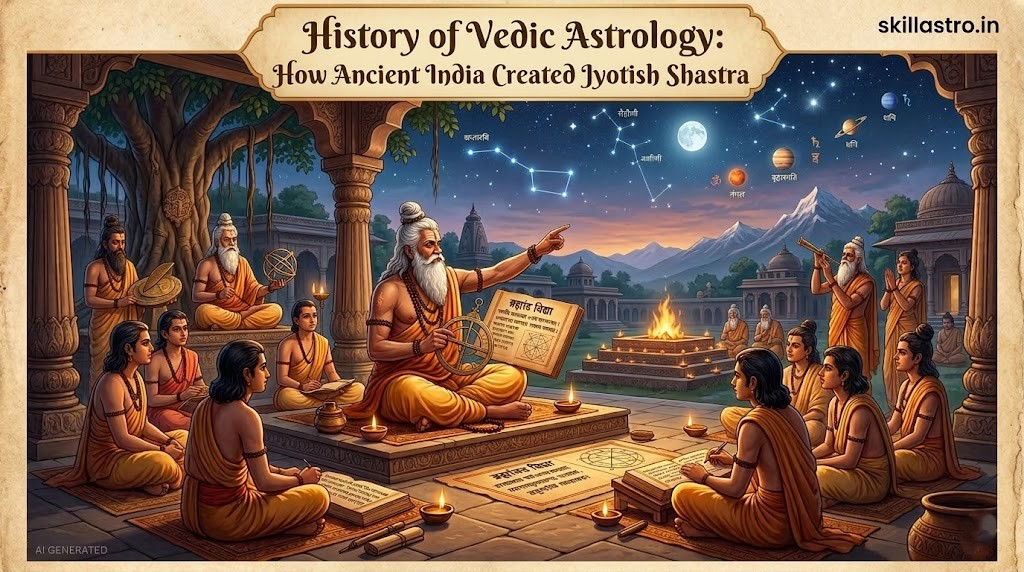
Vedic astrology, also known as 'Jyotish Shastra' or the 'Eye of the Kaal Purush' (Time Personified), is one of the oldest knowledge systems in the world. It is not merely a superstition or the art of fortune-telling, but rather a pure mathematical and spiritual science of time, planetary positions, and cosmic energy. The precise descriptions of planetary movements and their effects on human life given by the ancient sages of India thousands of years ago, without any modern telescopes, continue to astonish modern science today.
In this special article, we will deeply explore how our ancestors created this great scripture and how it gradually evolved.
The Origin of Jyotish Shastra and its Connection with the Vedas
The roots of Vedic astrology are embedded directly in the Vedas. Clear mentions of celestial bodies, constellations (Nakshatras), and planets are found in the Rigveda, Yajurveda, and Samaveda.
Significance of Vedanga Jyotisha In ancient times, astrology was considered a 'Vedanga', which translates to 'a limb of the Vedas'. Among the six Vedangas—Shiksha (Phonetics), Kalpa (Rituals), Vyakarana (Grammar), Nirukta (Etymology), Chhanda (Meter), and Jyotisha (Astronomy/Astrology)—astrology was given the utmost importance. Without it, determining the correct time (Muhurat) for Yagyas and religious rituals was impossible.
The Contribution of Sage Lagadha Around 1400 BCE (though opinions vary among scholars), Sage Lagadha authored a text named 'Vedanga Jyotisha'. This scripture was dedicated to the mathematical aspect of astrology, detailing the rules for calculating solar months, lunar months, and Nakshatras.
Talk to India's Best Astrologer at ₹1/min Only
Expert guidance for Career, Love & Marriage. Get accurate predictions instantly from verified Vedic Astrologers.
Chat Now »
Talk to India's Best Astrologer at ₹1/min Only
Expert guidance for Career, Love & Marriage. Get accurate predictions instantly from verified Vedic Astrologers.
Chat Now »
The Divine Vision and Research of Ancient Sages
The contribution of India's great Saptarishis (Seven Sages) and other seers in creating Jyotish Shastra has been unparalleled. These sages unraveled the secrets of the universe through their divine vision and continuous observation.
The Eighteen Great Founders According to the scriptures, there are eighteen main founders of astrology, prominent among whom are Brahma, Surya, Vashistha, Atri, Parashara, Kashyapa, Narada, Garga, and Bhrigu.
Maharishi Parashara and Brihat Parashara Hora Shastra The name of Maharishi Parashara is written in golden letters in the history of Vedic astrology. He authored the 'Brihat Parashara Hora Shastra', which is still considered the foundational pillar of predictive astrology today. It was he who formulated the subtle principles of planetary periods (like the Vimshottari Dasha), Yogas (planetary combinations), and Drishtis (aspects).
The Wondrous Creation of Nakshatras and the Zodiac
Ancient Indians divided the sky into 27 Nakshatras (lunar mansions). The evolution of the Zodiac (Rashi Chakra) was based on this incredibly subtle calculation of the Nakshatras.
The Connection Between the Moon and Nakshatras The sages observed that as the Moon orbits the Earth, it aligns with a specific star cluster every day. They named these star clusters 'Nakshatras'. These 27 Nakshatras, ranging from Ashwini to Revati, became the most accurate instruments for calculating time.
The Emergence of the Twelve Zodiac Signs When the Sun's orbital path was divided into twelve segments of 30 degrees each, the twelve Zodiac signs from Aries (Mesh) to Pisces (Meen) were born. This division was fundamentally based on the elements of Earth, Water, Fire, and Air.
The Golden Age: The Era of Varahamihira and Aryabhata
The Gupta period is known as the golden age of Indian astrology. During this time, Jyotish Shastra was not limited merely to religious rituals but emerged as an advanced science of astronomy.
Aryabhata's Revolutionary Theory In his treatise 'Aryabhatiya', Aryabhata clarified that the Earth is round and rotates on its axis. He proved the actual astronomical causes of eclipses (the casting of shadows) through mathematics.
Varahamihira and Panchasiddhantika Varahamihira systematically divided astrology into three main branches:
Siddhanta: Mathematical astronomy.
Samhita: Mundane astrology and natural phenomena.
Hora: Birth charts and predictive astrology. His masterwork, 'Brihat Samhita', is still revered as an encyclopedia today.
The Three Main Pillars of Vedic Astrology
Ancient India developed Jyotish Shastra very systematically into three distinct limbs.
Ganita or Siddhanta Jyotish This involves calculating the positions, movements, risings, settings, and eclipses of planets. It is entirely based on complex astronomical calculations.
Samhita Jyotish This branch studies collective events, such as famines, wars, pandemics, weather changes, and the future of nations.
Jataka or Phalita Jyotish This analyzes the events, nature, and future of a person based on their birth chart (Kundli). Ancient sages believed that a human's birth is the exact result of the union of their past karmas and celestial energies.
The Journey from Ancient Times to the Modern Era
During the medieval period, when external invasions occurred, several great universities like Nalanda and Takshashila—where astrology and astronomy were taught—were destroyed. Despite this, the knowledge was not lost.
The Secret of the Bhrigu Samhita Authored by Maharishi Bhrigu, the 'Bhrigu Samhita' is said to contain the details of the past, present, and future of millions of people. This scripture is a magnificent testament to how vast the statistical and predictive capabilities of ancient India truly were.
Astrological Afflictions and Remedial Measures
Ancient sages did not just predict the future; they also developed the science of 'Karma' and 'Remedies' (Upayas) to mitigate the negative effects of the planets.
The Importance of Charity and Virtue Donating specific items is prescribed as the most effective remedy to balance planetary energy. For example, donating sesame seeds for Saturn and Bengal gram (chana dal) for Jupiter.
The Power of Mantras Based on the science of sound (sound engineering), the sages composed powerful mantras. Chanting mantras creates a protective shield (aura) around a person that absorbs the adverse rays of the planets.
Gemology and Metallurgy Gemstones are used to channel specific planetary rays into the human body. Gems like Yellow Sapphire, Blue Sapphire, and Ruby improve physical health and mental states through the precise reflection of cosmic light.
Frequently Asked Questions (FAQs)
Are Vedic astrology and Western astrology the same?
No, Vedic astrology is based on the 'Sidereal' (Nakshatra) system, which looks at the actual fixed positions of the planets, whereas Western astrology uses the 'Tropical' (Sayana) system based on the seasons.
Is Jyotish Shastra really a science?
Yes, because it is based on mathematical calculations, the precise movements of celestial bodies, and statistical observations over millennia. It is historically known as the 'science of light'.
Can destiny be changed by performing remedies?
According to Vedic astrology, remedies can significantly reduce the intensity of Prarabdha (the fruits of past karmas) and provide a person with the willpower and strength to fight through difficult times.
Conclusion
The history of Vedic astrology is a profound testament to the great intellect of ancient India, which understood ages ago that everything in the universe is deeply interconnected. The ancient sages created Jyotish Shastra not merely out of a superficial curiosity to know the future, but as a guiding light for the attainment of Dharma (righteousness), Artha (wealth), Kama (desire), and Moksha (liberation). This scripture gently reminds us that we are a microscopic part of this vast universe, and the cosmic movement of the planets determines the rhythm of our lives. This divine knowledge of ancient India remains just as relevant today as it was thousands of years ago.