
 Join WhatsApp Channel
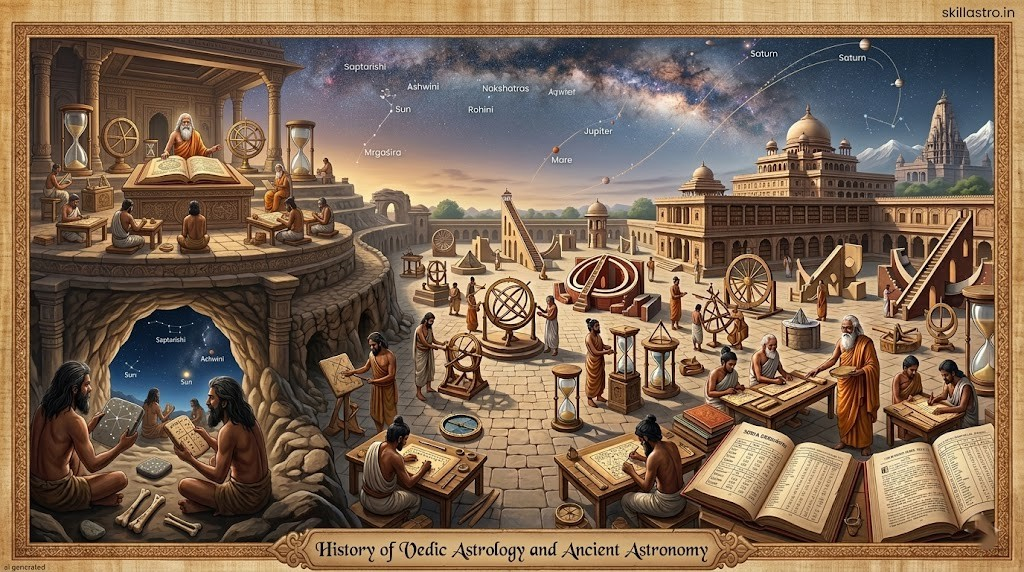
History of Vedic Astrology and Astronomy: The Most Ancient Confluence of Cosmic Secrets
In today's world, Astrology and Astronomy are considered two entirely separate subjects, but in the history of ancient India, they were two sides of the same coin. For the ancient sages, the sky was not just a cluster of stars, but a vast and magnificent laboratory. The "History of Vedic Astrology and Astronomy" tells us how, thousands of years ago, Indian scholars accurately calculated the distance, orbit, and speed of planets without the aid of any modern telescopes.
In this article, we will understand how India taught the world the fundamentals of astronomy and provided a profound mathematical foundation to astrology.
Siddhanta Jyotish: The Foundation of Astronomy
Indian astrology is divided into three main branches, the first and most important of which is 'Siddhanta'. Siddhanta translates to pure astronomy.
The Mathematics of Planetary Motion Through monumental texts like the 'Surya Siddhanta', ancient sages explained the precise difference between the Mean Motion and True Motion of planets. They utilized a microscopic unit of time called 'Kalanupada', which proves that their mathematics was just as advanced as modern Calculus.
The Theory of a Spherical Earth While the West considered the Earth to be flat for a very long time, Vedic astronomy explicitly referred to the Earth as 'Bhu-Gol' (meaning spherical Earth). Scholars like Varahamihira and Aryabhata clarified that the Earth is suspended in space without any physical support and rotates continuously on its own axis.
Talk to India's Best Astrologer at ₹1/min Only
Expert guidance for Career, Love & Marriage. Get accurate predictions instantly from verified Vedic Astrologers.
Chat Now »
Talk to India's Best Astrologer at ₹1/min Only
Expert guidance for Career, Love & Marriage. Get accurate predictions instantly from verified Vedic Astrologers.
Chat Now »
Great Astronomers of Ancient India and Their Research
The contribution of certain great personalities is absolutely unparalleled in shaping the history of Vedic astrology and astronomy.
Aryabhata: The Grandfather of Astronomy In the 5th century, Aryabhata composed his masterpiece, the 'Aryabhatiya'. He scientifically explained that the Moon and the planets shine by reflecting the light of the Sun. The calculation he made of the Earth's circumference (परिधि) is remarkably close to modern scientific measurements.
Varahamihira and Panchasiddhantika Varahamihira brilliantly compiled the five main astronomical treatises of his time (Paulisa, Romaka, Vashistha, Saura, and Paitamaha). In his 'Brihat Samhita', he provided a detailed description of how astronomical events directly impact the Earth's atmosphere, climate, and environment.
Bhaskaracharya and Gravity Centuries before Isaac Newton, Bhaskaracharya wrote in his 'Siddhanta Shiromani' that the Earth possesses a special attractive force through which it pulls heavy objects towards itself. He also provided an incredibly accurate mathematical description of planetary orbits.
Nakshatras and the Zodiac: Creation of the Celestial Map
Vedic astrology prepared a highly systematic and logical map to understand the vastness of the sky.
The Science of the 27 Nakshatras Based on the daily motion of the Moon, Indian astronomers divided the sky into 27 distinct star clusters. This became the most accurate time-calculation system in the world. They also meticulously studied the distance and light intensity of each Nakshatra.
The Ecliptic and the Zodiac (Rashi Chakra) The apparent path that the Sun travels upon was divided into 12 zodiac signs. This is entirely based on the angular distance of celestial bodies. Dividing this 360-degree cosmic cycle into 12 equal signs of 30 degrees each is a shining testament to the mathematical supremacy of ancient India.
Astronomical Secrets and Scientific Truth in the Vedas
Many formulas hidden within the sacred hymns of the Vedas align perfectly with today's advanced Astro-physics.
The Center of the Solar System In the Rigveda, the Sun is vividly described as the center of the 'Chakra' (wheel), with other planets described as revolving around it. According to the Vedas, the Sun alone binds all the planets in their orbits with its powerful rays (Gravity).
Micro-calculation of Time In Vedic astronomy, time was measured from a 'Truti' (the 33,750th fraction of a single second) all the way up to a 'Manvantara' and a 'Kalpa' (billions of years). Such incredibly minute calculation was simply impossible without highly advanced astronomy.
Astronomical Afflictions and Their Vedic Remedies
In ancient India, it was deeply understood that the magnetic waves of celestial bodies physically and mentally affect the elements of the human body.
Eclipse Period and Purification According to pure astronomy, an eclipse is merely a shadow. However, according to astrological science, harmful radiation drastically increases during this cosmic event. That is exactly why the sages prescribed chanting and meditation during eclipses—so that a person's internal energy and aura remain safely protected.
Planetary Pacification and the Science of Yagya The specific woods and the resonant sounds of mantras used in Yagyas (fire rituals) work to create harmony with cosmic energy. This was the brilliant, practical application of astronomy, designed to help individuals remain in perfect balance with the universe.
Frequently Asked Questions (FAQs)
Q1: Are Astrology and Astronomy different subjects?
Ans: Historically, they were the exact same subject. Astronomy provides the 'mathematics' (how planets move), while Astrology explains the 'effects' (how those movements impact human life).
Q2: How was the distance of planets measured in ancient India?
Ans: The ancient sages used highly complex mathematical formulas based on Trigonometry and the speed of light to calculate celestial distances.
Q3: How does modern science view Vedic astronomy?
Ans: Modern scientists are frequently amazed by the sheer accuracy of the 'Sayana' (Tropical) and 'Nirayana' (Sidereal) systems, as well as the precise calculation of the Ayanamsha (Precession of the Equinoxes) provided by Indian sages thousands of years ago.
Conclusion
The history of Vedic astrology and astronomy is a glowing testament to the fact that India has always been the ultimate confluence of science and spirituality. Our ancestors did not merely gaze at the stars; they understood their complex language and presented it for the welfare of all humanity in the form of 'Jyotish'. Today, as we launch satellites to explore space, we must look back with reverence at our ancient roots, where the profound secrets of the universe were mathematically compiled thousands of years ago. This rich history provides us with both immense pride and boundless knowledge.