 Join WhatsApp Channel
The History of the Zodiac: A Journey Through the 12 Cosmic Maps and Human Nature
When we gaze at the night sky across the infinite expanse of the universe, we see certain clusters of stars that evoke specific shapes. For thousands of years, human civilizations recognized these patterns, named them, and wove stories around them. In the science of astrology, these star clusters are called 'Rashi' (Zodiac Signs). The literal meaning of Rashi is a 'heap' or 'collection'—referring to a group of stars forming a definite shape.
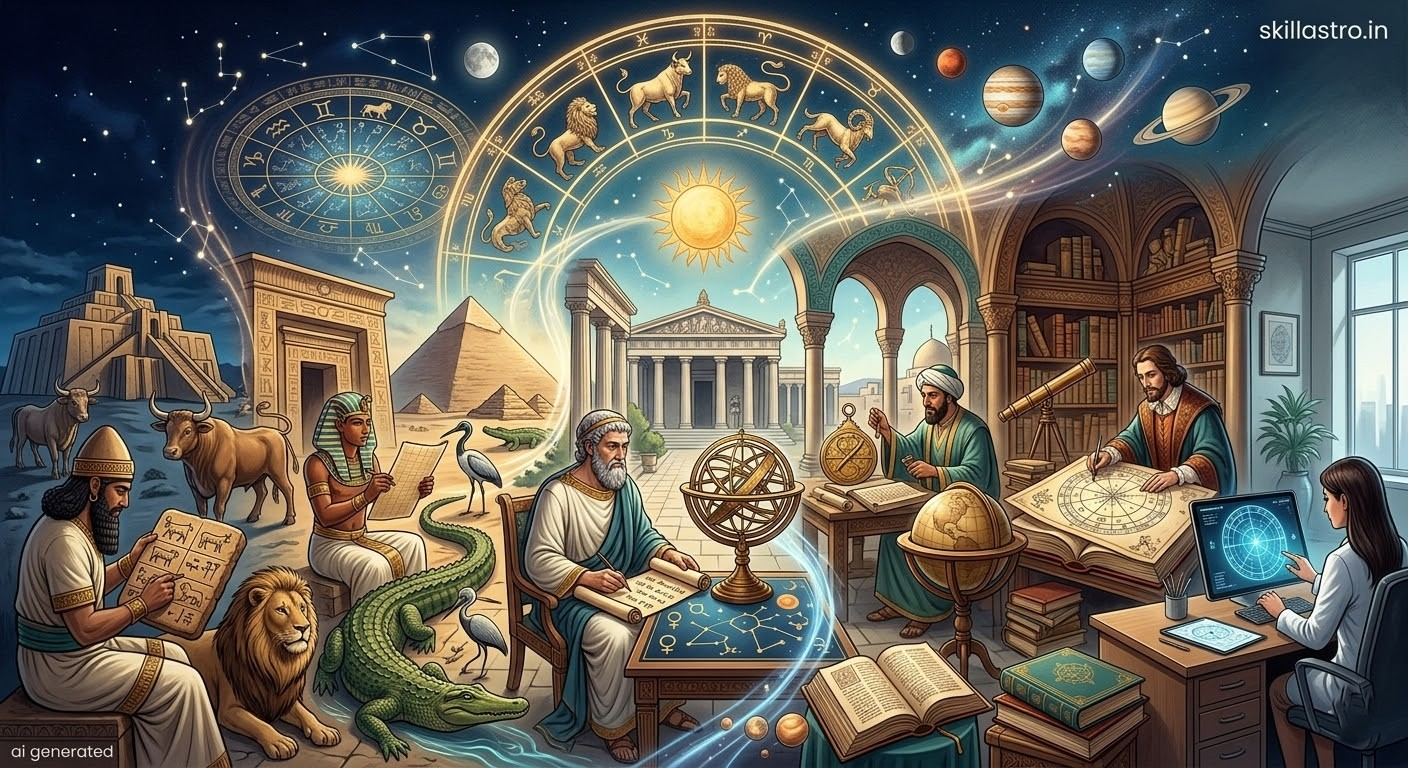
The history of the zodiac is not limited to astrology alone; it is a fascinating tale of the confluence of human history, astronomy, and diverse cultures. Let us turn back the wheel of time to where the journey of these 12 signs began.
The Origin of Zodiac Signs: The Confluence of Ancient Babylon and India
The beginning of the history of zodiac signs is primarily attributed to ancient Mesopotamia (Babylon) and the Vedic civilization of India. Babylonian astronomers were the first to attempt dividing the Ecliptic (the apparent path of the Sun) into equal parts. They observed that specific star groups were situated along the path the Sun traversed.
In the Indian context, descriptions of the zodiac signs are found indirectly as far back as the Rigveda, but they reached full expansion in 'Vedanga Jyotish' and later in the 'Parasara Hora Shastra.' Initially, Indian astrology gave more prominence to the 'Nakshatras' (constellations), which numbered 27. Later, to simplify astronomical calculations, the 360-degree celestial circle was divided into 12 parts of 30 degrees each, which we know today as the 12 zodiac signs.
Talk to India's Best Astrologer at ₹1/min Only
Expert guidance for Career, Love & Marriage. Get accurate predictions instantly from verified Vedic Astrologers.
Chat Now »
Talk to India's Best Astrologer at ₹1/min Only
Expert guidance for Career, Love & Marriage. Get accurate predictions instantly from verified Vedic Astrologers.
Chat Now »
Evolution of the Zodiac: Greek Influence and Global Expansion
Around the 2nd century BCE, as India came into contact with Greece, a global uniformity began to emerge in the names and symbols of the zodiac signs. Greek astronomers refined the Babylonian knowledge and associated the signs with human and animal forms. The word 'Zodiac' itself comes from the Greek word 'Zodiakos,' which means 'a circle of animals.'
Indian sages integrated the knowledge gained from these foreign contacts into their Vedic methodology. Texts like the 'Yavana Jataka' describe the detailed forms of the signs and their influence on human life. From here, the discipline of 'Phalit' or prediction based on zodiac signs became immensely popular.
The Symbols of the 12 Signs and Their Ancient Legends
History bears witness that the names of the zodiac signs were not chosen without reason. A deep philosophy and story lie behind every sign:
Aries (Mesh): A symbol of strength and new beginnings. In ancient civilizations, it was seen as a Ram, representing leadership and courage.
Taurus (Vrishabha): This symbolizes stability and material pleasure. The shape of the Bull represents power and patience.
Gemini (Mithun): This symbol of twins denotes communication and duality. It represents the two aspects of human intellect.
Cancer (Kark): The shape of the Crab shows protection and emotional depth. It is linked to the influence of the Moon and maternal affection.
Leo (Singh): A symbol of royal power and self-confidence. The Lion has always been a symbol of leadership and bravery.
Virgo (Kanya): A symbol of purity and service. This sign depicts the harmony between the harvest and intelligence.
Libra (Tula): This is the only inanimate symbol (the Scales), representing balance and justice.
Scorpio (Vrishchik): A symbol of mystery and intense energy. The shape of the Scorpion shows intuition and the capacity for transformation.
Sagittarius (Dhanu): A half-human and half-horse (Centaur) archer, symbolizing high goals and philosophical thinking.
Capricorn (Makar): This symbol of a crocodile or sea-goat denotes diligence and the desire to reach the heights.
Aquarius (Kumbh): A human pouring water from a pitcher, representing the spread of knowledge and humanitarian thinking.
Pisces (Meen): Two fish swimming in opposite directions, signaling spiritual depth and salvation (Moksha).
Astronomical Basis: The Scientific Significance of Zodiac Signs
The history of the zodiac is not merely imaginary; it has a solid astronomical basis. The celestial sphere is divided into 360 degrees. Each sign consists of 30 degrees. As the Earth revolves around the Sun, it faces a new sign every month. This forms the basis for determining the 'Sun Sign.'
In Indian astrology, the 'Moon Sign' is given more importance because the Moon is the significator of the mind and, being closest to Earth, has a direct impact on human emotions. Through the zodiac, our sages accurately calculated seasonal changes, tides, and agricultural cycles.
History of Zodiac Classification
In various eras, the zodiac signs were categorized based on their elements and qualities, making it easier to understand human nature:
| Element | Signs | Temperament and Qualities |
| Fire | Aries, Leo, Sagittarius | Enthusiastic, brave, and leadership-oriented. |
| Earth | Taurus, Virgo, Capricorn | Practical, stable, and hardworking. |
| Air | Gemini, Libra, Aquarius | Intellectual, social, and thoughtful. |
| Water | Cancer, Scorpio, Pisces | Emotional, sensitive, and intuitive. |
Zodiac Predictions and Human Destiny
The history of the zodiac teaches us that humans have always viewed themselves as connected to nature. The passage of planets through the signs in a birth chart is much like a traveler passing through different cities. A planet adopts the characteristics of the sign in which it resides.
According to ancient texts, the zodiac helps us understand the qualities we brought into this world and the areas where we need improvement. It is a map of our 'Swabhav' (disposition).
Ancient Remedies to Mitigate Adverse Zodiac Influences
In every era of history, sages suggested special remedies to remove the negative effects of the zodiac signs:
Element-Based Remedies: If your sign belongs to the fire element and you possess excessive anger, high water intake and meditation on the coolness of the Moon are beneficial.
Mantra Therapy: Each sign has a ruling planet. Chanting the Bija Mantra of that planet removes zodiac defects.
Color Therapy: Selecting colors according to the zodiac purifies our Aura. For instance, green is considered auspicious for the signs ruled by Mercury (Gemini, Virgo).
Service to Nature: Planting and nurturing trees and plants associated with the zodiac signs is the most Sattvic (pure) remedy.
Frequently Asked Questions (FAQs)
1. Are zodiac symbols the same in every culture?
Mostly, yes. Symbols in Babylon, Greece, and India are nearly identical, though their names differ according to local languages. Some cultures (like Chinese astrology) have signs named after animals, but their basis differs from the Indian and Western systems.
2. Does the 13th sign (Ophiuchus) actually exist?
In modern astronomy, the constellation Ophiuchus is recognized, but Vedic astrology does not include it in the zodiac. Astrology is based on a 360-degree mathematical division where the positions of only 12 signs are fixed.
3. Have the traits of the zodiac signs changed over time?
The fundamental traits and elements of the signs remain the same as they were thousands of years ago. However, their interpretation has evolved with modern lifestyles. For example, in ancient times 'courage' meant war; in today's context, it might mean taking business risks.
Conclusion
The history of the zodiac is the result of human thirst—the constant urge to know oneself. From the Vedic era to today's digital age, the zodiac signs have given us an identity that transcends geographical boundaries. This science tells us that while we may be made of clay, our direct connection is with the constellations and the stars.