 Join WhatsApp Channel
History of the Panchang: The Most Ancient and Scientific Basis of Time Calculation
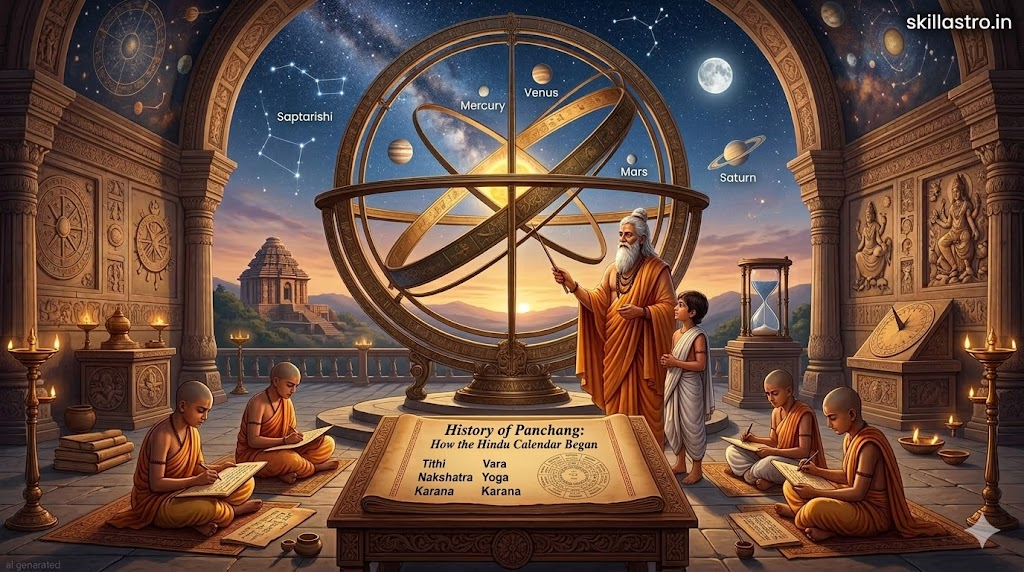
Almost all civilizations in the world created their own calendars to measure time, but the Indian 'Panchang' is the most unique due to its incredible accuracy and scientific depth. The history of the Panchang is not merely a tool for tracking dates; rather, it is a microscopic map of the dynamic movements of the Sun, Moon, and constellations (Nakshatras). While Western calendars are based solely on the Sun, our Panchang beautifully reflects the remarkable harmony between the Sun and the Moon.
In this article, we will deeply explore how the Hindu calendar originated and how the ancient sages meticulously crafted the five limbs of the Panchang.
Meaning and Origin of the Panchang
The word Panchang is derived from two Sanskrit words: 'Pancha' (five) and 'Anga' (limbs). It essentially refers to the scripture that divides time into five main components.
The Foundation of the Panchang in the Vedas The history of the Panchang is as ancient as the Vedas themselves. The Rigveda contains explicit descriptions of a 12-month and 360-day cycle. The ancient sages realized that the absolute purity of time (Muhurat) is essential for the success of Yagyas (fire rituals) and religious ceremonies. This very necessity gave birth to the highly advanced mathematical framework of the Panchang.
Luni-Solar System (Chandra-Saur Ganana) The Hindu calendar originated using the 'Luni-Solar' method. This means that the months are precisely determined by the phases of the Moon, while the balance of the entire year is maintained by the Sun's transit into different zodiac signs (Sankranti). It stands as the world's most complex, yet astonishingly accurate, time calculation system.
Talk to India's Best Astrologer at ₹1/min Only
Expert guidance for Career, Love & Marriage. Get accurate predictions instantly from verified Vedic Astrologers.
Chat Now »
Talk to India's Best Astrologer at ₹1/min Only
Expert guidance for Career, Love & Marriage. Get accurate predictions instantly from verified Vedic Astrologers.
Chat Now »
The Five Limbs of the Panchang: The Five Pillars of Time
Ancient India established five major pillars for measuring time, which are universally known as the five limbs of the Panchang:
1. Tithi (Lunar Day) The angular distance between the Moon and the Sun is called a 'Tithi'. One Tithi is completed when the Moon moves exactly 12 degrees ahead of the Sun. The formation of the 15 Tithis leading up to the Full Moon (Purnima) and the 15 Tithis leading to the New Moon (Amavasya) is entirely based on this astronomical phenomenon.
2. Vara (Day of the Week) The Panchang outlines seven Varas (days). Interestingly, these seven days are named sequentially after the seven main planets that can be seen with the naked eye (Sun, Moon, Mars, Mercury, Jupiter, Venus, Saturn).
3. Nakshatra (Constellation) The celestial sphere is divided into 27 equal parts, known as Nakshatras. The Moon enters a new Nakshatra every single day. Throughout the history of the Panchang, the calculation of Nakshatras has remained the most precise scale for measuring time and cosmic energy.
4. Yoga A 'Yoga' is formed by the mathematical sum of the positions of the Sun and the Moon. There are a total of 27 Yogas, which play a crucial role in determining a person's nature and finding the auspicious timings for major tasks.
5. Karana Exactly half of a Tithi is called a 'Karana'. There are a total of 11 Karanas. In the Panchang, they are specifically utilized to extract highly auspicious timings for agricultural, commercial, and vital life events.
The Origin of the Hindu Calendar: Vikram and Shaka Samvat
The history of the Panchang is deeply associated with various 'Samvats' (eras). For calculating time in India, two main calendars became the most prominent.
The Rise of Vikram Samvat King Vikramaditya established the 'Vikram Samvat' in 57 BCE to commemorate his grand victory over the Shakas in Ujjain. This Panchang is still the most widely used and popular calendar in North India today. It is based on the movement of the Moon and marks its new year on Chaitra Shukla Pratipada.
Shaka Samvat and the National Calendar The Shaka Samvat began in 78 CE. It has been officially adopted by the Government of India as the 'National Calendar'. Its precise calculations are based on the Sun's transit, specifically the 'Aries Equinox' (Mesh Sankranti).
The Secret of Adhik Maas: The Scientific Balance of the Panchang
In the Western (Gregorian) calendar, a 'Leap Year' occurs every 4 years. However, the Hindu Panchang manages this through the highly scientific system of an 'Adhik Maas' (an intercalary month, also known as Purushottam Maas).
The Difference Between the Solar and Lunar Year A solar year consists of approximately 365 days, whereas a lunar year consists of roughly 354 days. To bridge this critical 11-day gap, an extra month is added to the Panchang every third year. Because of this brilliant adjustment, our festivals (like Diwali or Holi) always maintain perfect harmony with the changing seasons and never fall behind.
The Astronomical and Mathematical Significance of the Panchang
The great astronomers of ancient India built the Panchang on a foundation of pure mathematics and geometry.
The Research of Aryabhata and Varahamihira In his treatises, Aryabhata clarified the microscopic and complex calculations of the Panchang. Through monumental texts like the 'Surya Siddhanta', Varahamihira explained the exact positions of the planets and the methods for constructing the Panchang—calculations that astonishingly align with modern NASA data today.
Vedic Remedies to Overcome Panchang Doshas (Flaws)
Certain periods in the Panchang are deemed 'inauspicious' and are known as Doshas (flaws). The sages compassionately provided methods to resolve them as well.
Consideration of Bhadra and Rahu Kaal In the Panchang, periods like Bhadra and Rahu Kaal are strictly prohibited for starting auspicious tasks. However, if a task must urgently be done, the sages advised performing it during the 'Abhijit Muhurat', a powerful time window that destroys all astrological flaws.
Pacifying Flaws through Mantras and Charity If an individual is born during an inauspicious Nakshatra or Tithi (such as Gandmool or Amavasya), the Panchang Shastra prescribes specific mantra chanting and planetary donations (Daan). These remedies effectively pacify the planets and reduce life's struggles.
Frequently Asked Questions (FAQs)
Q1: Is the Panchang only meant for worship and religious rituals?
Ans: No, the Panchang is a complete, holistic science used for understanding agriculture, health, travel, weather forecasting, and human psychological energy.
Q2: What is the significance of Purnima and Amavasya?
Ans: Purnima (Full Moon) is a symbol of the Moon's complete power, representing mental peace and fulfillment. Amavasya (New Moon) represents the union of the Sun and the Moon and is considered highly significant for ancestral rites (Pitru Karya) and deep meditation.
Q3: When does the Hindu New Year begin?
Ans: The Hindu New Year begins on 'Chaitra Shukla Pratipada' (usually falling in March-April), which is also joyously celebrated as 'Gudi Padwa', 'Ugadi', or 'Nav Samvatsar'.
Conclusion
The history of the Panchang is the glorious story of India's intellectual supremacy—a civilization that made a remarkable effort to scientifically decode and bind time. The Hindu calendar originated not just to casually count dates, but to establish a profound harmony between human life, nature, and the vast universe. Even today, our Panchang seamlessly guides us on when to sow seeds, when to fast, and when to embark on new beginnings. This precious gift from the ancient sages continues to make our lives disciplined, purposeful, and prosperous today.