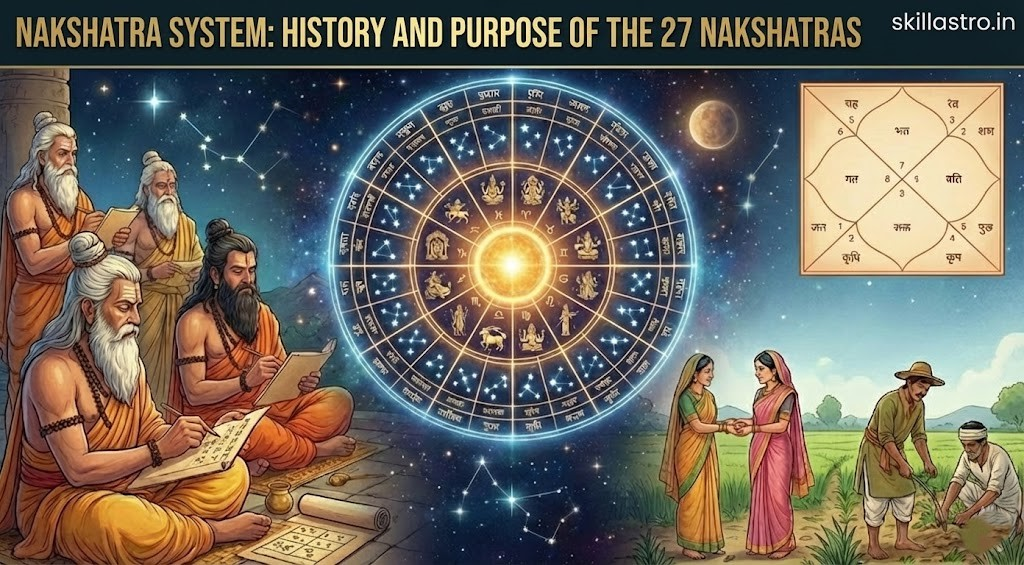
When we look up at the sky at night, we see countless twinkling stars. To modern science, these may just be spheres of hydrogen and helium, but to our ancient Indian sages, they were a giant clock for 'Time Calculation' (Kaal Ganana).
The foundation of Indian Astrology, also known as 'Vedic Astrology', is the 'Nakshatra'. Have you ever wondered why there are only 12 signs in the Zodiac, but 27 Nakshatras? Why is their history considered older than the Zodiac signs? And the most important question—why did our ancestors divide the sky into exactly 27 parts?
The history of the Nakshatra system is a golden chapter in the intellectual journey of human civilization. In today's detailed article, we will turn the pages of the Vedas and uncover the history of the Nakshatra system, its scientific basis, and its 5000-year-old secrets.
Part 1: Meaning and Definition of the Word 'Nakshatra'
Before understanding the history of the Nakshatra system, we must understand the essence of the word itself. According to Nirukta (Vedic Etymology), the word Nakshatra has several meanings:
Na Ksharati Iti Nakshatrah: That which does not decay, is not perishable, and does not deviate from its place. This refers to the Fixed Stars.
Naksha + Tara: 'Naksha' means 'to obtain' or 'to move', and 'Tara' means star. Meaning, the stars through which the Moon moves.
Naksh (Night) + Tra (Protector): The protectors of the night.
Ancient Indian astronomers observed that while the Sun, Moon, and other planets move across the sky, the groups of stars (Constellations) behind their path remain stationary. These star groups were called 'Nakshatras'.
Talk to India's Best Astrologer at ₹1/min Only
Expert guidance for Career, Love & Marriage. Get accurate predictions instantly from verified Vedic Astrologers.
Chat Now »
Talk to India's Best Astrologer at ₹1/min Only
Expert guidance for Career, Love & Marriage. Get accurate predictions instantly from verified Vedic Astrologers.
Chat Now »
Part 2: Origin – First Evidence of Nakshatras in the Vedas
The Nakshatra system was not born in a single day. It is the result of centuries of Observation. Historically, the Nakshatra system is much older than the 12 Zodiac Signs.
1. Mention in the Rigveda
Clear references to Nakshatras are found in the Rigveda, the world's oldest text. Rigveda (1.50.2) discusses the relationship between the Sun and the stars. Names like 'Tishya' (Pushya) and 'Revati' are found there. At that time, Nakshatras were used primarily to determine the timing of Yagyas (sacrificial rituals).
2. Atharvaveda and Taittiriya Samhita
The complete List of Nakshatras is found in the Taittiriya Samhita of the Yajurveda and the Atharvaveda. Here, there is a detailed description of the names of 27 (and sometimes 28) Nakshatras and their deities in order. This proof establishes that at least 3000-4000 years before Christ, Indians had already mapped the sky.
3. Vedanga Jyotish – The First Astronomical Text
Composed by Lagadha Muni around 1400 BC, 'Vedanga Jyotish' was entirely based on Nakshatras. By that time, the 12 Zodiac signs (Aries, Taurus, etc.) were not in vogue. The Indian calendar was entirely dependent on the position of the Sun and the Nakshatras.
Part 3: Why Only 27 Nakshatras? (The Science Behind 27)
This is the most critical technical part of this blog. Why did our sages divide the sky into 27 parts, and not 10, 20, or 50? There is deep Astronomy and mathematics behind this.
1. The Daily Motion of the Moon
Indian Astrology is 'Moon-centric'. Sages observed that while the Sun takes 365 days to complete one circle of the sky, the Moon is very fast.
The Moon takes approximately 27.32 days to complete one full circle of the Earth (or the celestial sphere).
This period of 27.32 days is called the 'Sidereal Month' (Nakshatra Maas).
2. Division of the Sky
Since the Moon takes about 27 days to complete a circle, the sages divided the 360-degree circle of the sky into 27 equal parts.
Math: 360° ÷ 27 = 13° 20' (13 degrees 20 minutes).
This means the Moon travels through one part (13° 20') every day.
This single part was called a 'Nakshatra'.
Thus, the Nakshatra system is essentially the Moon's GPS. It tells us which 'Star Mansion' the Moon is resting in tonight.
Part 4: The Mystery of Abhijit Nakshatra (The 28th Star)
There is an interesting twist in history. Ancient Vedic texts often speak of 28 Nakshatras. This 28th Nakshatra is 'Abhijit'.
The Problem: The Moon's orbital period is not exactly 27 days, but 27.32 days. This remaining 0.32 day could create errors in calculation over time.
The Solution: To adjust for this extra time, a small space between the Uttarashada and Shravana Nakshatras was given to 'Abhijit'.
Current Status: Over time, for mathematical simplicity, the system of 27 Nakshatras became the standard, and Abhijit was considered a 'subtle' or 'invisible' Nakshatra and removed from daily calculations. Today, it is used only for special auspicious moments (like Abhijit Muhurta).
Part 5: Mythological History – The Story of Daksha Prajapati and the Moon
In Indian culture, science is often explained through stories (Mythology) so that it remains memorable to the common people. The mythological story of the origin of Nakshatras is very famous.
According to the Puranas, Daksha Prajapati had 27 daughters (from Ashwini to Revati). All of them were married to the Moon God (Chandra).
This story is a personification of astronomical truth. The Moon (husband) stays in the house of one of his wives (Nakshatras) every night.
Love for Rohini: The story says that the Moon loved Rohini Nakshatra the most and spent more time with her. Astronomically, this represents the Moon's 'Exaltation' point, where the Moon is considered strongest and most auspicious.
Daksha's Curse: When the Moon discriminated, Daksha cursed him to 'decay' (TB/Waning). This explains the waxing and waning phases of the Moon (Krishna Paksha and Shukla Paksha).
Part 6: Nakshatra vs. Zodiac Signs (Rashi) – Which Came First?
There is often confusion in history about whether Zodiac Signs (Rashis) came first or Nakshatras.
Nakshatras (Oldest): Nakshatras were prevalent since the Vedic period (5000 BC). At that time, there was no existence of Aries or Taurus signs in Indian texts.
Rashis (Later): In the early centuries AD, when Greek influence merged with the Indian Siddhanta era, the 12 Zodiac signs were developed.
The Relationship: Indian sages integrated both. They decided that:
1 Rashi = 2.25 Nakshatras (Two and a quarter Nakshatras).
For example, the sign of Aries contains the entire Ashwini, entire Bharani, and the first quarter of Krittika.
This Integration is the most amazing example of mathematics in world history, which is still alive today in the form of the 'Panchang'.
Part 7: Classification of Nakshatras and Deities
The ancient sages did not just divide the sky; they also deeply studied the Nature of each Nakshatra. They assigned a specific 'Ruling Deity' to each Nakshatra, representing its energy.
| Nakshatra | Deity | Nature/Energy |
| Ashwini | Ashwini Kumar (Physicians) | Healing, Speed, Beginnings |
| Bharani | Yama (God of Death) | Restraint, Struggle, Justice |
| Krittika | Agni (Fire) | Sharpness, Purity, Burning |
| Rohini | Prajapati (Brahma) | Creation, Growth, Attraction |
| Ardra | Rudra (Shiva) | Destruction, Tears, Renewal |
This classification tells us what the nature of a person born in that Nakshatra will be or which activity is auspicious to do on that day.
Part 8: Historical and Practical Importance of the Nakshatra System
This system of 27 Nakshatras remained not just limited to books but deeply influenced Indian society.
1. Naming Ceremony (Namkaran Sanskar)
In Indian history, a person's identity was defined by their Nakshatra.
Each Nakshatra has 4 quarters (Padas), and each quarter has a specific Sound/Syllable.
The child's name was kept starting with that letter so that their name carries the Vibration of cosmic energy. This tradition continues today.
2. Marriage Matching (Gun Milan)
The '36 Gunas' matched for marriage are entirely based on Nakshatras (Nadi Dosha, Bhakoot Dosha, Gana Dosha, etc.). This was an ancient method to test Genetic Compatibility and mental harmony.
3. Agriculture and Meteorology
For farmers, Nakshatras were a calendar. Sayings like "Sowing seeds in Ardra" or "Crops ripening in Swati" are still prevalent in rural India. The ancient text 'Krishi-Parashara' contains formulas for predicting rain based on Nakshatras.
Part 9: List of Nakshatras (At a Glance)
For the convenience of readers, here is the order of the 27 Nakshatras starting from 0 degrees Aries to 360 degrees Pisces in the sky:
Ashwini, 2. Bharani, 3. Krittika, 4. Rohini, 5. Mrigashira, 6. Ardra, 7. Punarvasu, 8. Pushya, 9. Ashlesha, 10. Magha, 11. Purva Phalguni, 12. Uttara Phalguni, 13. Hasta, 14. Chitra, 15. Swati, 16. Vishakha, 17. Anuradha, 18. Jyeshtha, 19. Mula, 20. Purva Ashadha, 21. Uttara Ashadha, 22. Shravana, 23. Dhanishtha, 24. Shatabhisha, 25. Purva Bhadrapada, 26. Uttara Bhadrapada, 27. Revati.
Frequently Asked Questions (FAQs)
Q1: is the total number of Nakshatras 27 or 28?
Answer: Originally, in the Vedic period, 28 Nakshatras were considered (including Abhijit). However, to keep astronomical calculations precise and in equal parts, the system of 27 Nakshatras was later standardized. Abhijit is now considered a 'subtle Nakshatra'.
Q2: What is the difference between Nakshatra and Rashi (Zodiac Sign)?
Answer: A Nakshatra is a small division of the sky (13 degrees 20 minutes), while a Rashi is a large division (30 degrees). One Rashi contains two and a quarter Nakshatras. Nakshatras indicate effects at a 'Micro' level, while Rashis at a 'Macro' level.
Q3: Which is considered the most auspicious Nakshatra?
Answer: In Vedic Astrology, 'Pushya' Nakshatra is called the 'King of Nakshatras'. It is considered nourishing and extremely auspicious (except for marriage). Apart from this, Rohini and Mrigashira are also considered very auspicious.
Q4: What are Gandmool Nakshatras?
Answer: In the Nakshatra wheel, where both the Rashi and the Nakshatra end together (junction points), those Nakshatras are called 'Gandmool'. These are—Ashwini, Ashlesha, Magha, Jyeshtha, Mula, and Revati. Special peace rituals (Shanti Puja) are prescribed for children born in these Nakshatras.
Q5: Who invented the Nakshatra system?
Answer: This is not the invention of a single person. It is a system developed by many sages (like Lagadha, Garga, Parashara) over thousands of years. Its original source is the 'Vedas', which are considered Apaurusheya (divinely revealed).
Conclusion
The history of the Nakshatra system tells us how advanced India's ancient science was. When the world was only estimating day and night by looking at the Sun, our sages measured the subtle path of the Moon and created an infallible Map of 27 Nakshatras that is relevant even thousands of years later.
This arrangement of 27 Nakshatras was not just to know 'fortune', but an attempt to understand 'Time'. It teaches us that we are not separate from the universe; just as the Moon breathes in a Nakshatra, our mind beats in the same rhythm.
This glorious history inspires us to understand this scientific heritage and respect it not as superstition but as 'Ancient Astronomy'.