 Join WhatsApp Channel
History of the Horoscope: A Journey of Cosmic Energy Maps and Human Consciousness
In the history of human civilization, curiosity has been the greatest power. When early humans first emerged from caves and looked at the twinkling stars in the night sky, the question must have surely arisen: "Is there a connection between these shining bodies and my life?" That was the exact moment the seed of the science of the 'Horoscope' (Kundali) was sown. The word Kundali literally means a 'circle' or 'coil'—representing the cycle of time that contains the entire cosmic energy of the specific moment an entity is born.
The history of the horoscope is not just the history of lines drawn on paper; it is the saga of the discovery of the unbreakable bond between time, the sky, and humanity. Let us turn the pages of history to when sages first began to understand the language of the stars.
Origin of the Horoscope: Eyes of the Vedas and the Divine Vision of Sages
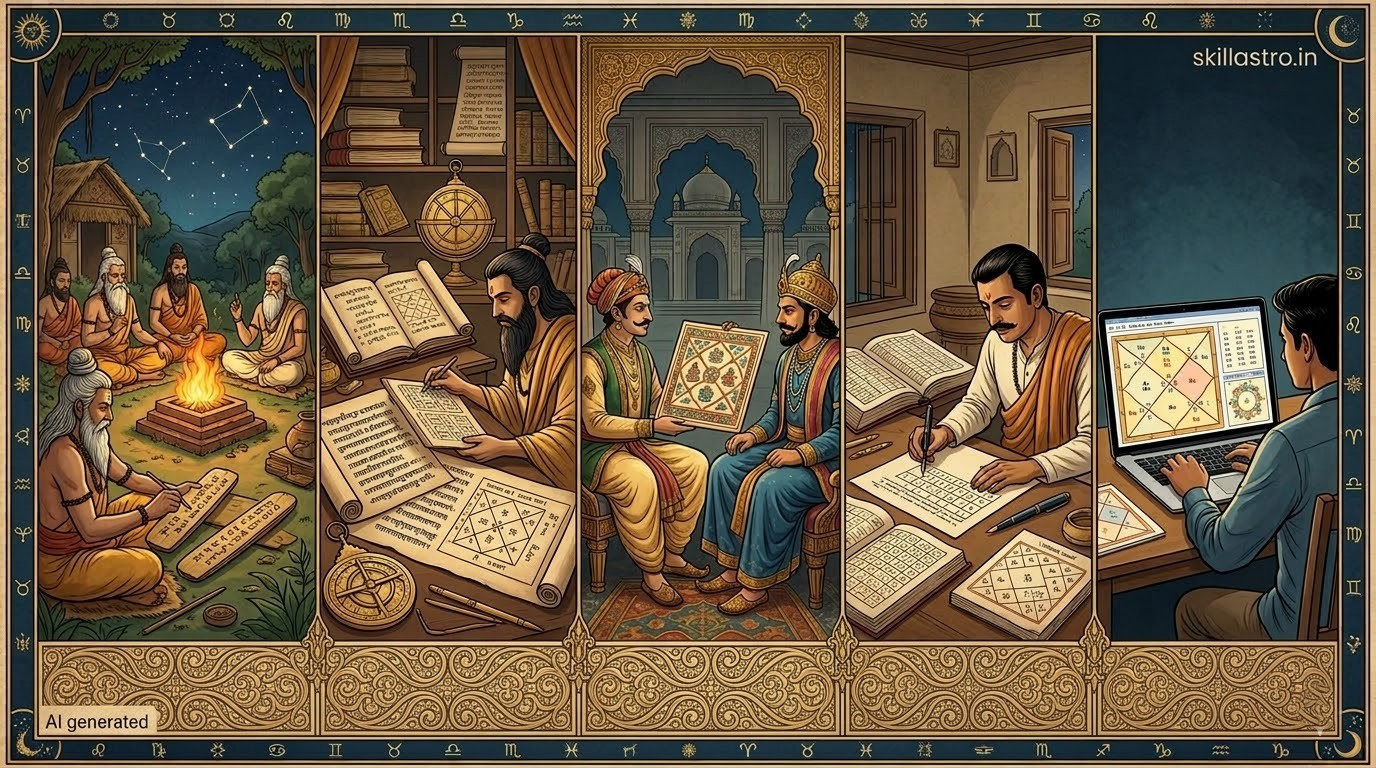
In Indian tradition, the history of the horoscope begins in the Vedic period. Astrology is called 'Vedanga,' meaning a limb of the Vedas. Just as a human cannot see the world without eyes, it is impossible to understand the subtle science of time in the Vedas without astrology. In ancient times, the primary purpose of a horoscope was to determine 'Auspicious Timing' (Muhurta) for rituals and sacrifices.
In the initial stages, the horoscope was not the 12-house diagram we see today. At that time, the 'Nakshatra Kundali' held primary importance. During the era of the Rigveda and Yajurveda, a person’s life path was determined based on the constellation (Nakshatra) the Moon resided in at the time of birth. After thousands of years of research, sages realized that constellations alone were not enough; the positions of other planets and the Ascendant (Lagna) were equally vital.
Talk to India's Best Astrologer at ₹1/min Only
Expert guidance for Career, Love & Marriage. Get accurate predictions instantly from verified Vedic Astrologers.
Chat Now »
Talk to India's Best Astrologer at ₹1/min Only
Expert guidance for Career, Love & Marriage. Get accurate predictions instantly from verified Vedic Astrologers.
Chat Now »
Mathematical Evolution: The Rise of the Ascendant and Houses
The biggest turning point in the history of the horoscope came when the concept of the 'Lagna' (Ascendant) was developed. Since the Earth rotates on its axis, a new zodiac sign rises on the eastern horizon every two hours. Ancient sages, particularly Maharishi Parasara and Varahamihira, observed that two individuals born on the same day have different destinies because the Ascendant changes based on the exact 'time' and 'place' of birth.
Maharishi Parasara composed the Brihat Parasara Hora Shastra, which remains the foundational pillar of horoscope science today. He divided the horoscope into 12 Houses (Bhavas) and linked each house to a specific aspect of human life. This marked the beginning of the golden age of predictive astrology, where the horoscope became a mirror of an individual's character, health, wealth, and transition.
Global Context: Influence of Mesopotamia and Greek Horoscopy
The history of the horoscope was not confined to India alone. Evidence of recording planetary positions exists in ancient Babylon (Mesopotamia) as well. The earliest evidence of individual birth charts has been found on 'Clay Tablets' dating back to the 5th century BCE.
Later, following the invasion of Alexander the Great, the meeting of Indian and Greek cultures further refined the art of horoscope writing. Greek astrologers clarified the personified symbols of the zodiac signs, while Indian sages gave birth to subtle calculations like the 'Dasha System' and 'Navamsha' (divisional charts). The science that emerged from this exchange gained global fame as 'Hora Shastra.'
The 12 Houses: 12 Historical Dimensions of Life
In history, the 12 boxes of a horoscope are considered a summary of a human’s entire existence. Ancient texts organized them in this manner:
| Horoscope House | Historical and Philosophical Significance |
| Ascendant (1st) | The arrival of the soul on Earth and the physical form. |
| 5th (Knowledge) | Accumulated merits from past lives and intellectual capacity. |
| 8th (Longevity) | The mysteries of life, crises, and the process of transformation. |
| 9th (Fortune) | Religion, the Guru, and the blessings of ancestors. |
| 11th (Gains) | Achievements in society and the fulfillment of desires. |
| 12th (Moksha) | Sacrifice, expenditure, and the ultimate liberation of the soul. |
The Medieval Era: Grandeur of Handwritten Horoscopes
In medieval India, the creation of a horoscope became a grand art. Upon the birth of kings and nobles, the 'Royal Priest' would work for weeks to create long, detailed horoscopes. These were written on palm leaves or handmade paper, often adorned with beautiful illustrations.
During that time, a horoscope was not just a tool to know the future, but a mandatory document for 'Guna Milan' (compatibility matching) at the time of marriage and for 'Dosha Nivaran' (remedy of defects) during sacraments. It is recorded in history that many major decisions regarding wars and treaties were taken only after observing planetary conjunctions in horoscopes.
The Modern Era: Digital Revolution and the New Form
In the 21st century, the history of the horoscope has taken a giant leap. Modern platforms like SkillAstro have made calculations 100% accurate through computer and AI technology. Calculations that took ancient astrologers hours are now available in a hundredth of a second.
Today’s 'Digital Horoscope' contains not just the 12 houses, but also Ashtakvarga, subtle divisions of the Vimshottari Dasha, and scientific analysis of planetary degrees. Although the medium has changed, the sentiment behind it remains the same—to understand the relationship between man and the cosmos.
Spiritual Essence: Destiny and Self-Effort
The history of the horoscope teaches us that human life is not a mere coincidence. A horoscope is an account of our 'Prarabdha' (the fruit of past actions). However, sages never claimed that the horoscope is everything; they always emphasized 'Purushartha' (current self-effort).
A horoscope tells us when a 'storm' is coming and when the 'sun' will shine. It inspires us to maintain patience during adverse times and to act with full velocity during favorable periods. History bears witness that great individuals have changed the influence of malefic planets in their charts through their spiritual practice and actions.
Ancient Remedies to Mitigate Negative Influences
In every period of history, sages have suggested Sattvic and psychological remedies to reduce the hardships indicated in a horoscope:
Sound Therapy (Mantra): Chanting specific Bija Mantras to balance planetary energy.
Nature Therapy (Charity): Giving away or donating items related to the planet causing a negative influence.
Gemstone Science: Using specific metals and gems to allow the sun’s rays to enter the body effectively.
Lifestyle Changes: Developing discipline for Saturn, respect for Jupiter, and courage for Mars.
Frequently Asked Questions (FAQs)
1. Is the history of horoscopes based on superstition?
Absolutely not. The horoscope is entirely based on mathematical calculations and astronomy. It is an ancient scientific method of observing the positions and movements of planets, which modern astronomy also acknowledges.
2. Is the map of a horoscope different in different cultures?
Yes, in India, two main maps are prevalent: 'North Indian' (square) and 'South Indian' (rectangular). Western countries use a 'Circular' chart. Although the form is different, the planetary calculations and principles of their results are nearly identical.
3. Can a horoscope be made if the exact birth time is unknown?
In the history of astrology, there are mentions of branches like 'Nashta Jataka' (lost horoscopy) and 'Prashna Kundali' (horary astrology), through which solutions to a person's problems can be found even without birth details.
Conclusion
The history of the horoscope is truly the story of human intelligence’s victory—learning to read the language of the stars by transcending the boundaries of time. From the Vedic era to the age of supercomputers today, the horoscope has always reminded us that we are a part of the universe.