
 Join WhatsApp Channel
History of the Birth Chart: The Amazing Art of Capturing a Moment in Time
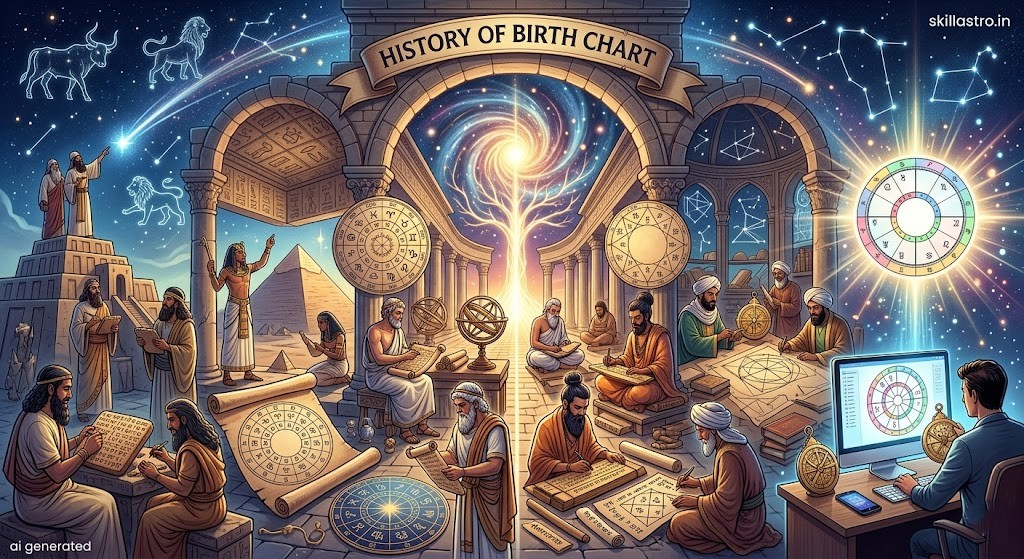
When we hear the word "birth chart," we often picture a piece of paper with a grid of squares and names of planets. But have you ever wondered when humans first thought that the positions of planets in the sky at the time of their birth could be linked to their entire life? The history of the birth chart is essentially the story of the evolution of human consciousness, where man began to see time not just as the ticking of a clock, but as a unique cosmic 'snapshot' of energy.
A birth chart is truly a 'Map of Time.' It is the blueprint of that specific moment when a living being took its first breath on this earth. Let’s travel back thousands of years to see how this incredible discipline was sown and developed.
The Origin of the Birth Chart: The Union of Astronomical Calculation and Divine Justice
The early history of the birth chart stands at the intersection of ancient Mesopotamia and Vedic India. Evidence from around the 5th century BCE suggests that humans began recording planetary positions at the time of individual births. In ancient civilizations, 'Muhurta Jyotish' (Electional Astrology) was initially dominant, used primarily for the future of kings and nations.
However, Indian sages gave this a new depth. They postulated that every human brings with them a 'bundle' of karmas from previous lives. To understand this karmic fruit, studying the sky at the moment of birth was considered mandatory. Maharishi Parasara, whom we call the patriarch of predictive astrology, established the birth chart as a complete science through the Hora Shastra.
Talk to India's Best Astrologer at ₹1/min Only
Expert guidance for Career, Love & Marriage. Get accurate predictions instantly from verified Vedic Astrologers.
Chat Now »
Talk to India's Best Astrologer at ₹1/min Only
Expert guidance for Career, Love & Marriage. Get accurate predictions instantly from verified Vedic Astrologers.
Chat Now »
Evolution of the Chart’s Format: Timeline and Cultures
The format of the birth chart was not always as we see it today. Its history has seen many changes:
Nakshatra-Based Calculation: In the ancient Vedic period, only the 'Nakshatra' (Constellation) was observed. A person's nature and fortune were determined by the constellation they were born under.
The Rise of the Ascendant (Lagna): Gradually, sages realized that Nakshatras alone were not enough. Since the Earth rotates on its axis, the sign rising on the eastern horizon changes every two hours. This was called the 'Lagna.' The introduction of the Lagna brought 'Precision' to the birth chart.
Melding of Greek and Indian Methods: Around the 2nd century BCE, when Indian and Greek (Yavana) astrologers came into contact, the concept of the 12 Houses (Bhavas) became more solidified. Texts like the Yavana Jataka explained the results of the various houses in detail.
The Mystery of the 12 Houses: A Complete Portrait of Life
History bears witness that the 12 boxes of the chart were linked to 12 essential areas of human life. Our ancestors organized this very scientifically:
| House of the Chart | Area of Life | Historical Significance |
| First House (Lagna) | Body and Personality | Symbol of the individual's very existence. |
| Second House | Wealth and Speech | Focus on family and accumulated capital. |
| Fourth House | Happiness and Mother | Center of land, home, and mental peace. |
| Seventh House | Marriage and Partnership | Mirror of social relations and household life. |
| Tenth House | Action (Karma) and Status | The field of status in society and livelihood. |
| Twelfth House | Expenditure and Salvation | The ultimate goal of life and spiritual journey. |
The Medieval Period and the Art of Chart Writing
In the medieval period, the importance of the birth chart grew immensely. This was the era when the tradition of creating handwritten charts (Janmapatris) began. Upon the birth of kings, astrologers would calculate for weeks to prepare long scrolls. These included not just the 12 houses, but also 'Shodashvarga' (16 types of subtle divisions).
The yellow, hand-drawn chart made by the local 'Pandit Ji' using an almanac remains a living part of our history in Indian villages. In those times, having a chart was not just for knowing the future, but acted like an 'Identity Card,' used mandatorily in marriages and sacraments.
Modern Era: The History of Computerized and Digital Charts
At the end of the 20th century and the beginning of the 21st, the biggest revolutionary change in the history of the birth chart occurred. With the advent of computers and software, calculations that took hours are now available with a single click. Platforms like SkillAstro have bridged this ancient wisdom with modern technology, making it accessible to the common man.
Today’s charts contain not only planetary positions but also scientific graphs, Ashtakvarga, and precise time calculations. Although technology has changed, the principles provided by Maharishi Parasara and Varahamihira remain immovable.
Philosophical Basis: Is Everything Pre-determined?
The history of the birth chart teaches us the balance between 'Destiny' and 'Free Will.' The chart tells us which cards we have been dealt, but how to play those cards depends on our effort (Purushartha). Sages called the chart 'Light'—like a flashlight on a dark road. The light can show that there is a pit ahead, but avoiding that pit or falling into it depends on human wisdom.
Ancient and Effective Remedies to Remove Chart Defects
In every era of history, sages have prescribed Sattvic remedies to mitigate chart defects (such as Manglik Dosha, Kaal Sarp Dosha, or Shani's Sade Sati):
Graha Shanti Puja: In ancient times, negative planetary waves were calmed through the ritual of Mantras.
Gems and Metals: There has been a tradition of wearing specific gemstones in rings or pendants to balance planetary rays within the body.
Philanthropy and Charity: This is the most powerful historical remedy. Donating items related to the afflicted planet reduces the hardships of past destiny.
Mantra Chanting: Personal practice and mental chanting of Mantras strengthen the inner self, giving the power to fight the ill effects of the chart.
Frequently Asked Questions (FAQs)
1. Can a difference of a few minutes in birth time change the chart?
Yes, absolutely. History describes 'Varga Kundalis' (Divisional Charts) that change every few minutes. Especially in the case of twins, an exactly accurate time is mandatory for subtle calculations.
2. Is the birth chart only for Hindus?
No, it is an astronomical science. Although its roots are in the Vedas, the influence of planets falls on every human born on this earth. Parsi, Jain, Buddhist, and even Western cultures have their own forms of charts recorded in history.
3. Can the future be known without a birth chart?
In the history of astrology, there are other disciplines like 'Prashna Kundali' (Horary Astrology) and 'Palmistry,' which are used when an individual does not have their birth details. However, the birth chart is considered the most authentic and detailed.
Conclusion
The history of the birth chart is truly the history of the search for the self. For thousands of years, this discipline has reminded us that our life is not just a coincidence, but part of a grand cosmic plan. From the verses of the Vedas to today’s mobile apps, the birth chart has always shown us the way.