 Join WhatsApp Channel
History of the 27 Nakshatras: A Journey Through the Heartbeat of Time and Celestial Milestones
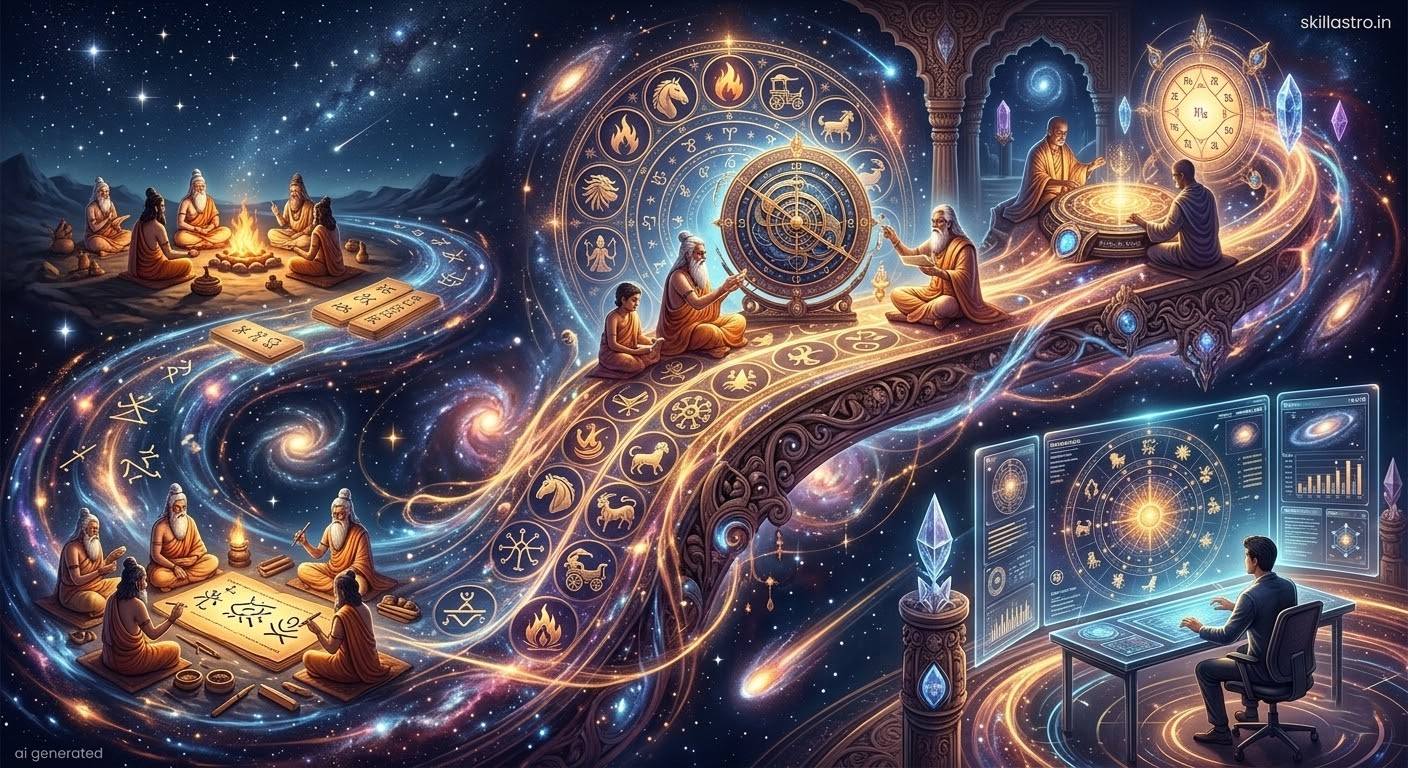
In the infinite expanse of the universe, when we gaze at the sky in the quiet darkness of the night, thousands of stars enchant us with their brilliance. Thousands of years ago, when there were no clocks or compasses, our great sages identified these star clusters and developed the most accurate calculation of time based on them. In astrology, these star groups are called 'Nakshatras.' The literal meaning of Nakshatra is—'Na Ksharati Iti Nakshatram', meaning that which never decays and remains forever stable.
The history of the Nakshatras is much more ancient than the history of the Zodiac signs (Rashis). While the Zodiac signs are based on the path of the Sun, the Nakshatras are directly related to the motion of the Moon. Let us travel back to the era of the sages where the divine journey of these 27 Nakshatras began.
The Origin of Nakshatras: Sacred Vedic Wisdom and Mythological Legends
In Indian culture, the oldest and most authentic references to the Nakshatras are found in the Rigveda and Yajurveda, the world's most ancient scriptures. In the Vedas, the Nakshatras are considered the 'abodes of the gods.' In ancient times, the Moon was regarded as the primary yardstick for time. Sages observed that the Moon completes one revolution of the Earth in approximately 27.3 days. The star cluster near which the Moon rests each day was named a 'Nakshatra.'
The Mythological Legend:
In the Puranas, the history of the Nakshatras is explained through a beautiful story. According to the legend, these 27 Nakshatras are the 27 daughters of Prajapati Daksha, who were married to the Moon God (Chandra Dev). The Moon loved 'Rohini' the most among all his wives. This story is actually a personification of an astronomical event, showing that the Moon is closest to the Rohini constellation and reaches its point of exaltation there.
Talk to India's Best Astrologer at ₹1/min Only
Expert guidance for Career, Love & Marriage. Get accurate predictions instantly from verified Vedic Astrologers.
Chat Now »
Talk to India's Best Astrologer at ₹1/min Only
Expert guidance for Career, Love & Marriage. Get accurate predictions instantly from verified Vedic Astrologers.
Chat Now »
Journey from the Vedic Period to the Modern Era
The history of the Nakshatras evolved in several stages:
Vedic Era: During this time, Nakshatras were primarily used to determine seasonal changes and the timing for Yagnas (sacrifices). A complete list of Nakshatras is found in the 'Taittiriya Samhita.'
Mahabharata Era: Detailed descriptions of Nakshatra positions are found during the time of the Mahabharata war. Lord Krishna relied on the calculation of Nakshatras to determine the start of the war and other key events.
Vedanga Jyotish: Sage Lagadha gave a mathematical foundation to the Nakshatras through 'Vedanga Jyotish' and explained how future events could be predicted using them.
Names of the 27 Nakshatras and Their Historical Symbols
History bears witness that every Nakshatra was named based on its shape and its inherent qualities. Here is a list of the 27 Nakshatras and a brief description of their symbols:
| Nakshatra Range | Nakshatra Names | Symbol and Historical Meaning |
| 1-3 | Ashwini, Bharani, Krittika | Horse's head, Yoni, and Axe (Power and Beginning). |
| 4-6 | Rohini, Mrigashira, Ardra | Chariot, Deer's head, and Tear drop (Beauty and Struggle). |
| 7-9 | Punarvasu, Pushya, Ashlesha | Bow, Cow's udder, and Serpent (Resurrection and Knowledge). |
| 10-12 | Magha, Purva Phalguni, Uttara Phalguni | Throne, Legs of a bed (Royal grandeur and Comfort). |
| 13-15 | Hasta, Chitra, Swati | Palm of the hand, Pearl, and Sword (Art and Freedom). |
| 16-18 | Vishakha, Anuradha, Jyeshtha | Potter's wheel, Lotus, and Earring (Goal and Seniority). |
| 19-21 | Mula, Purvashadha, Uttarashadha | Bunch of roots, Winnowing basket, and Elephant's tusk (Depth and Victory). |
| 22-24 | Shravana, Dhanishta, Shatabhisha | Ear, Drum, and Empty circle (Listening and Mystery). |
| 25-27 | Purva Bhadrapada, Uttara Bhadrapada, Revati | Sword, Twin children, and Fish (Sacrifice and Salvation). |
The Amazing Harmony Between Nakshatras and Zodiac Signs
In history, when the 12 Zodiac signs and 27 Nakshatras were integrated, astrology became even more subtle and accurate. One Zodiac sign contains two and a quarter Nakshatras (9 quarters/padas). This is why individuals born in the same Zodiac sign have different temperaments, as their Nakshatras differ. Nakshatras gave birth to subtle divisions like the 'Navamsha Chart,' which remains the greatest feature of Vedic astrology today.
Scientific and Psychological Significance
Ancient sages did not just name the Nakshatras; they also associated them with specific trees, birds, and animals. This is known today as the 'Nakshatra Vatika' (Constellation Garden). In history, this was a wonderful method of environmental conservation. Every individual was taught to worship and protect the tree associated with their birth Nakshatra.
On a psychological level, the Nakshatras represent the human soul and its mental makeup. While the Rashi (Zodiac sign) tells us about the external personality, the Nakshatra reveals the hidden tendencies and habits within us.
Ancient Remedies to Mitigate Adverse Nakshatra Influences
In every era of history, specific methods have been prescribed to remedy the defects of a birth Nakshatra (such as Mula Dosha or Gandmool Dosha):
Nakshatra Shanti Pujan: Worshiping the presiding deity of the birth Nakshatra and chanting mantras is the most effective historical remedy.
Plantation: Planting and nurturing the tree associated with one's birth Nakshatra removes negativity from the native's life.
Tradition of Charity: The scriptures mention donating specific grains and items related to each Nakshatra.
Mantra Therapy: Chanting the 'Bija Mantras' of the Nakshatras positively activates the brain cells.
Frequently Asked Questions (FAQs)
1. Has the number of Nakshatras always been 27?
Ancient texts also mention a 28th Nakshatra called 'Abhijit,' located between Shravana and Uttarashadha. However, in predictive astrology, 27 Nakshatras are primarily used, while Abhijit is used only for determining extremely auspicious timings (Muhurta).
2. How does the birth Nakshatra affect our life?
The birth Nakshatra is the primary basis for our mental state, the calculation of life cycles (Vimshottari Dasha), and marriage compatibility (Guna Milan). The ups and downs of your life depend on the Dasha (period) of the Nakshatra.
3. Was Nakshatra Vidya only prevalent in India?
No, the history of Nakshatras is also found in ancient China, Arabia, and Mesopotamia. In Chinese astrology, they are called 'Lunar Mansions.' However, the Indian Vedic Nakshatra system is world-renowned for its precision and spiritual depth.
Conclusion
The history of the 27 Nakshatras is the result of that great vision of human civilization which, while sitting on Earth, felt the heartbeat of the stars. Starting from the verses of the Vedas to today's modern digital almanacs, the Nakshatras have always introduced us to the speed of time and the mysteries of life.
Nakshatras teach us that we are not just a puppet of flesh and bone, but a part of that grand cosmic consciousness connected to stars shining thousands of light-years away. If we understand the nature of our Nakshatra and mold our lifestyle accordingly, we can not only be successful but also lead our lives toward ultimate bliss and salvation.