
 Join WhatsApp Channel
The History of Astrology: A Saga of the Union Between Cosmic Mysteries and Human Consciousness
Since the dawn of civilization, human curiosity has always looked toward the sky. Those shimmering stars, the waxing and waning of the moon, and the disciplined rising and setting of the sun were not merely celestial events, but a language our ancestors sought to decipher. Astrology, known as 'Vedanga' or the eye of the Vedas, is not just a scripture of predictions; it is a profound study of the calculation of time, the science of Karma, and the impact of celestial energies on human life.
The astrology we see today has roots dating back thousands of years. This history is as ancient as human thought itself. Let us walk back through the corridors of time to where the seeds of this divine science were first sown.
The Origin of Astrology: The Vedic Period and the Contribution of Sages
In Indian culture, the most ancient reference to astrology is found in the Rigveda, the oldest scripture in the world. In the Vedas, astrology is called 'Chakshu' or the eye. Just as eyes help us see the external world, the science of astrology empowers us to perceive the unseen future and the subtle movement of time.
In ancient times, the primary purpose of astrology was to determine the exact timing (Muhurta) for Yagnas and rituals. At that time, it was known as 'Vedanga Jyotish', composed by Sage Lagadha. He established rules for calculating seasons, months, and dates based on planetary positions. In that era, 'Nakshatras' (constellations) were given more importance than the zodiac signs.
Talk to India's Best Astrologer at ₹1/min Only
Expert guidance for Career, Love & Marriage. Get accurate predictions instantly from verified Vedic Astrologers.
Chat Now »
Talk to India's Best Astrologer at ₹1/min Only
Expert guidance for Career, Love & Marriage. Get accurate predictions instantly from verified Vedic Astrologers.
Chat Now »
Great Astrologers of Ancient India and Their Theories
As time passed, the knowledge of astrology did not remain limited to mere calculation; it began to take the form of predictive astrology (Phalit). During this evolutionary journey, many great personalities dedicated their entire lives to celestial calculations:
Aryabhata: A great mathematician and astronomer of the Gupta period who authored the 'Aryabhatiya'. He proved that the Earth rotates on its axis and explained the scientific reasons behind solar and lunar eclipses.
Varahamihira: He gave astrology the form of a systematic science through texts like 'Panchasiddhantika' and 'Brihat Samhita'. He categorized astrology into predictive (Phalit), mathematical (Ganit), and mundane (Samhita).
Bhaskaracharya: His text 'Siddhanta Shiromani' shed light on the motion of planets and early principles of gravity, which remain subjects of research for modern science.
Medieval Period and Foreign Contact: Global Expansion of Astrology
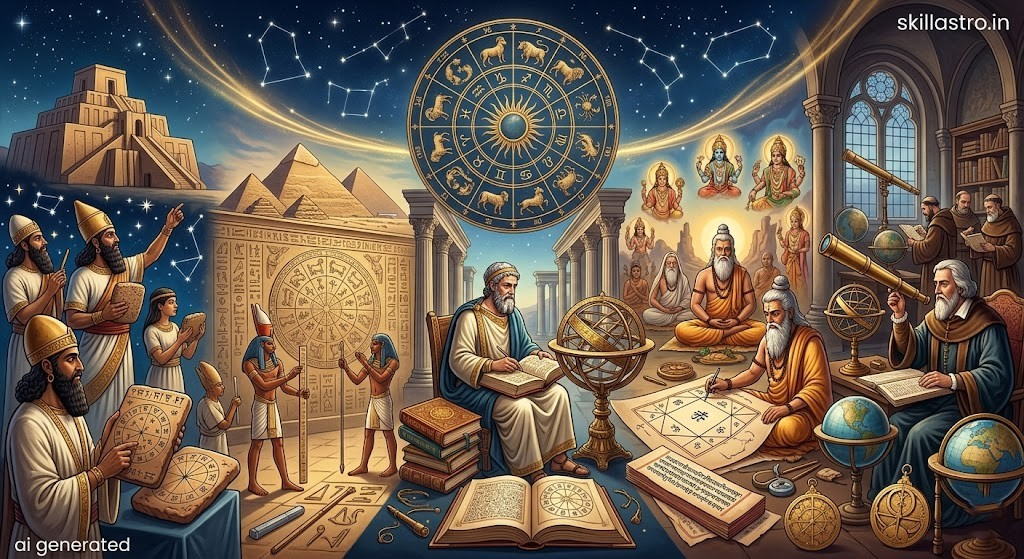
The knowledge of Indian astrology was not confined to the caves of the Himalayas. Through the Silk Road and trade routes, this wisdom reached Greece, Arabia, and Persia. After coming into contact with Greek astrology, the inclusion of 'Hora Shastra' and the 'Zodiac' became even more distinct in Indian astrology. Texts like the 'Yavana Jataka' showcase a beautiful confluence of Indian and Greek methodologies.
During the medieval period and the era of Mughal rulers, the importance of astrology did not diminish. Royal astrologers held significant positions in the courts of kings, determining everything from war strategies to the timing of coronations. It was during this time that branches like 'Lal Kitab' and 'Tajik Neelkanthi' developed, connecting astrology to the solutions of the common man's problems.
Astrology in the Modern Era: Science or Belief?
In the current age, astrology stands before us in a new form. While computers and software have resolved complex calculations in seconds, astrology is also being analyzed from a psychological perspective. Today, people do not just want to know what will happen, but why it will happen.
Modern astrology is no longer mere superstition; it has become a powerful medium for personality analysis, mental health, and career counseling. Universities across the world are now conducting research on the history of astrology and its mathematical foundation.
The Main Pillars of Astrology: A Brief Introduction
To understand the history of astrology, it is essential to know its three main branches:
| Branch | Description |
| Siddhanta (Ganit) | Focuses on the mathematical calculation of planetary motions and positions. |
| Samhita | Studies the impact of planets on the world, weather, and collective destiny. |
| Hora (Phalit) | Focuses on individual birth charts (Horoscopes) and predicting personal events. |
Astrology and the Theory of Karma
History bears witness that astrology never teaches one to sit idle. Our sages clarified that the birth chart is a map of our 'Prarabdha' (the fruits of past actions). Just as a skilled driver navigates safely even on a bad road through caution, astrology alerts us to upcoming obstacles so we can mitigate them through our present efforts and actions (Purushartha).
Ancient Astrological Remedies for a Happy Life
Alongside the history of astrology, 'remedies' have had their own evolutionary sequence. In ancient times, Mantras and Yagnas were prioritized, but over time, simpler remedies became popular:
The Glory of Charity: Donating items related to specific planets has been considered the best way to reduce their negative influence since ancient times.
Spirit of Service: Serving the elderly and helpless to please Saturn (Shani Dev), and respecting teachers for Jupiter (Guru), are considered the greatest remedies.
Connection with Nature: The worship of trees like Peepal, Banyan, and Shami is actually a way of environmental conservation and balancing planetary energies.
Mantra Chanting: Chanting Bija Mantras calms brain waves and increases concentration.
Frequently Asked Questions (FAQs)
1. Is the history of astrology limited only to India?
No, the history of astrology is global. Ancient Mesopotamia, Egypt, China, and the Maya civilization also had their own advanced theories of astrology. However, Indian Vedic astrology is considered the most authentic due to its mathematical depth and predictive accuracy.
2. Has the science of astrology changed over time?
The core principles of astrology (such as planetary traits and Nakshatras) are static, but the method of interpreting them has evolved. In olden times, predictions were made in the context of kings and emperors; today, they are made based on careers, technology, and modern lifestyles.
3. How accurate are predictions in astrology?
Astrology is a science of probabilities. A skilled astrologer can indicate accurate trends based on planetary positions. Success depends on how pure the calculation is and how much attention is paid to the 'Desh, Kaal, Paatra' (Place, Time, and Individual circumstances).
Conclusion
The history of astrology is the story of the indomitable human spirit that seeks to give itself meaning on the vast canvas of the universe. Starting from the verses of the Vedas and reaching modern computer screens, this science teaches us that we are not alone in this infinite cosmos. We are made of stardust, and the movement of the planets is connected to the pulse of our lives.