
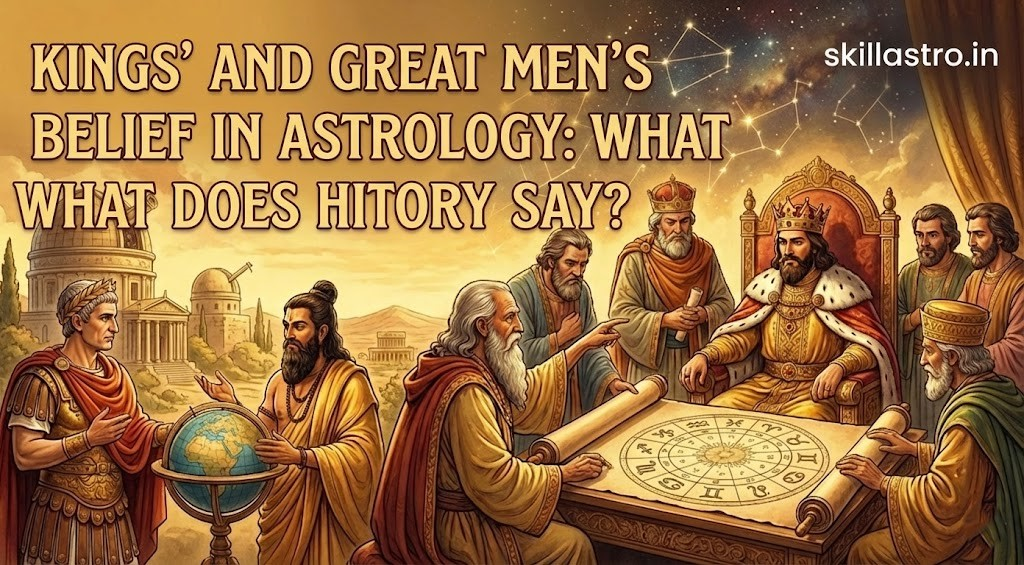
It is said that "Heavy is the head that wears the crown." Power brings with it uncertainty and fear. Will my kingdom remain safe? Will I win the war? Will my heir be worthy? These questions have plagued even the most powerful kings, emperors, and modern leaders in history.
When human intelligence and spy reports reached their limits, these great men looked toward the sky. Astrology has not just been a discipline but an integral part of governance and royalty. From the Chakravarti Emperors of ancient India to the Presidents of the United States, the history of belief in astrology is profound and fascinating.
In today's detailed article, we will turn the pages of history where the edge of the sword and the movement of planets together wrote the destiny of the world.
Part 1: Ancient India – Dharma, Royalty, and Astrology
India is considered the mother of astrology. Here, the king's duty was not only to protect the subjects but also to harmonize with 'Kaal' (Time).
1. Ramayana and Mahabharata Era
The two greatest epics of Indian history are filled with astrological references.
Ramayana: King Dasharatha had the Muhurta (auspicious time) for Lord Rama's coronation calculated by his family guru, Vashistha. Although the events changed due to Kaikeyi's boon, it proves that the importance of an auspicious time was paramount in that era.
Mahabharata: Bhishma Pitamah, who was blessed with the boon of choosing his time of death, waited for the 'Sun's Uttarayan' (northward movement) to leave his mortal body. This highlights the deep connection between celestial events and liberation (Moksha).
2. Emperor Vikramaditya and His Navratnas
There has hardly been any king in history who respected astrology as much as Emperor Vikramaditya of Ujjain.
He kept 'Navratnas' (Nine Gems) in his court, among whom Varahamihira (the great astronomer and astrologer) was prominent.
Varahamihira's predictions were so accurate that the King would not take any major decision—whether war or justice—without knowing the planetary positions.
3. Chanakya and the Mauryan Empire
Acharya Chanakya, who transformed Chandragupta Maurya from a common boy into an Emperor, understood the importance of astrology. In his treatise 'Arthashastra', he wrote that a king must appoint a 'Daivachintaka' (Astrologer) and a 'Mauhurtika' (Timekeeper). However, he also wisely stated, "He who only waits for the stars loses his objective," which is an excellent example of balance.
Talk to India's Best Astrologer at ₹1/min Only
Expert guidance for Career, Love & Marriage. Get accurate predictions instantly from verified Vedic Astrologers.
Chat Now »
Talk to India's Best Astrologer at ₹1/min Only
Expert guidance for Career, Love & Marriage. Get accurate predictions instantly from verified Vedic Astrologers.
Chat Now »
Part 2: The Unique Blend of the Mughal Empire and Astrology
It is a common misconception that medieval Islamic rulers did not believe in astrology, but history tells a different story. Mughal emperors not only believed in astrology but were also connoisseurs of it.
1. Humayun – The Planet Enthusiast
Mughal Emperor Humayun was the ruler most dependent on astrology. Abul Fazl wrote in 'Ain-i-Akbari' that:
Humayun had decorated his court according to the planets.
He wore clothes of different colors on the seven days of the week, corresponding to the ruling planet of that day (e.g., yellow/gold on Sunday, white on Monday, red on Tuesday).
He built a 'Tent of the Heavens' (Tambu-e-Falak), which had 12 doors corresponding to the 12 Zodiac signs. People entered the court through the door of their respective Zodiac sign.
2. Jahangir and Zodiac Coins
Humayun's grandson, Jahangir, took his love for astrology a step further. During his reign, he minted gold and silver coins that featured the 12 Zodiac Signs.
In Islamic history, printing images of living beings on coins was rare, but Jahangir had images of Aries (Ram), Taurus (Bull), and Leo (Lion) minted, which is proof of his astrological belief.
Part 3: Western History – From Alexander to Elizabeth
Astrology was not limited to the East. The great conquerors of the West also sought their fortune in the stars.
1. Alexander the Great
At the time of Alexander's birth, an Egyptian astrologer and magician named Nectanebo was present in his father Philip's court. According to legends, he asked the Queen to delay the delivery for a while because the planetary positions at that moment were not favorable for the birth of a "World Conqueror." Alexander was born only when the correct moment arrived. Throughout his life, Alexander continued to believe in "Oracles" (prophets).
2. Queen Elizabeth I and Dr. John Dee
In the 16th century, the powerful Queen Elizabeth I of England had a chief advisor—Dr. John Dee.
He was a mathematician, astronomer, and astrologer.
The Queen decided the date of her Coronation based on Dr. Dee's advice. He believed that favorable planetary positions were essential for the stability of the empire.
3. Roman Emperors and "Fatal" Predictions
The fear of astrology was so deep among Roman Emperors that Emperor Augustus publicly published his horoscope so that people would know his destiny was "to rule." On the other hand, some emperors (like Tiberius) banished astrologers from the country because they feared astrologers might predict their death and incite a rebellion.
Part 4: Modern Era – Hitler, Reagan, and Indira Gandhi
Did astrology end in the age of science? Absolutely not. Astrology played a role behind some of the biggest political decisions of the 20th century.
1. Adolf Hitler and Nazi Germany
During World War II, astrology was used as a weapon (Psychological Warfare).
Hitler's propaganda minister, Joseph Goebbels, often used the old prophecies of Nostradamus to scare the Allies.
Although Hitler publicly banned astrologers, his close associates (like Heinrich Himmler) had a deep belief in astrology and the occult. The Allies also hired astrologers to understand Hitler's potential moves.
2. Ronald Reagan – The White House and the Stars
This is the most documented truth of modern history. United States President Ronald Reagan and his wife Nancy Reagan had an unwavering belief in astrology.
After the assassination attempt on Reagan in 1981, Nancy Reagan became very fearful. She sought refuge in famous astrologer Joan Quigley.
Joan Quigley determined when the President's plane would take off, when he would give speeches, and when he would meet foreign leaders. The White House schedule was created based on planetary positions (like Void of Course Moon). This was later admitted by Reagan's Chief of Staff in his book.
3. Indira Gandhi and Indian Politics
Former Prime Minister of India, Indira Gandhi, also had faith in astrology, especially after the death of her son Sanjay Gandhi. It is said that she consulted her trusted astrologers before taking important political decisions. Not only her, but even today in Indian politics, swearing-in ceremonies are organized only after checking the 'Shubh Muhurat' (auspicious time).
Part 5: Scientists and Thinkers – From Galileo to Newton
It may be surprising to know that the scientists who laid the foundation of modern science also practiced astrology.
Johannes Kepler: Kepler, who discovered the Laws of Planetary Motion, was a professional astrologer. He earned his livelihood by making horoscopes for kings. He said, "God has provided every animal with a means of sustenance, and for the astronomer, He has created astrology."
Sir Isaac Newton: There is a famous anecdote that when his friend Edmond Halley mocked astrology, Newton replied, "Sir Halley, I have studied the subject, you have not."
Part 6: Psychological Analysis – Why Do Kings Believe in Astrology?
History bears witness to why people at the pinnacle of power lean towards astrology. There are three main psychological reasons behind this:
Burden of Decision: One wrong decision by a king can cost millions of lives. When logic and spies fail, they seek a 'Divine Confirmation' to make decisions with confidence.
Loneliness: A person is lonely at the peak of power. He does not fully trust even his ministers. In such a situation, he considers planets and stars as his silent and impartial advisors.
Controlling the Uncontrollable: A king can control his subjects, but not death, disease, or natural disasters. Astrology gives them the illusion (or belief) that they can see the future and to some extent, control it.
Frequently Asked Questions (FAQs)
1. Did Alexander the Great believe in astrology?
Yes, from Alexander's birth to his campaigns, the predictions of astrologers (Oracles) played a big role. He had great faith in the Egyptian Oracle of Siwa, who declared him the "Son of God."
2. Which Mughal Emperor believed most in astrology?
Humayun. He decided the colors of his court, clothes, and seating arrangements entirely according to planetary positions.
3. Did Hitler actually use astrology?
Hitler's relationship with astrology was complex. Publicly he banned astrology, but his close advisors (like Heinrich Himmler and Rudolf Hess) believed deeply in it. The Allies also used astrologers to read Hitler's mind.
4. Did any US President believe in astrology?
Yes, Ronald Reagan. During his tenure, through his wife Nancy Reagan, astrologer Joan Quigley had a major influence on White House decisions.
5. Do Indian Prime Ministers also believe in astrology?
Officially India is a secular country, but personally, there have been reports and evidence of many Prime Ministers, from Indira Gandhi to others, consulting astrologers. Swearing-in times are often decided based on 'Shubh Muhurat'.
Conclusion
The belief of kings and great men in astrology is a chapter of history that cannot be denied. Whether it is Vikramaditya of ancient India, Mughal Emperor Humayun, or US President Ronald Reagan—everyone has looked at the sky with hope at some point.
This belief is not superstition, but a symbol of the primal human curiosity that yearns to know the 'Unknown'. As long as the future is uncertain and the stakes of power are high, astrology will remain alive, directly or indirectly, in the corridors of palaces and parliaments.
History teaches us that the greatest victories are won not just by swords, but by identifying the right 'Time'.