
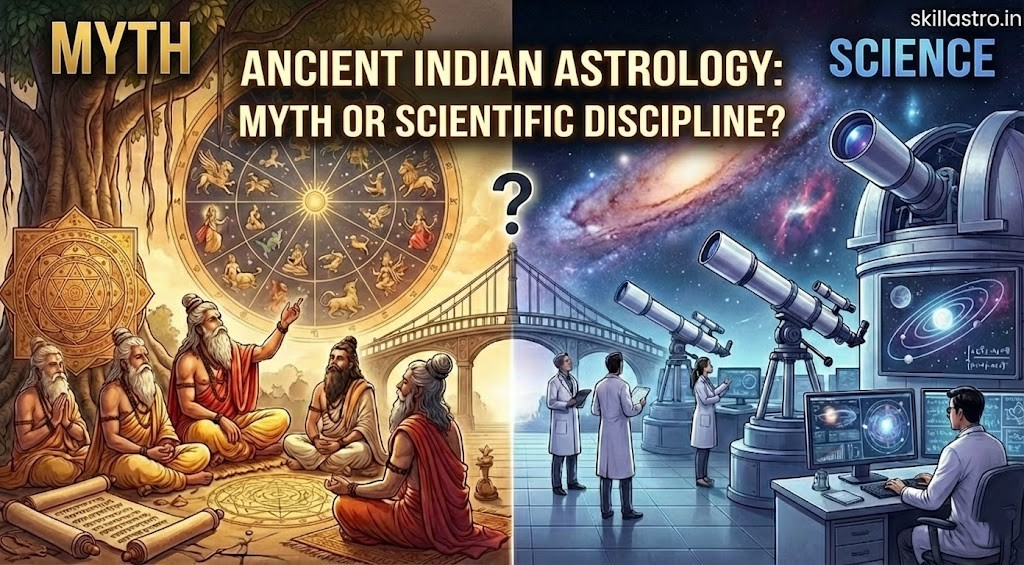
When we hear the word 'Astrology', two kinds of images emerge in our minds. On one hand, the ancient sages who could calculate the precise movements of planets without any telescopes, and on the other, a person sitting by the roadside with a parrot, telling fortunes.
This conflict exists even in today's modern society. Was astrology in ancient India really a science, or is it just a bundle of superstitions? Did our ancestors develop it based on Mathematics and Astronomy, or is it merely a business of fear?
In this detailed blog, instead of judging one side as right or wrong, we will turn the pages of history and test ancient Indian astrology on the touchstone of science.
Part 1: The Meaning of Astrology - "The Eye of the Vedas"
In ancient India, astrology was considered a 'Vedanga' (limb of the Vedas). The word 'Jyotish' means—the study of Jyoti (Light). It is called "Vedasya Chakshuh" (The Eye of the Vedas).
Imagine, thousands of years ago when there were no clocks, no GPS, how did our ancestors keep time?
They determined the day by the position of the Sun.
They determined the months (Maas) by the phases of the Moon.
They predicted seasons by the movement of Nakshatras (constellations).
Therefore, fundamentally, astrology was the 'Science of Timekeeping'. Calling it superstition would be an insult to those great mathematicians who discovered Zero and the Decimal system.
Talk to India's Best Astrologer at ₹1/min Only
Expert guidance for Career, Love & Marriage. Get accurate predictions instantly from verified Vedic Astrologers.
Chat Now »
Talk to India's Best Astrologer at ₹1/min Only
Expert guidance for Career, Love & Marriage. Get accurate predictions instantly from verified Vedic Astrologers.
Chat Now »
Part 2: Ancient Indian Scientists and Their Contribution
If we claim that ancient astrology was a science, we must provide evidence. The discoveries made by India's great Astronomers still astonish scientists at NASA today.
1. Aryabhata (476 AD) – The Earth is Round
When the whole world believed the Earth was flat and at the center of the universe, 23-year-old Aryabhata wrote in his treatise 'Aryabhatiya':
The Earth is round and rotates on its axis (causing day and night).
He explained the scientific cause of Solar and Lunar eclipses (shadows), not demons named Rahu and Ketu swallowing them.
He calculated the length of a year as 365.25868 days, which is extremely close to modern calculations.
2. Varahamihira (505 AD) – Hint at Gravity
In his books 'Panchasiddhantika' and 'Brihat Samhita', Varahamihira wrote that there is a force that pulls things towards the Earth. This was a hint at Gravity, 1000 years before Newton. He also stated that "The Moon and planets do not shine on their own; they reflect the light of the Sun."
Conclusion: It is clear that the basis of ancient astrology was rigorous mathematics and astronomy. It cannot be called a 'myth'.
Part 3: The Shift from Science to Prediction
The problem begins when we mix 'Ganita Jyotish' (Astronomy) and 'Falita Jyotish' (Predictive Astrology).
Ancient sages observed that:
When it is a Full Moon, high tides occur in the ocean.
During an eclipse, the behavior of birds and animals changes.
Crops are affected by sunlight (seasons).
They thought, "If celestial bodies can move such vast oceans, wouldn't they affect the human body (which is 70% water)?"
From here, a great philosophy was born:
"Yatha Pinde Tatha Brahmande" (As is the Microcosm (body), so is the Macrocosm (universe))
This philosophy is not superstition, but close to Quantum Physics, which states that every particle in the universe is connected. The sages tried to decode this "Connection", which later came to be known as 'Predictive Astrology'.
Part 4: The Three Pillars of Astrology – What is Science, What is Myth?
Varahamihira divided astrology into three parts. Let's see which is science and which is myth:
| Branch | Description | Scientific Status |
| 1. Tantra (Astronomy/Siddhanta) | Calculation of planetary movements, eclipses, distances. | Pure Science (Astronomy) |
| 2. Samhita (Mundane Astrology) | Prediction of weather, earthquakes, rainfall, crops, and the rise and fall of nations. | Observational Science |
| 3. Hora (Predictive Astrology) | Individual birth charts, marriage, jobs, future. | Controversial (Pseudoscience/Belief) |
The astrology we debate today falls into the third category (Hora).
Part 5: Myths vs. Reality
A scientific analysis of some major myths prevalent in society:
Myth 1: "If you have Manglik Dosha, your spouse will die."
Reality: Ancient texts nowhere state that Mars "kills" anyone. Scientific/Psychological Logic: Mars is the planet of 'Energy', 'Aggression', and 'Courage'. If Mars is very dominant in someone's chart, that person might be very energetic and slightly short-tempered. If they marry an extremely calm (Low Energy) person, there will be a mismatch leading to conflicts. 'Manglik Dosha' is merely advice for Energy Matching, not a death sentence.
Myth 2: "Sade Sati ruins life."
Reality: Saturn is the slowest planet. It stays in one sign for 2.5 years. Logic: Sade Sati is the time when a person faces life's difficulties. Psychologically, this is a time for "Maturity". For a disciplined and hardworking person, Saturn is never bad. This fear has been created by astrologers, not by the scriptures.
Myth 3: "Planets control our Karma."
Reality: Vedic astrology states—"Planets are indicators, not causes." Just as a thermometer is not the cause of fever but only indicates it, planets only indicate that the fruit of your past actions (Karma/Genetics) is about to arrive. Karma is supreme.
Part 6: The Scientific Critique
For an unbiased blog, it is necessary to know the critics' side. Why do scientists reject astrology?
No Physical Force: Science asks how the planet Saturn, millions of kilometers away, can affect a newborn baby through gravity or magnetic force. Its effect is less than the gravitational pull of the hospital ceiling or the nurse standing nearby.
Precession of Equinoxes (Ayanamsa): The Earth wobbles on its axis like a spinning top, shifting the position of stars by 1 degree every 72 years.
Western Astrology ignores this (Tropical Zodiac), so it is astronomically incorrect.
Vedic Astrology acknowledges this (Sidereal System) and corrects the calculation. In this regard, Vedic astrology is more scientific than Western.
Barnum Effect: Psychologists say that horoscope language is so general (e.g., "You will get a surprise today" or "You are a bit worried") that everyone feels it applies to them.
Part 7: The Real Purpose of Astrology – Medicine and Psychology
In ancient India, astrology was used less for fortune-telling and more for Medicine (Ayurveda).
Ayurveda and Astrology: Charaka Samhita states that the body's Vata, Pitta, and Kapha are connected to the Sun, Moon, and other planets.
Mental Health: The Moon is connected to the 'Mind'. Even today, police and hospital data suggest that on Full Moon days, restlessness in mental patients and crime rates increase. Science dismisses this as the 'Lunar Effect', but the data suggests otherwise.
Frequently Asked Questions (FAQs)
Q1. Is astrology completely scientific?
The mathematical part of astrology (Astronomy) is completely scientific. Its predictive part (Predictions) is based on probabilities and psychology, which modern science does not fully recognize.
Q2. Are Vedic Astrology and Western Astrology the same?
No. Vedic Astrology is based on the Moon and Nakshatras (Sidereal Zodiac), which tells the actual position of celestial bodies. Western Astrology is based on the Sun and Seasons (Tropical Zodiac). Vedic Astrology is considered astronomically more accurate.
Q3. Is Manglik Dosha real?
Manglik Dosha is just a specific position of the planet Mars indicating High Energy. It is not a curse. After the age of 28 or with proper matching, its effect becomes balanced.
Q4. Does wearing Gemstones change destiny?
According to science, gemstones have no effect on planets. However, due to 'Color Therapy' and the 'Placebo Effect', there might be a change in the wearer's confidence.
Q5. What was the main use of astrology in ancient India?
Its main purposes were determining the correct time (Muhurta) for Yagyas and rituals, predicting rain for agriculture, and Navigation.
Conclusion
So, is ancient Indian astrology a science or a myth? The answer is "Both".
As a Science: When it talks about planetary calculations, the calendar (Panchang), and time measurement (Astronomy), it is pure science. Our ancestors were great scientists.
As a Myth: When it is used for "becoming rich overnight by remedies" or "selling rings out of fear of planets," it becomes a myth and a business.
Final Thought: Astrology is a science of Statistical Probabilities. It is like a weather forecast—"There is a possibility of rain today, carry an umbrella." It is neither set in stone nor a complete lie. The ancient sages gave us "Vision", not "Fear". If we use it for Self-analysis and guidance, it is science. If we sit idle relying on fate, it is superstition.