
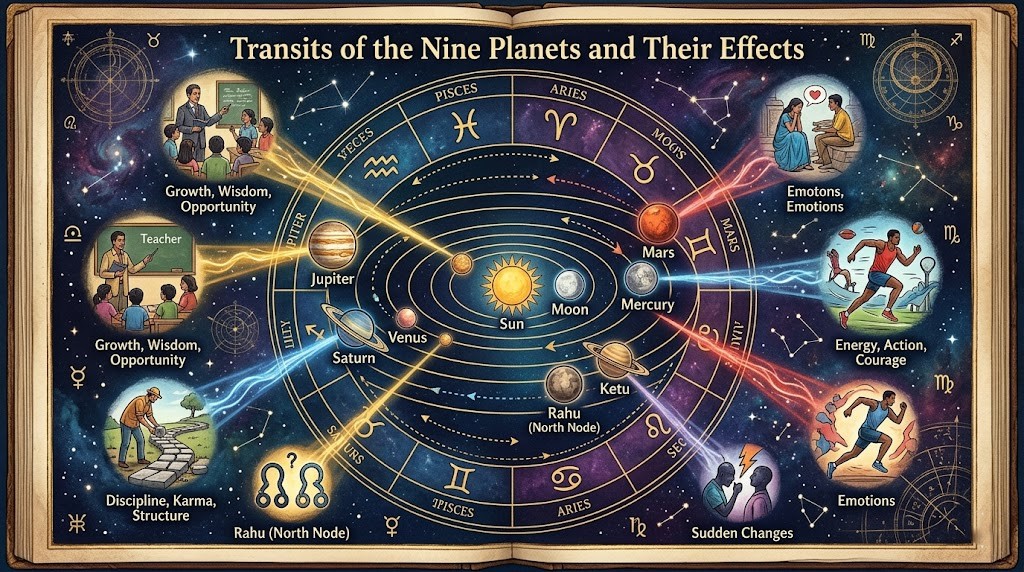
Navgraha Transit and Its Impact: An Astrological Analysis of Planetary Movements on Your Life
In , cosmic energy and the continuously changing positions of planets have a profound and direct impact on human life. While traveling in space, whenever a planet leaves one zodiac sign and enters another, this astronomical event is called a 'Transit' (Gochar) in astrological language. Understanding Navgraha transits and their effects is essential for anyone who wants to connect the dots between the secrets of their birth chart and future events.
This movement of planets determines the direction of our karma, destiny, health, career, marriage, and daily life. In today's detailed and informative article, we will deeply explore how the transits of the nine planets affect our zodiac signs, how they are analyzed, and what their consequences are.
Today's Panchang: The Mirror of Planetary Positions
In Vedic astrology, observing the daily Panchang is considered the most important step before analyzing any transit or auspicious event. The Panchang consists of five limbs (Tithi, Vaar, Nakshatra, Yoga, and Karana).
An ideal daily Panchang takes the following aspects into account:
Tithi and Vaar: Determines the auspiciousness of the day and the ruling deity.
Nakshatra: Shows the constellation the Moon is transiting, reflecting our mental state.
Rahu Kaal: The time of day when starting any new or auspicious work is strictly prohibited.
Shubh Muhurat (Abhijit Muhurat): The most positive time when planetary energies are in your favor.
Disha Shool: Prohibited directions for travel.
For accurate transit predictions, the current position of the planets is matched with these elements of the Panchang.
What is Navgraha Gochar?
The word 'Gochar' is mainly made up of two words—'Go' (meaning stars or planets) and 'Char' (meaning to move or wander). All planets in the universe are revolving around the Sun at their designated speeds.
The snapshot of the planetary positions in the sky at the exact time of your birth is called your 'Birth Chart' (Janam Kundali). This remains unchanged throughout your life. However, the continuously changing positions of the planets in the present time are known as the 'Transit Chart' (Gochar Kundali).
In Vedic astrology, the effect of a transit is primarily analyzed by considering the Moon Sign of the birth chart as the ascendant (Lagna). Whenever a planet transits, it combines with your ongoing Mahadasha and Antardasha to create auspicious or inauspicious events in life.
Detailed Impact of Navgraha Transits on All Zodiac Signs
The transit duration and speed of each planet are different. Let's understand in detail how the nine planets affect human life during their transits:
1. Sun Transit
The Sun is the king of the universe. It is the significator of the soul, father, government jobs, honor, leadership skills, and self-confidence. The Sun stays in one zodiac sign for about 30 days (one month).
Positive Effects: When the Sun transits through auspicious houses (like the 3rd, 6th, 10th, or 11th), it brings promotion in career, high status in society, success in government work, and a massive boost in self-confidence.
Negative Effects: An inauspicious transit may bring ego issues, ideological differences with the father or authorities, and health problems related to the heart or eyes.
2. Moon Transit
The Moon is the lord of the mind, mother, water element, and our emotions. It is the fastest-moving planet among the nine and stays in a sign for only about 2.25 days.
Effects: The Moon's transit controls our daily mental and emotional state. If the Moon transits with auspicious planets, the mind remains happy, decision-making ability improves, and benefits from the mother are received. An afflicted Moon causes mental stress, mood swings, insomnia, and restlessness.
3. Mars Transit
Mars is the fierce significator of energy, courage, blood, land, army, and valor. It changes its sign approximately every 45 days.
Positive Effects: When Mars's transit is auspicious, the person becomes extremely courageous and quick in decision-making. Massive benefits are gained in real estate, property, and technical fields.
Negative Effects: In an unfavorable position, it can cause anger, accidents, blood pressure issues, and disputes (especially with siblings or neighbors).
4. Mercury Transit
Mercury is the significator of intellect, business, communication, mathematics, banking, and skin. It stays in a sign for about 21 to 30 days.
Positive Effects: Mercury's transit refines business decisions, intellectual capacity, and logical thinking. People associated with writing, media, and education achieve spectacular success.
Negative Effects: An inauspicious Mercury indicates a loss of control over speech, nerve-related issues, and financial losses in business transactions.
5. Jupiter Transit
Jupiter, the Guru of the Gods, is the greatest natural benefic planet representing knowledge, luck, marriage, children, religion, and wealth. It transits one sign for about 1 year.
Positive Effects: Jupiter's transit brings the biggest and most positive changes in life. It creates marriage prospects for the unmarried, grants immense success in education, and strengthens financial status. Jupiter's aspect is considered akin to 'nectar'.
Negative Effects: If Jupiter transits in a weak or inauspicious house, it can lead to wealth expenditure, weight gain, and obstacles in education.
6. Venus Transit
Venus is the significator of love, romance, material comforts (luxury), vehicles, art, and beauty. It stays in a sign for about 26 days.
Positive Effects: Venus's transit brings happiness, prosperity, and material resources into life. It brings immense sweetness to love relationships and married life.
Negative Effects: An inauspicious Venus transit can cause character deviation, uncontrolled expenses, secret diseases, and discord in married life.
7. Saturn Transit
Saturn is the giver of karmic results, the judge, and the significator of delays. It is the slowest-moving planet, staying in one sign for about 2.5 years.
Effects: Saturn's transit has the deepest and longest-lasting impact on human life. 'Sade Sati' and 'Dhaiya' are results of this transit. If Saturn is in an auspicious transit (like the 3rd, 6th, or 11th house), it can turn a pauper into a king. It teaches discipline. When inauspicious, it brings intense struggles, delays in ongoing work, disappointment, and heavy challenges.
8. Rahu and Ketu Transit
In Vedic astrology, these are considered 'Shadow Planets' or 'Nodes'. They always move retrograde (backward motion) and stay in a sign for about 18 months (1.5 years).
Effects of Rahu: Rahu is the significator of illusion, foreign travel, sudden events, the stock market, and politics. Its auspicious transit can bring immense sudden wealth or overnight fame, while an inauspicious Rahu causes deceit, bad habits, and mental confusion.
Effects of Ketu: Ketu symbolizes liberation (Moksha), detachment, sacrifice, and deep spirituality. Ketu's transit distances a person from the material world and worldly attachments, turning them toward solitude, occult sciences, and religion.
Infallible Astrological Remedies to Avoid the Negative Effects of Navgraha Transits
If the position of any planet is unfavorable in your transit chart, Vedic astrology prescribes some simple and effective remedies to pacify it:
Chanting Mantras: Regularly chanting the Vedic, Tantric, or Beej mantra of the respective planet destroys the transit's flaws.
Charity and Karma: Donate items related to the planet on the right day (e.g., mustard oil and black sesame for Saturn, copper and jaggery for the Sun).
Wearing Appropriate Gemstones: Never wear a gemstone based solely on a transit. Always wear a benefic planet's gemstone only after getting an accurate analysis of your original birth chart by an expert.
Serving Nature and Animals: Planting trees, feeding grass to cows, and providing food to dogs and birds miraculously reduce the inauspicious effects of planets.
Frequently Asked Questions (FAQs)
Q1. How does a Navgraha transit affect life?
Answer: A transit is the current position of planets in the universe. When these planets pass over the planets or various houses of your birth chart, their combined energies directly impact your health, career, marriage, and financial status.
Q2. On what basis should transit results be analyzed - Lagna (Ascendant) or Moon Sign?
Answer: In Vedic astrology, the most accurate and nuanced results of a transit are seen based on the 'Moon Sign' of the birth chart because the Moon is the significator of our mind, and events first affect our mind. However, the Lagna is also analyzed for a comprehensive overview.
Q3. Which planet's transit is considered the most important?
Answer: Saturn (2.5 years), Jupiter (1 year), and Rahu-Ketu (1.5 years) are slow-moving planets. Because they transit a single sign for a long time, their impact brings the biggest, clearest, and most long-term changes in life.
Q4. Does the effect of a transit always depend on our Mahadasha?
Answer: Yes, a transit never works independently. It always functions under the ongoing 'Mahadasha' and 'Antardasha' in the chart. If the Dasha is favorable and the transit is auspicious, the results are excellent. If the Dasha is bad, even an auspicious transit cannot yield many positive results.
Conclusion
"Navgraha Transit and Its Impact" is an extremely important and strong pillar of Vedic astrology, helping us understand the cycle of time and prepare in advance for upcoming challenges and opportunities. The daily Panchang and the changing astronomical positions of the planets remind us that the energy of the universe is in constant flow, and change is the rule of nature.