
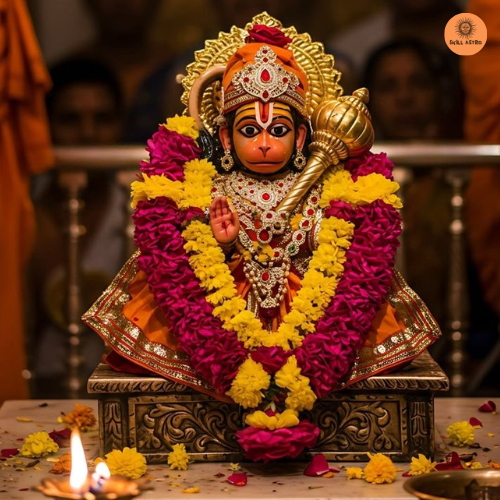
Introduction
The Sri Hanuman Chalisa is one of Hinduism's most revered and powerful devotional hymns, composed by the legendary saint-poet Goswami Tulsidas in the 16th century. This sacred text comprises 40 verses (chalisa means "forty" in Hindi) that celebrate Lord Hanuman—the embodiment of courage, strength, wisdom, and unwavering devotion. For centuries, millions of devotees across the world have chanted this hymn seeking protection, strength, and spiritual transformation. In this comprehensive guide, we explore the complete meaning of all 40 verses, their individual significance, and the transformative benefits of regular recitation.
What is the Hanuman Chalisa?
Definition and Historical Background
The Hanuman Chalisa is a devotional hymn (stotra) written in Awadhi language by Goswami Tulsidas, making it accessible to common people of his time. The text consists of:
2 Opening Couplets (Dohas): Introduction and invocation
40 Quatrains (Chaupais): Main verses praising Hanuman
1 Closing Couplet (Doha): Tulsidas's final prayer
This 42-verse composition is structured to glorify Lord Hanuman's divine qualities while serving as a practical spiritual tool for meditation and devotion.
Why Hanuman Chalisa Matters Today
In today's fast-paced world, millions turn to the Hanuman Chalisa for:
Mental peace and stress relief
Protection from negative energies
Enhanced courage and confidence
Spiritual growth and enlightenment
Healing from physical and mental ailments
Success in overcoming life's obstacles
Complete Verse-by-Verse Analysis of 40 Verses
Opening Doha (Couplet)

Sanskrit Text:
"Shri Guru Charan Saroj Raj, Nij Manu Mukuru Sudhāri।
Barna-oun Raghubara Bimala Jasu, Jo Dāyku Phal Chāri॥"
Translation:
"Cleansing the mirror in the form of my mind with the pollen of the lotus-feet of the Guru, I describe the unblemished glory of Rama, which bestows the four fruits."
Meaning:
This opening establishes the spiritual framework of the Chalisa. Tulsidas seeks to purify his mind (mirror) using divine knowledge from the guru. The "four fruits" refer to the four Purusharthas: Dharma (righteousness), Artha (prosperity), Kama (pleasure), and Moksha (liberation).
Second Opening Doha
Sanskrit Text:
"Budhihin Tanu Jaanike, Sumira-un Pavan-Kumār।
Bal Budhi Vidya Dehu Moh, Harahu Kalesha Vikaar॥"
Translation:
"Knowing my body to be devoid of intelligence, I remember Hanuman, the son of Vayu. Give me strength, intelligence, and knowledge; remove all ailments and impurities."
Meaning:
Tulsidas humbly invokes Hanuman as the "son of Vayu" (wind god), acknowledging human limitations and requesting divine blessings. This verse emphasizes humility as the foundation of spiritual practice.
Verses 1-5: Introduction and Divine Attributes
Verse 1: "Jai Hanuman Gyan Guna Sagar"
"Victory to Hanuman, the ocean of wisdom and virtue. Victory to the Lord of monkeys who is supreme among the three worlds."
Significance: This opening acclamation sets the devotional tone. Hanuman is described as an "ocean" of wisdom—boundless, deep, and life-giving. His supremacy extends across all three worlds (physical, celestial, and ethereal realms).
Spiritual Benefit: Chanting this verse awakens the seeker's recognition of divine intelligence and omnipresence.
Verse 2: "Ram Doot Atulit Baldhama"
"You are the messenger of Rama, possessing unmatched strength and power. O son of Anjani, you are known as Pavan-sut (son of the wind)."
Significance: This verse emphasizes Hanuman's dual role as both a divine ambassador and a symbol of limitless energy. His paternal association with Vayu (wind) symbolizes mobility, swiftness, and the power to move obstacles.
Practical Application: Meditating on this verse helps overcome lethargy and stagnation.
Verse 3: "Mahabir Bikram Bajrangi"
"O mighty and valiant one, your body is like thunderbolt. You are the dispeller of darkness and companion of good sense."
Significance: "Bajrangi" (thunderbolt-like) refers to Hanuman's unbreakable resolve. The verse highlights his power to destroy ignorance and evil thoughts while promoting wisdom and virtue.
Healing Benefit: This verse is believed to increase inner strength and mental resilience.
Verse 4: "Kanchan Baran Viraj Subesa"
"Your complexion matches gold, and you are adorned with beautiful garments. You wear earrings, and your hair is curly."
Significance: This physical description represents Hanuman's divine beauty and celestial nature. The golden complexion symbolizes spiritual purity and divine radiance.
Visual Meditation: Devotees use this verse to visualize Hanuman's divine form, enhancing meditative experiences.
Verse 5: "Hath Vajra Aur Dhvaje Viraje"
"Vajra (mace) and flag shine brilliantly in your hand. Sacred thread made of Munja grass adorns your shoulder."
Significance: The vajra (mace) represents power and protection; the flag symbolizes victory. The Munja sacred thread indicates spiritual discipline and purity.
Symbolic Meaning: These symbols represent the balance of strength and spirituality.
Verses 6-10: Divine Lineage and Extraordinary Feats
Verse 6: "Shankar Suvan Kesari Nandan"
"O partial incarnation of Lord Shiva, giver of joy to King Kesari. Your great majesty is revered by the whole world."
Significance: This verse establishes Hanuman's spiritual ancestry. As Shiva's partial incarnation, he carries divine consciousness. Kesari (his father) represents earthly valor.
Spiritual Insight: Hanuman bridges the divine and human realms, making him accessible to devotees.
Verse 7: "Vidyavaan Guni Ati Chatur"
"You are learned, righteous, and very intelligent, always prepared to do the work of Lord Rama."
Significance: Knowledge (vidya), virtue (guni), and intelligence (chatur) form the trinity of spiritual development. Hanuman's readiness to serve represents the ideal of purposeful living.
Daily Application: Reciting this verse helps cultivate focus on righteous goals.
Verse 8: "Ram Shabd Priya Kanan Phire"
"You delight in hearing of the Lord's deeds. Ram, Lakshman, and Sita dwell in your heart."
Significance: This verse describes the bhakti (devotion) that fills Hanuman's consciousness. His constant remembrance of the divine is the source of his power.
Meditative Practice: Focus on keeping divine remembrance central to daily consciousness.
Verse 9: "Asthir Rup Dhari Sita Mileu"
"Assuming tiny form you appeared to Sita, and in awesome guise, you burned Lanka."
Significance: This verse celebrates Hanuman's ability to shift between forms—from the subtle (to console Sita) to the formidable (to combat Ravana). It symbolizes adaptability and strength in service.
Life Lesson: True power lies in using strength appropriately according to circumstances.
Verse 10: "Bhim Roop Dhari Asur Sanghare"
"Taking dreadful form you slaughtered the demons. This is how you completed Lord Rama's tasks."
Significance: This verse emphasizes that righteous action sometimes requires fierce manifestation. Hanuman's terrifying form was necessary to destroy evil forces (demons/asuras).
Protective Benefit: This verse is believed to protect against malevolent forces.
Verses 11-15: Hanuman's Service to Lord Rama
Verse 11: "Laye Sanjivan Lakhan Jiyaye"
"Bringing the magic herb (Sanjivani), you revived Lakshman. Lord Rama embraced you in joy."
Significance: This verse commemorates one of Hanuman's most heroic deeds. After Lakshman was wounded in battle, Hanuman flew to the Himalayas to obtain the Sanjivani herb that revived him.
Symbolic Meaning: Represents the healing power of selfless service and the joy that comes from dedicated action.
Verse 12: "Raghupati Kinhi Bahut Badai"
"Greatly did the Raghu Lord praise you, saying 'Brother, you are as dear to me as Bharat.'"
Significance: This verse captures Rama's deep appreciation for Hanuman's devotion. The comparison to Bharat (Rama's own brother) elevates Hanuman's status to that of a beloved sibling.
Emotional Resonance: Illustrates the reciprocal love between the divine and the devoted.
Verse 13: "Sahas Badan Tumharo Yas Gavain"
"May the thousand-hooded serpent (Shesha Naga) sing your glory. Saying this, Lord Rama embraced you."
Significance: Shesha Naga, who supports the universe, represents eternal cosmic consciousness. That even such divine beings praise Hanuman indicates his universal importance.
Cosmic Significance: Hanuman's deeds reverberate throughout all dimensions of existence.
Verse 14: "Sankaadik Brahmadi Munisa"
"Sanak and the sages, Lord Brahma, and great saints, Narada, Saraswati, and the king of serpents, cannot fully describe your glories."
Significance: Even the most enlightened beings cannot completely comprehend Hanuman's virtues. This verse emphasizes that divine qualities are boundless and inexhaustible.
Spiritual Truth: The infinite nature of divinity transcends all descriptions.
Verse 15: "Narad Sarodhe Ramayan Kahain"
"The sage Narad and other divine beings constantly sing your praises, narrating the Ramayana throughout the universe."
Significance: Hanuman's glory is proclaimed across all cosmic dimensions. His story is eternally celebrated as the ultimate example of devotion.
Inspirational Message: Devotion to the divine creates ripples across all existence.
Verses 16-20: Hanuman's Miraculous Feats
Verse 16: "Tum Upkar Sugrivahi Keenha"
"You rendered great service to Sugriva, presenting him to Rama and giving him kingship back."
Significance: Through Hanuman's intervention, Sugriva (the monkey king) was restored to power. This demonstrates Hanuman's role in establishing dharma (righteousness) and just governance.
Political/Social Lesson: True leadership supports justice and righteous authority.
Verse 17: "Tumharo Mantra Vibhishn Maana"
"By heeding your advice, Vibhishana became Lord of Lanka, known throughout the universe."
Significance: Vibhishana, Ravana's brother, followed Hanuman's counsel and was rewarded with kingdom and wisdom. This shows that virtuous advice benefits even those in opposing camps.
Ethical Teaching: Wisdom and righteous guidance transcend enmity.
Verse 18: "Yug Sahasra Yojana Para Bhanu"
"Though the sun is thousands of miles away, as a child you swallowed it, thinking it a sweet fruit."
Significance: This famous childhood incident represents Hanuman's insatiable hunger for knowledge. The sun symbolizes the highest worldly attainment, yet he sought to consume it in his search for wisdom.
Allegorical Meaning: True seekers possess an unfathomable quest for enlightenment.
Verse 19: "Prabhu Mudrika Meli Mukh Maahi"
"Holding Lord Rama's ring in your mouth, you crossed the ocean without wonder or difficulty."
Significance: This verse references Hanuman's epic ocean leap carrying Rama's ring as a token of divine connection. The ring represents the seal of divine authority.
Spiritual Meaning: Armed with divine grace, no obstacle is insurmountable.
Verse 20: "Durgam Kaaj Jagat Ke Jete"
"Every difficult task in this world becomes easy by your grace. There is no wonder in your crossing the ocean."
Significance: This verse emphasizes that with Hanuman's grace, even the most impossible becomes possible. The ocean crossing is presented as a natural consequence of divine support.
Practical Benefit: Invoking Hanuman dissolves the perception of insurmountable difficulties.
Verses 21-25: Hanuman's Power and Position
Verse 21: "Ram Kaaj Roop Khoj Dhare"
"You are the guardian of Ram's door; none enters without your leave."
Significance: Hanuman controls access to divine grace. He is the gatekeeper between the human and divine realms, protecting those who seek righteous connection.
Spiritual Protocol: Seeking Hanuman's blessings is the pathway to divine favor.
Verse 22: "Sukshma Roop Dhari Siyahi Dikhave"
"Taking subtle form, you revealed yourself to Sita and comforted her during her captivity."
Significance: This demonstrates Hanuman's compassion and his ability to adapt his manifestation to serve specific purposes. His subtlety allowed him to reach Sita in Lanka.
Emotional Support: This verse symbolizes hope reaching those in darkest circumstances.
Verse 23: "Apna Tej Sahmaro Apai"
"You alone can withstand your own magnificence. All three worlds tremble at one roar of yours."
Significance: Hanuman's power is so immense that only he can contain it. His strength transcends all worldly limits, affecting even celestial dimensions.
Cosmic Understanding: True power operates beyond ordinary comprehension.
Verse 24: "Chahun Yug Partap Tumhara"
"Your splendor fills all four ages (yugas). Your glory is famous throughout the world."
Significance: Hanuman's relevance is eternal, extending across all cosmic ages. His teachings and power remain constant throughout time.
Timeless Value: Divine wisdom transcends temporal limitations.
Verse 25: "Sadhu Sant Ke Tum Rakhvare"
"You are the savior and guardian of saints and sages, destroyer of demons, the cherished beloved of Lord Rama."
Significance: Hanuman's protective power extends specifically to the righteous. He is dharma's champion, standing against adharma (unrighteousness).
Spiritual Protection: Righteousness itself guarantees Hanuman's protection.
Verses 26-30: Hanuman's Blessings and Benefits
Verse 26: "Ashta Sidhi Nav Nidhi Ke Data"
"Mother Sita granted you the boon to become the bestower of eight Siddhis and nine Nidhis."
Significance: The eight Siddhis are supernatural powers (Anima, Mahima, Garima, Laghima, Prapti, Prakamya, Isitva, Vasitva). The nine Nidhis are divine treasures. Hanuman can grant both spiritual and material blessings.
Blessing Potential: Those devoted to Hanuman can access both spiritual powers and material prosperity.
Verse 27: "Ram Rasayan Tumhare Pasa"
"You possess the essence of Ram's divine name. May you always remain the humble servant of Raghupati."
Significance: Hanuman carries the concentrated essence of divine nectar (Rama's name). His humility ensures that this power remains pure and accessible.
Spiritual Practice: Remembering Hanuman's humility enhances the power of divine remembrance.
Verse 28: "Sankat Katai Mitai Sab Pira"
"All obstacles are overcome, all suffering ceases for those who remember Hanuman with devotion."
Significance: This verse directly addresses the protective benefits of Hanuman's remembrance. It presents a universal promise: sincere devotion brings liberation from difficulties.
Practical Assurance: Regular meditation on Hanuman dissolves obstacles.
Verse 29: "Aur Devta Chit Na Dharehi"
"One who focuses on Hanuman alone need not hold any other deity in mind. Hanuman will provide all happiness and prosperity."
Significance: While not dismissing other deities, this verse emphasizes Hanuman's comprehensive protective power. Single-pointed devotion to Hanuman is sufficient for spiritual fulfillment.
Devotional Focus: Concentrated faith in Hanuman encompasses all forms of divine grace.
Verse 30: "Aur Manorath Jo Koi Lavai"
"Those who come to you with any sincere yearning will obtain abundant life that remains forever."
Significance: This verse promises that Hanuman grants not just temporary relief but permanent spiritual elevation. Sincere prayers are never rejected.
Universal Promise: Divine compassion responds to genuine human yearning.
Verses 31-35: Divine Witnessing and Spiritual Fruits
Verse 31: "Charun Jug Partap Tumhara"
"Your glory pervades all four ages (Satya, Treta, Dwapara, and Kali yugas). Your magnificence is famous throughout the world."
Significance: Hanuman's power is cosmic and eternal. His relevance extends across all time periods and will endure through the Kali Yuga (current age).
Contemporary Relevance: Even in challenging times, Hanuman's protection remains available.
Verse 32: "Sadhu Sant Ke Tum Rakhvare"
"You are the protector of the virtuous and saints, the slayer of demons, and the beloved of Lord Rama."
Significance: Hanuman's primary function is to safeguard dharma. He is specifically the guardian of those walking the righteous path.
Practical Implication: Living with integrity attracts Hanuman's protection.
Verse 33: "Ashta Sidhi Nav Nidhi Ke Data"
"You bestow the eight powers and nine treasures to your devotees."
Significance: Reiteration of Hanuman's capability to grant both supernatural abilities and material abundance, emphasizing this benefit.
Balanced Blessing: Hanuman grants both inner power and outer prosperity.
Verse 34: "Ram Rasayan Tumhare Pasa"
"The essence of divine love and Rama's name resides with you. May you always remain the servant of Raghupati."
Significance: Hanuman embodies the concentrated essence of bhakti (devotion). His eternal servitude to Rama makes him a perfect role model.
Role Model: Hanuman's devoted service is the ideal human attitude.
Verse 35: "Anth Kaal Raghubar Pur Jayee"
"At the moment of death, one attains Lord Rama's abode. Upon rebirth, one becomes a devoted follower of Rama."
Significance: This verse promises ultimate liberation (Moksha) for devoted followers. Even if final liberation is not attained in one lifetime, the devotee's trajectory is assured toward enlightenment.
Eternal Promise: Devotion to Hanuman ensures spiritual progression across lifetimes.
Verses 36-40: Final Affirmations and Spiritual Culmination
Verse 36: "Aur Devta Chit Na Dharehi"
"One who holds Hanuman alone in their heart need not contemplate any other deity. Hanuman alone will fulfill all desires and provide all happiness."
Significance: This verse emphasizes the sufficiency of Hanuman-centered devotion. It's not an exclusive negation of other paths but rather an affirmation of Hanuman's completeness.
Devotional Simplicity: Focused devotion is more powerful than scattered efforts.
Verse 37: "Sankat Katai Mitai Sab Pira"
"All dangers are dispelled, all pain dissolves for those who constantly remember the courageous Lord Hanuman."
Significance: The mantra is repetition and remembrance. Constant invocation creates a protective shield around the devotee.
Protective Power: Regular mention of Hanuman's name builds spiritual immunity.
Verse 38: "Jo Sumire Hanumat Balbeera"
"Whoever remembers Hanuman, the mighty and strong, all their sorrows are destroyed."
Significance: This verse emphasizes Hanuman's role as a solver of problems. His strength becomes accessible to those who invoke his memory.
Problem Solving: Hanuman's energy dissolves obstacles and difficulties.
Verse 39: "Jai Jai Jai Hanuman Gosain"
"Victory, victory, victory to Lord Hanuman. Be merciful even as is the Divine Master."
Significance: This triple acclamation (Jai, Jai, Jai) intensifies the invocation. The verse appeals to Hanuman's mercy and compassionate nature.
Peak Invocation: The crescendo of devotion reaches its apex.
Verse 40: "Kripya Karahu Gurudev Ki Nai"
"Bestow upon us your grace as a true spiritual guide. Tulsidas, the eternal servant of Lord Hari, requests: Please establish your abode in my heart."
Significance: Tulsidas concludes his hymn with a personal prayer. He identifies as "eternal servant of Hari" and requests Hanuman's permanent residence in his heart.
Personal Dedication: The hymn ends with the devotee's complete surrender.
Closing Doha (Final Couplet)
Sanskrit Text:
"Pavan-Tanay Sankat Haran Mangal Murti Roop।
Ram Lakhan Sita Sahit Hriday Basahu Sura Bhup॥"
Translation:
"O Son of the Wind, you are the destroyer of all sorrows and the embodiment of auspiciousness. Together with Lord Rama, Lakshman, and Sita, dwell eternally in my heart, O King of Gods."
Significance: This closing prayer synthesizes the entire Chalisa. It requests not just Hanuman's presence but the divine family (Rama, Lakshman, Sita) to reside within the devotee's consciousness.

Complete Benefits of Reciting Hanuman Chalisa
Mental and Emotional Benefits
1. Stress Relief and Mental Peace
Chanting the Hanuman Chalisa creates positive vibrations that calm the mind. The rhythmic recitation acts as a mantra, balancing the nervous system and reducing cortisol levels associated with stress. Regular practitioners report significant improvements in anxiety management.
2. Enhanced Concentration and Focus
The structured nature of 40 verses requires focused attention. This practice strengthens the mind's ability to concentrate, benefiting both spiritual practitioners and professionals in demanding fields.
3. Confidence and Courage
Hanuman embodies fearlessness. Meditating on his qualities instills bravery and self-belief, helping devotees face life's challenges with greater confidence and determination.
4. Clarity in Decision-Making
The wisdom embedded in the verses provides psychological frameworks for understanding complex life situations, enabling better decision-making and problem-solving abilities.
Spiritual and Transcendent Benefits
5. Spiritual Protection
The Hanuman Chalisa is believed to form a protective spiritual shield around the chanter. Many devotees report feeling protected from negative energies, ill-wishes, and malevolent forces.
6. Acceleration of Spiritual Growth
Regular chanting accelerates one's progress on the spiritual path. It cultivates qualities essential for enlightenment: devotion, purity, courage, and wisdom.
7. Connection with Divine Consciousness
The hymn creates a direct channel to higher consciousness. As one internalizes Hanuman's qualities of devotion and service, one naturally aligns with divine will.
8. Blessing of Abundant Life
Verse 30 promises that sincere devotion grants "amita jeevan phal" (abundant fruit of life). This represents both spiritual fulfillment and material prosperity.
Physical and Health Benefits
9. Healing Power
Several verses, particularly "Nasai rog harai sab pira" (diseases are destroyed, all suffering ends), are believed to have specific healing vibrations. The sonic frequencies of Sanskrit create therapeutic effects on the human body.
10. Longevity and Vital Energy
Hanuman is considered the god of life. Worshipping him increases prana (life force), providing energy and vitality for daily activities.
11. Recovery from Illness
Devotees report faster recovery from illnesses when reciting the Chalisa with sincere faith. The positive psychological effects complement conventional healing.
Social and Relational Benefits
12. Cultivation of Devotion
The hymn's focus on Hanuman's unwavering devotion to Rama naturally cultivates similar devotional qualities in the practitioner.
13. Better Relationships
Hanuman's qualities—loyalty, service, humility—when internalized, improve one's relationships and social standing.
14. Success in Endeavors
Hanuman is the remover of obstacles. Those engaged in virtuous pursuits find unexpected support and success.
How to Recite the Hanuman Chalisa for Maximum Benefits
Proper Method (Vidhi)
Purification: Begin with a clean body and mind. Bathe or at least wash hands and face.
Sacred Space: Sit in a clean, peaceful location, ideally facing east or north.
Posture: Sit in a comfortable but upright position—cross-legged, kneeling, or on a chair.
Intention Setting: Set a clear intention (sankalpa) for your recitation.
Invocation: Begin with "Aum" and a brief prayer to remove obstacles.
Recitation: Chant all 40 verses clearly and mindfully. Don't rush; maintain proper pronunciation.
Completion: End with the closing doha and any personal prayers.
Optimal Frequency:
Daily: Once daily for continuous benefits
Intensive Practice: 108 times (over 108 days) for powerful transformations
Problem-Specific: 21 times daily for 21 days to overcome specific obstacles
Pronunciation Guide
The Hanuman Chalisa is written in Awadhi, a dialect of Hindi. Correct pronunciation enhances vibrational benefits:
Sanskrit Emphasis: "Jai Hanuman Gyan Guna Sagar" (JAI HA-NOO-MAAN GYAAN GOO-NAH SAH-GAR)
Nasal Sounds: The "n" (ण) should be pronounced with nasal resonance
Consonant Clarity: Each consonant must be pronounced distinctly for proper mantra vibration
Scientific Perspective on Hanuman Chalisa Benefits
Research Findings
Recent studies on mantra recitation reveal:
Vagal Stimulation: Chanting activates the vagus nerve, promoting parasympathetic nervous system activation, which reduces heart rate and blood pressure.
Brainwave Synchronization: Rhythmic recitation synchronizes brainwaves, inducing meditative states beneficial for mental health.
Vibrational Healing: Sanskrit phonemes emit specific frequencies that resonate with human organs, promoting healing at the cellular level.
Psychological Anchoring: Regular mantric practice creates positive psychological anchors, improving emotional resilience.
Integration with Modern Wellness
Many corporate professionals, students, and athletes use Hanuman Chalisa recitation as:
Stress management tool
Pre-performance ritual
Meditation practice
Night-time relaxation method
Hanuman Chalisa in Modern Times
Relevance for Contemporary Practitioners
Despite its ancient origins, the Hanuman Chalisa addresses universal human concerns:
Fear and insecurity (addressed by Hanuman's courage)
Lack of purpose (solved by his devotion)
Obstacles and failures (removed by his problem-solving)
Spiritual emptiness (filled by divine connection)
Celebrity Practitioners
Many renowned figures have credited the Hanuman Chalisa for their success:
Amitabh Bachchan: Recites daily for spiritual strength
Cricket players: Use it for confidence before important matches
Business leaders: Practice it for clarity and decision-making
Conclusion
The Sri Hanuman Chalisa represents a complete spiritual system encompassing devotion, wisdom, strength, and protection. Its 40 verses systematically present different facets of the divine, each offering specific benefits when contemplated and chanted with sincere faith.
Whether you approach it from a religious, spiritual, or scientific perspective, the Hanuman Chalisa offers:
Practical Tools for managing modern stress and anxiety
Spiritual Pathways for deeper connection with the divine
Psychological Frameworks for understanding courage, devotion, and purpose
Energetic Blessings for health, prosperity, and protection
The promise of the Chalisa is clear: sincere devotion and regular recitation open channels of divine grace, transform consciousness, and create conditions for a life of abundance, peace, and enlightenment.
Final Affirmation
As Tulsidas concludes: "Those who read this Hanuman Chalisa gain success. Lord Shiva, Himself, is the witness to it."
Begin your practice today. Whether recited once daily or 108 times for intensive transformation, the Hanuman Chalisa awaits to shower its blessings upon all sincere devotees.
Quick Reference: Key Verses and Their Primary Benefits
| Verse Number | Primary Theme | Main Benefit |
|---|---|---|
| 1-2 | Introduction & Power | Spiritual Awakening |
| 3-5 | Divine Attributes | Inner Strength |
| 6-10 | Service & Heroism | Courage & Action |
| 11-15 | Divine Relationships | Trust & Faith |
| 16-20 | Miraculous Power | Obstacle Removal |
| 21-25 | Guardian Role | Protection |
| 26-30 | Blessing Potential | Abundance |
| 31-35 | Eternal Presence | Spiritual Security |
| 36-40 | Culmination | Complete Fulfillment |