 Join WhatsApp Channel
Shiva Puja: The Simple and Infallible Path to Attaining Mahadev's Infinite Grace
In Sanatan Dharma, Lord Shiva is exalted as 'Devon Ke Dev Mahadev' (The God of Gods). He is as innocent as he is quick to be pleased. It is a profound belief that if a devotee offers even a single pot of pure water on the Shivling with true devotion, Mahadev washes away the sins of their many lifetimes. Shiva Puja not only grants immense spiritual elevation but also possesses the supreme power to eradicate mental unrest, planetary flaws (Graha Dosha), and the toughest struggles of life. Many people often wonder: What is the exact and correct method to perform Shiva Puja at home?
In this special article, we will explain the scientific and spiritual significance of Shiva Puja, provide a detailed step-by-step worship method, and share powerful mantras through which you can seek Mahadev's blessings right from the comfort of your home.
Preparation and Essential Ingredients (Samagri) for Shiva Puja
Mahadev does not favor ostentation; he is only fond of pure emotions and inner cleanliness. Before beginning the Puja, gather the following essential items:
For Abhishek (Ritual Bath): Pure water, Ganges water (Gangajal), raw unboiled milk, curd, honey, pure ghee, and sugar (or a mixture of these known as Panchamrit).
For Offerings (Arpan): Sandalwood paste (white or yellow), Akshat (unbroken whole rice grains), Belpatra (leaves with three intact leaflets), Datura, Madar (Crown flower), Bhasma (sacred ash), and Attar (natural perfume).
Naivedya (Food Offering): Fresh fruits, sweets, or Panchamewa (a mix of five dry fruits).
Others: A lamp (diya) filled with ghee or sesame oil, incense sticks (Agarbatti), and camphor (Kapoor) for Aarti.
Skill Astro - Fixed Centering Banner Talk to India's Best Astrologer at ₹1/min Only
Expert guidance for Career, Love & Marriage. Get accurate predictions instantly from verified Vedic Astrologers.
Chat Now »
Skill Astro - Fixed Centering Banner Talk to India's Best Astrologer at ₹1/min Only
Expert guidance for Career, Love & Marriage. Get accurate predictions instantly from verified Vedic Astrologers.
Chat Now »
Complete Method for Shiva Puja at Home: From Jalabhishek to Aarti
If you are worshiping a Shivling at home, following these specific steps yields highly fruitful results:
Step 1: Purification and Sankalpa (Vow)
After taking a bath in the morning, wear clean clothes. First, sprinkle some Gangajal over yourself and the Puja items for purification. Take a little water in your right palm and take a solemn vow (Sankalpa) stating that you are performing this Puja for Mahadev's grace or for a specific heartfelt desire.
Step 2: Jalabhishek and Panchamrit Bath
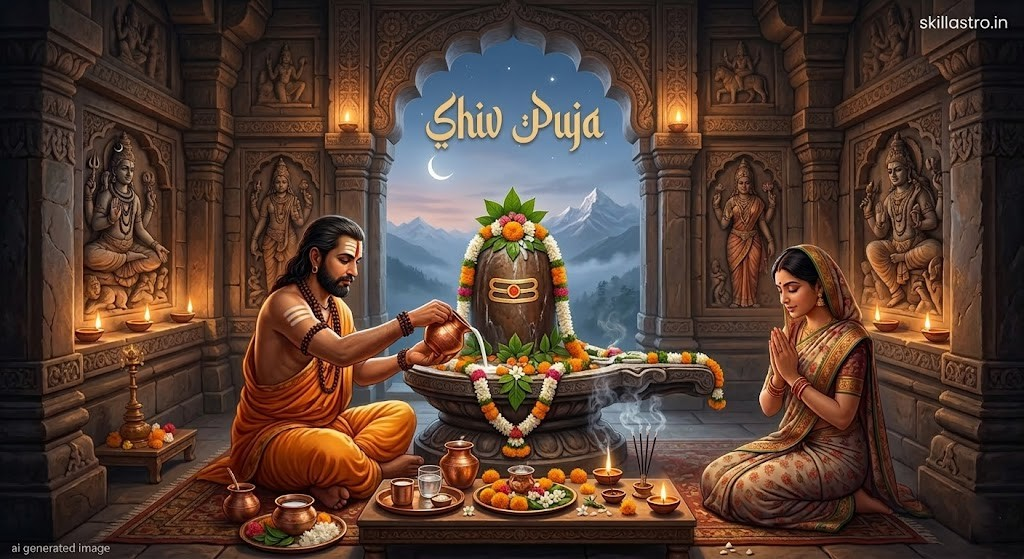
Begin by offering a steady stream of pure water onto the Shivling. Following this, sequentially offer raw milk, curd, ghee, honey, and sugar (or offer the combined Panchamrit). Finally, thoroughly cleanse the Shivling again with pure water or Gangajal. Continuously chant the mantra 'Om Namah Shivaya' throughout the entire Abhishek process.
Step 3: Shringar (Adornment) and Offerings
Now, apply a beautiful tilak of sandalwood paste on the Shivling. Next, offer Mahadev's beloved Belpatra (ensure the smooth side touches the Shivling). Make sure the stalk of the Belpatra is not pointing toward you. Following this, offer Datura, flowers, and Bhasma. When offering Akshat, be absolutely certain that not a single grain of rice is broken.
Step 4: Naivedya and Mantra Chanting
Offer fresh fruits or sweets as Bhog to Mahadev. After this, sit with a calm, focused mind and chant Shiva mantras using your Rudraksha mala.
Powerful Shiva Mantras
Chanting these specific mantras during the Puja multiplies the spiritual power of your worship exponentially:
Simple Root Mantra: "Om Namah Shivaya" (This mantra is completely perfect and self-sufficient).
Mahamrityunjaya Mantra: "Om Tryambakam Yajamahe Sugandhim Pushtivardhanam. Urvarukamiva Bandhanan Mrityormukshiya Maamritat." (Chanted for protection from untimely death and severe diseases).
Rudra Gayatri Mantra: "Om Tatpurushaya Vidmahe Mahadevaya Dhimahi Tanno Rudrah Prachodayat." (Chanted for attaining sharp intellect and absolute clarity).
Important Rules and Precautions to Remember During Shiva Puja
It is mandatory to pay special attention to certain rules during the worship of Mahadev; otherwise, the full spiritual fruit of the Puja is not attained:
Tulsi is Prohibited: Never use Tulsi (Holy Basil) leaves in the worship of Lord Shiva.
Ketaki Flower: According to the Shiva Purana, one must never offer the Ketaki or Kevada flower to Mahadev.
Use of Conch Shell (Shankh): Offering water to Lord Shiva using a conch shell is strictly prohibited (due to the mythological slaying of the demon Shankhachuda).
Turmeric and Kumkum: Turmeric (Haldi) and Sindoor/Kumkum are never offered on the Shivling. Instead, always use pure sandalwood paste (Chandan) or sacred ash (Bhasma).
Astrological and Spiritual Benefits of Shiva Puja
According to Vedic astrology, regular Shiva Puja completely eradicates several highly complex flaws (Doshas) in a birth chart:
Liberation from Chandra Dosha: Since the Moon eternally adorns Mahadev's forehead, worshiping Him instantly removes Chandra Dosha (Moon affliction) and grants profound mental peace.
Kaal Sarp and Shani Dosha: Offering water to the Shivling and chanting the Mahamrityunjaya Mantra significantly reduces the harsh effects of Saturn's Sade Sati and the dreaded Kaal Sarp Dosha.
Marital Bliss: The joint worship of Goddess Parvati and Lord Shiva removes obstacles causing delays in marriage and brings deep sweetness and harmony to married life.
Frequently Asked Questions (FAQs)
Q1: Can women touch the Shivling?
Ans: Yes, from a scriptural perspective, women can absolutely worship the Shivling with pure devotion and offer water to it.
Q2: Why is only a half-circumambulation (Parikrama) of the Shivling performed?
Ans: Crossing the 'Jaladhari' (the outlet from where the offered water flows) is strictly prohibited because it is considered the energetic pathway of Goddess Shakti. Therefore, only a half-circumambulation (up to the Somasutra) is performed.
Q3: Which is the most auspicious day for Shiva Puja?
Ans: Mondays, Pradosh Vrat days, and Maha Shivaratri are universally considered the absolute best and most powerful days for Shiva worship.
Conclusion
The worship of Lord Shiva is a pure path of simplicity and unconditional love. There is absolutely no need for grand ostentation to please Mahadev; all that is required is a pure and devoted heart. Regularly performing Jalabhishek and chanting Shiva mantras at home transforms the environment into a hub of positive energy and brings lasting prosperity to the family. This beautiful journey from Jalabhishek to Aarti brings you intimately close to the divine consciousness of the Supreme Lord.