 Join WhatsApp Channel
Ekadashi Parana: The Decisive Time for the Completion of the Fast and Attainment of Merit
In Hinduism, the Ekadashi fast is considered the most supreme of all fasts. However, the true success of this fast lies not merely in observing the abstinence, but in breaking it systematically, a ritual known as 'Parana'. According to the scriptures, if the Ekadashi Parana is not performed at the correct time and with the proper method, the spiritual merit of the entire fast is not fully attained. The process of breaking the fast on the following day, which is the Dwadashi Tithi, is called 'Parana'. Parana carries its own strict rules, and observing them is mandatory for every person keeping the fast.
In this special article, we will describe in detail the scientific and religious significance of Ekadashi Parana, how to select the right time, and the complete method for performing it.
What is the Correct Time for Ekadashi Parana?
The timing for Parana is carefully selected based on precise astrological calculations. It is absolutely essential to keep two main factors in mind for this:
Talk to India's Best Astrologer at ₹1/min Only
Expert guidance for Career, Love & Marriage. Get accurate predictions instantly from verified Vedic Astrologers.
Chat Now »
Talk to India's Best Astrologer at ₹1/min Only
Expert guidance for Career, Love & Marriage. Get accurate predictions instantly from verified Vedic Astrologers.
Chat Now »
Parana Within the Dwadashi Tithi
The Ekadashi fast should always be broken before the Dwadashi Tithi ends. If the Parana is not completed within the active window of the Dwadashi Tithi, it is considered contrary to the scriptures, and the spiritual fruits of the fast may become void.
Avoidance of Hari Vasar
The biggest precaution during the time of Parana must be taken regarding 'Hari Vasar'. The first one-fourth duration of the Dwadashi Tithi is known as 'Hari Vasar'. Breaking the fast during this specific window is strictly prohibited. It is considered auspicious to perform the Parana only after Hari Vasar has completely concluded.
The Correct Method of Ekadashi Parana: Steps to Attain Shri Hari's Blessings
The Ekadashi fast is profoundly Sattvic (pure), so its conclusion should also be conducted with absolute purity.
Morning Preparations
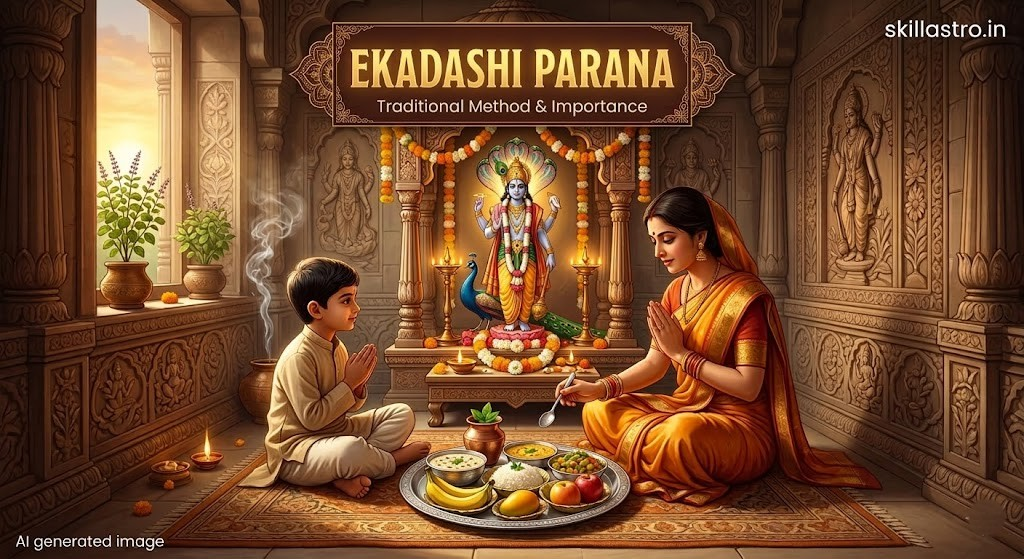
Wake up before sunrise on the day of Dwadashi and take a purifying bath. Wear clean clothes (preferably yellow, as it is dear to Lord Vishnu). Light a pure ghee lamp in front of the idol or picture of Lord Vishnu and sincerely seek forgiveness for any unknown mistakes made during the fast.
Preparing Food and Offering (Bhog)
Prepare fresh, Sattvic food for the Parana. Do not use garlic or onions in the food under any circumstances. First, offer the food (Bhog) to Lord Vishnu by placing a sacred Tulsi leaf in it. After this, feed a Brahmin or a needy person, and offer them charity or monetary donations (Dakshina) according to your capacity.
Rules of Parana: What to Eat and What Not to Eat?
Your choice of food during Parana has a direct and significant impact on your physical health and state of mind.
What to Eat (Do's):
The Significance of Rice: Consuming rice is strictly prohibited on Ekadashi; therefore, eating rice during the Parana on the day of Dwadashi is considered mandatory. This signifies the successful completion of the fast.
Tulsi Water: It is best to begin the Parana by consuming water that has touched the Lord's feet (Charanamrit) along with a Tulsi leaf.
Sattvic Vegetables: Consume light, Sattvic vegetables like bottle gourd (Lauki) or pumpkin to be gentle on your digestive system.
What Not to Eat (Don'ts):
Tamasic Food: Do not even think about consuming heavy, deep-fried, or non-vegetarian food for the Parana.
Masoor Dal (Red Lentils): The consumption of red lentils and honey is strictly prohibited on the day of Parana.
Bronze Utensils: According to the scriptures, one should avoid eating food from bronze utensils on the day of Dwadashi.
Religious Significance of Ekadashi Parana: Accumulation of Merit
It is stated in the sacred scriptures that a person who performs Parana on the day of Dwadashi—strictly after sunrise and after Hari Vasar has passed—attains spiritual merit equivalent to performing a grand Ashwamedha Yagya. The time of Parana is not merely about satisfying physical hunger; it is a spiritual celebration of expressing deep gratitude towards the Lord and conquering one's own senses. If someone, out of ignorance, breaks the fast after Dwadashi has completely passed, they are considered to incur sin.
Special Mantra to be Chanted at the Time of Parana
Lord Vishnu becomes extremely pleased when a devotee chants this mantra while performing the Parana:
Mantra: "Agyanaghoratamasandhasya Vratanena Keshava. Prasida Sumukho Bhutva Jnanadrishtiprado Bhava."
Meaning: O Keshava, be pleased with me, who is blinded by the terrible darkness of ignorance, and by Your divine grace, bestow upon me the clear vision of ultimate knowledge.
Frequently Asked Questions (FAQs)
Q1: What should be done if the Dwadashi Tithi ends before sunrise?
Ans: In such a rare situation, the Ekadashi Parana must still be done only after sunrise. However, one should seek the guidance of a learned astrologer or consult a reliable 'Daily Panchang' to find the most auspicious permissible time window.
Q2: Do we get the spiritual fruit of Ekadashi without performing Parana?
Ans: No, Parana is an integral and inseparable part of the Ekadashi fast. Without a proper Parana, the fast is considered incomplete.
Q3: Can we eat salt during Parana?
Ans: Yes, Sattvic salt (like rock salt/Sendha Namak or regular plain salt) can definitely be used in the food prepared for Parana.
Conclusion
Ekadashi Parana is not merely the physical act of consuming food; it is the ultimate and final test of your patience, discipline, and devotion. Performing the Parana at the exact right time infuses fresh cosmic energy into the body and keeps the mind joyful and at peace. Always ensure you break your fast only after knowing the precise timing of Parana through a reliable 'Daily Panchang'. The devotee who strictly follows the rules from Ekadashi through Dwadashi remains eternally blessed by the grace of Shri Hari.